
运动训练对 2 型糖尿病患者生活质量的影响:一项随机对照试验。
Exercise training and quality of life in individuals with type 2 diabetes: a randomized controlled trial.
机构信息
Pennington Biomedical Research Center, Baton Rouge, Lousiana, USA.
出版信息
Diabetes Care. 2013 Jul;36(7):1884-90. doi: 10.2337/dc12-1153. Epub 2013 Feb 12.
OBJECTIVE
To establish whether exercise improves quality of life (QOL) in individuals with type 2 diabetes and which exercise modalities are involved.
RESEARCH DESIGN AND METHODS
Health Benefits of Aerobic and Resistance Training in individuals with type 2 Diabetes (HART-D; n = 262) was a 9-month exercise study comparing the effects of aerobic training, resistance training, or a combination of resistance and aerobic training versus a nonexercise control group on hemoglobin A1c (HbA1c) in sedentary individuals with type 2 diabetes. This study is an ancillary analysis that examined changes in QOL after exercise training using the Short Form-36 Health Survey questionnaire compared across treatment groups and with U.S. national norms.
RESULTS
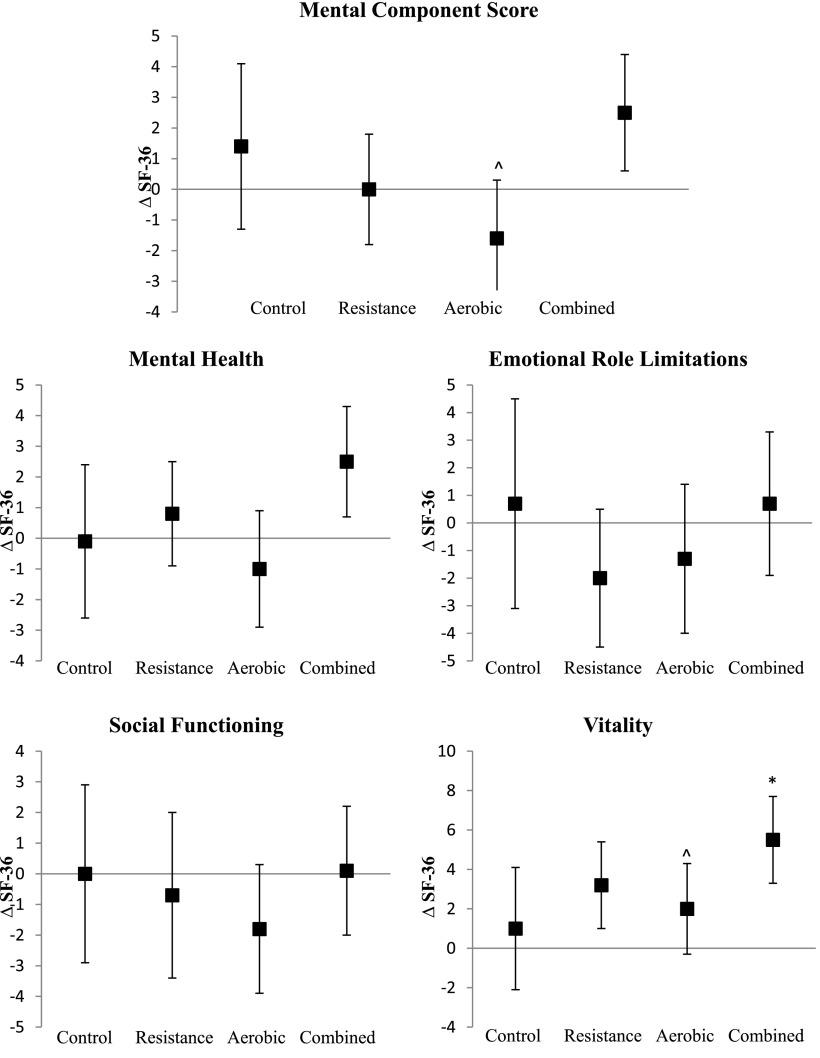
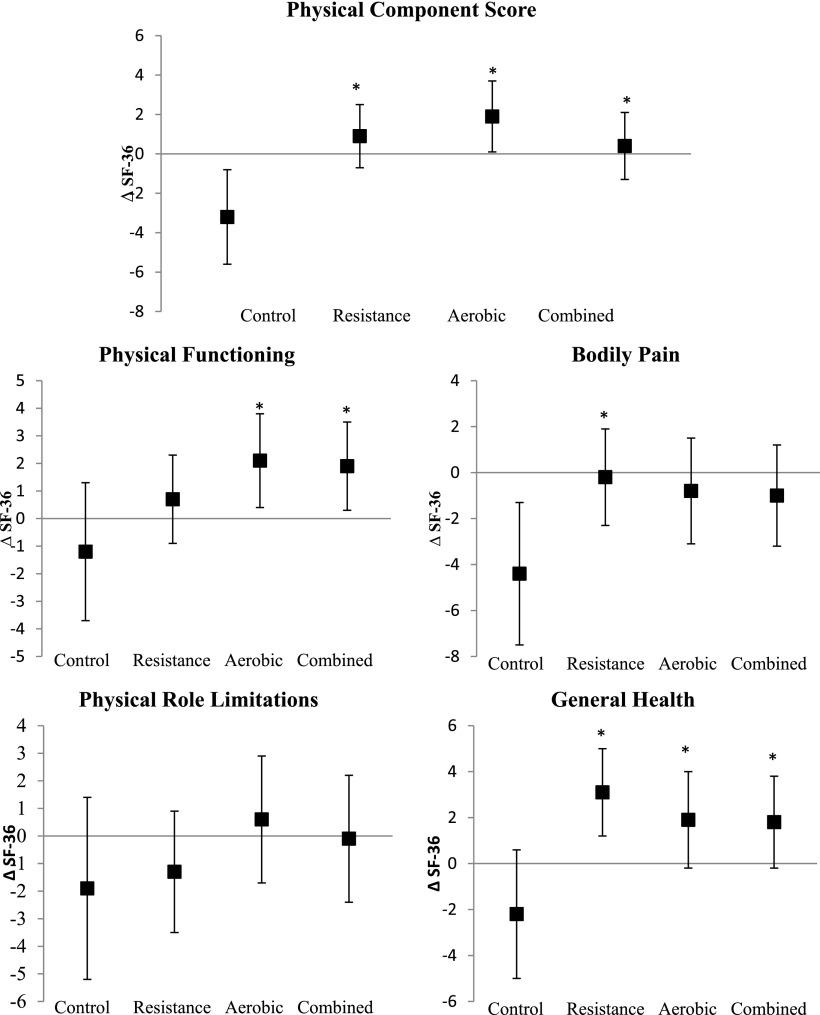
The ancillary sample (n = 173) had high baseline QOL compared with U.S. national norms. The QOL physical component subscale (PCS) and the general health (GH) subscale were improved by all three exercise training conditions compared with the control group condition (resistance: PCS, P = 0.005; GH, P = 0.003; aerobic: PCS, P = 0.001; GH, P = 0.024; combined: PCS, P = 0.015; GH, P = 0.024). The resistance training group had the most beneficial changes in bodily pain (P = 0.026), whereas physical functioning was most improved in the aerobic and combined condition groups (P = 0.025 and P = 0.03, respectively). The changes in the mental component score did not differ between the control group and any of the exercise groups (all P > 0.05). The combined training condition group had greater gains than the aerobic training condition group in the mental component score (P = 0.004), vitality (P = 0.031), and mental health (P = 0.008) and greater gains in vitality compared with the control group (P = 0.021).
CONCLUSIONS
Exercise improves QOL in individuals with type 2 diabetes. Combined aerobic/resistance exercise produces greater benefit in some QOL domains.
目的
研究运动是否能提高 2 型糖尿病患者的生活质量(QOL),并探讨具体的运动方式。
研究设计和方法
健康益处的有氧运动和阻力训练在 2 型糖尿病患者(HART-D;n=262)是一个 9 个月的运动研究比较有氧运动、阻力训练或阻力和有氧运动的组合与非运动对照组在久坐的 2 型糖尿病患者的糖化血红蛋白(HbA1c)的影响。本研究是一个辅助分析,使用健康调查简表 36 项(Short Form-36 Health Survey questionnaire),比较了治疗组之间和与美国全国标准之间运动训练后 QOL 的变化。
结果
辅助样本(n=173)的 QOL 基线水平高于美国全国标准。与对照组相比,所有三种运动训练条件都改善了 QOL 生理成分子量表(PCS)和一般健康(GH)子量表(阻力:PCS,P=0.005;GH,P=0.003;有氧:PCS,P=0.001;GH,P=0.024;联合:PCS,P=0.015;GH,P=0.024)。阻力训练组在身体疼痛方面的变化最为有益(P=0.026),而有氧和联合训练组在身体机能方面的改善最为显著(P=0.025 和 P=0.03,分别)。在心理成分评分方面,对照组与任何运动组之间的变化都没有差异(所有 P>0.05)。与有氧训练组相比,联合训练组在心理成分评分(P=0.004)、活力(P=0.031)和心理健康(P=0.008)方面的改善更为显著,与对照组相比,活力的改善更为显著(P=0.021)。
结论
运动可以提高 2 型糖尿病患者的生活质量。有氧/阻力运动的联合应用在某些 QOL 领域产生了更大的益处。
 Zotero 插件