
随机对照试验的临床研究报告:先前保密的行业报告的探索性综述。
Clinical study reports of randomised controlled trials: an exploratory review of previously confidential industry reports.
机构信息
Divisions of General Pediatrics and General Internal Medicine, Johns Hopkins University School of Medicine, Baltimore, Maryland, USA.
出版信息
BMJ Open. 2013 Feb 26;3(2). doi: 10.1136/bmjopen-2012-002496. Print 2013.
OBJECTIVE
To explore the structure and content of a non-random sample of clinical study reports (CSRs) to guide clinicians and systematic reviewers.
SEARCH STRATEGY
We searched public sources and lodged Freedom of Information requests for previously confidential CSRs primarily written by the industry for regulators.
SELECTION CRITERIA
CSRs reporting sufficient information for extraction ('adequate').
PRIMARY OUTCOME MEASURES
Presence and length of essential elements of trial design and reporting and compression factor (ratio of page length for CSRs compared to its published counterpart in a scientific journal).
DATA EXTRACTION
Data were extracted on standard forms and crosschecked for accuracy.
RESULTS
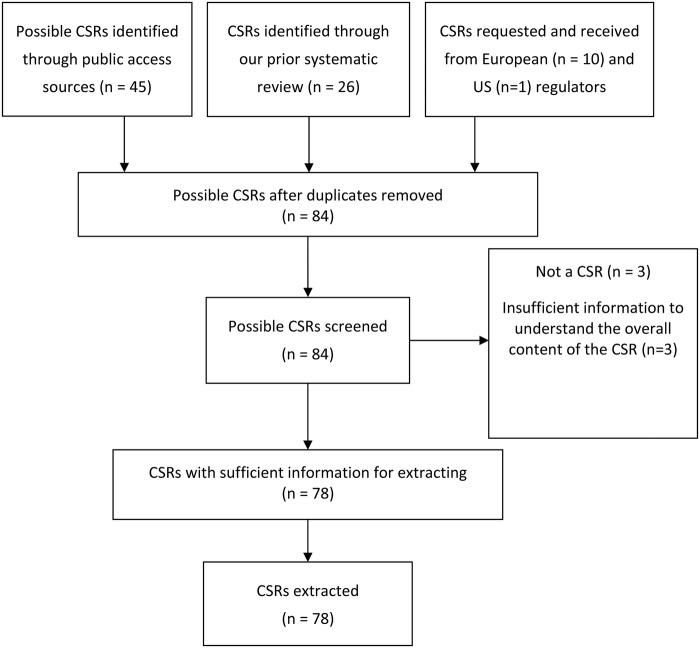
We assembled a population of 78 CSRs (covering 90 randomised controlled trials; 144 610 pages total) dated 1991-2011 of 14 pharmaceuticals. Report synopses had a median length of 5 pages, efficacy evaluation 13.5 pages, safety evaluation 17 pages, attached tables 337 pages, trial protocol 62 pages, statistical analysis plan 15 pages and individual efficacy and safety listings had a median length of 447 and 109.5 pages, respectively. While 16 (21%) of CSRs contained completed case report forms, these were accessible to us in only one case (765 pages representing 16 individuals). Compression factors ranged between 1 and 8805.
CONCLUSIONS
Clinical study reports represent a hitherto mostly hidden and untapped source of detailed and exhaustive data on each trial. They should be consulted by independent parties interested in a detailed record of a clinical trial, and should form the basic unit for evidence synthesis as their use is likely to minimise the problem of reporting bias. We cannot say whether our sample is representative and whether our conclusions are generalisable to an undefined and undefinable population of CSRs.
目的
探索临床研究报告(CSR)的结构和内容,为临床医生和系统评价者提供指导。
检索策略
我们检索了公共资源,并根据信息自由请求,获取了主要由行业为监管机构编写的先前保密的 CSR。
选择标准
报告有足够信息可供提取的 CSR(“充分”)。
主要结果测量
试验设计和报告的基本要素的存在和长度以及压缩因子(CSR 的页面长度与在科学期刊上发表的对应物的比值)。
数据提取
数据以标准表格提取,并进行准确性交叉检查。
结果
我们汇集了 78 份 CSR(涵盖 90 项随机对照试验;总共有 144610 页),涉及 14 种药物,日期为 1991 年至 2011 年。报告摘要的中位数长度为 5 页,疗效评估为 13.5 页,安全性评估为 17 页,附加表格为 337 页,试验方案为 62 页,统计分析计划为 15 页,个别疗效和安全性列表的中位数长度分别为 447 页和 109.5 页。尽管有 16 份(21%)CSR 包含完整的病例报告表,但我们仅在一个案例中获得了这些表(代表 16 个人的 765 页)。压缩因子范围在 1 到 8805 之间。
结论
临床研究报告代表了迄今为止隐藏和未被充分利用的详细和详尽数据来源,每个试验。对临床试验详细记录感兴趣的独立方应查阅这些报告,并且应该作为证据综合的基本单位,因为它们的使用可能会最小化报告偏倚的问题。我们不能说我们的样本是否具有代表性,我们的结论是否可以推广到未定义和不可定义的 CSR 人群。

 Zotero 插件