
新型热休克蛋白 90 抑制剂 NVP-HSP990 处理的人胰腺 MIA PaCa-2 和 U251 神经胶质瘤细胞系的放射敏感性和放射热敏感性增加。
Increased radiosensitivity and radiothermosensitivity of human pancreatic MIA PaCa-2 and U251 glioblastoma cell lines treated with the novel Hsp90 inhibitor NVP-HSP990.
机构信息
Department of Radiation Oncology, University Hospital Freiburg, Freiburg 79106, Germany.
出版信息
Radiat Oncol. 2013 Feb 28;8:42. doi: 10.1186/1748-717X-8-42.
BACKGROUND AND PURPOSE
Heat shock Protein 90 (Hsp90) is a molecular chaperone that folds, stabilizes, and functionally regulates many cellular proteins involved in oncogenic signaling and in the regulation of radiosensitivity. It is upregulated in response to stress such a heat. Hyperthermia is a potent radiosensitizer, but induction of Hsp90 may potentially limit its efficacy. Our aim was to investigate whether the new Hsp90 inhibitor NVP-HSP990 increases radiosensitivity, thermosensitivity and radiothermosensitivity of human tumor cell lines.
MATERIAL AND METHODS
U251 glioblastoma and MIA PaCa-2 pancreatic carcinoma cells were used. To determine clonogenic survival, colony forming assays were performed. Cell viability and proliferation were assesed by Trypan blue staining. Cell cycle and apoptosis analyses were performed by flow cytometry. DAPI staining was used to detect mitotic catastrophe.
RESULTS
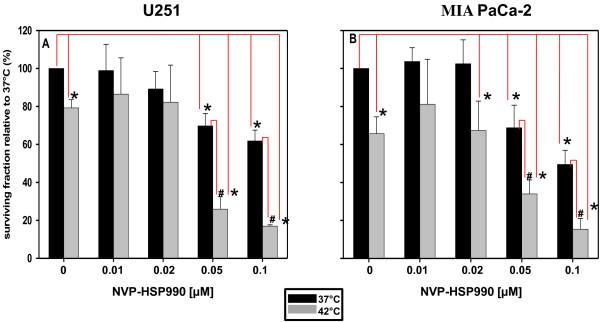
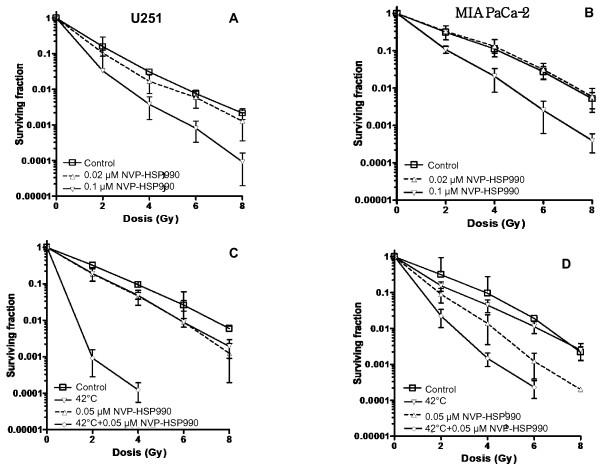
NVP-HSP990 increased the thermosensitivity, radiosensitivity and radio-thermosensitivity of both cell lines in clonogenic assays. 72 hours after irradiation with 4 Gy, a significant reduction in cell number associated with considerable G2/M acumulation and mitotic catastrophe as well as cell death by apoptosis/necrosis was observed.
CONCLUSIONS
Treatment with NVP-HSP990 strongly sensitized U251 and MIA PaCa-2 cells to hyperthermia and ionizing radiation or combination thereof through augmentation of G2/M arrest, mitotic catastrophe and associated apoptosis.
背景与目的
热休克蛋白 90(Hsp90)是一种分子伴侣,可折叠、稳定和功能调节许多参与致癌信号和调节放射敏感性的细胞蛋白。它会因热等应激而上调。高热是一种有效的放射增敏剂,但 Hsp90 的诱导可能会限制其疗效。我们的目的是研究新型 Hsp90 抑制剂 NVP-HSP990 是否增加人肿瘤细胞系的放射敏感性、热敏性和放射热敏感性。
材料与方法
使用 U251 神经胶质瘤和 MIA PaCa-2 胰腺癌细胞。为了确定克隆存活,进行了集落形成测定。通过台盼蓝染色评估细胞活力和增殖。通过流式细胞术进行细胞周期和凋亡分析。使用 DAPI 染色检测有丝分裂灾难。
结果
NVP-HSP990 在集落形成测定中增加了两种细胞系的热敏性、放射敏感性和放射热敏感性。照射 4Gy 后 72 小时,观察到细胞数量显著减少,同时伴随着明显的 G2/M 积累和有丝分裂灾难以及细胞凋亡/坏死。
结论
通过增加 G2/M 期阻滞、有丝分裂灾难和相关的细胞凋亡,NVP-HSP990 治疗强烈敏化 U251 和 MIA PaCa-2 细胞对高热和电离辐射或其组合的敏感性。




 Zotero 插件