
纹状体直接和间接通路神经元在鼠和大鼠切片中的膜特性及其多巴胺调制。
Membrane properties of striatal direct and indirect pathway neurons in mouse and rat slices and their modulation by dopamine.
机构信息
Department of Neuroscience, Karolinska Institute, Stockholm, Sweden.
出版信息
PLoS One. 2013;8(3):e57054. doi: 10.1371/journal.pone.0057054. Epub 2013 Mar 1.
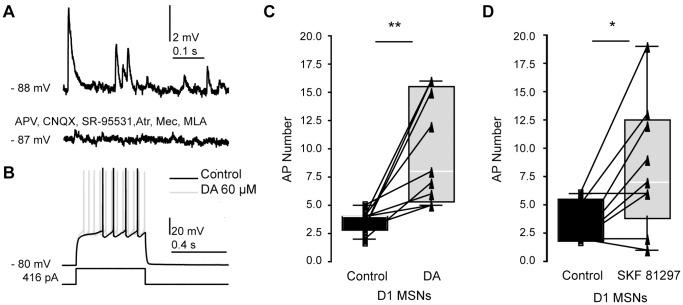
D1 and D2 receptor expressing striatal medium spiny neurons (MSNs) are ascribed to striatonigral ("direct") and striatopallidal ("indirect") pathways, respectively, that are believed to function antagonistically in motor control. Glutamatergic synaptic transmission onto the two types is differentially affected by Dopamine (DA), however, less is known about the effects on MSN intrinsic electrical properties. Using patch clamp recordings, we comprehensively characterized the two pathways in rats and mice, and investigated their DA modulation. We identified the direct pathway by retrograde labeling in rats, and in mice we used transgenic animals in which EGFP is expressed in D1 MSNs. MSNs were subjected to a series of current injections to pinpoint differences between the populations, and in mice also following bath application of DA. In both animal models, most electrical properties were similar, however, membrane excitability as measured by step and ramp current injections consistently differed, with direct pathway MSNs being less excitable than their counterparts. DA had opposite effects on excitability of D1 and D2 MSNs, counteracting the initial differences. Pronounced changes in AP shape were seen in D2 MSNs. In direct pathway MSNs, excitability increased across experimental conditions and parameters, and also when applying DA or the D1 agonist SKF-81297 in presence of blockers of cholinergic, GABAergic, and glutamatergic receptors. Thus, DA induced changes in excitability were D1 R mediated and intrinsic to direct pathway MSNs, and not a secondary network effect of altered synaptic transmission. DAergic modulation of intrinsic properties therefore acts in a synergistic manner with previously reported effects of DA on afferent synaptic transmission and dendritic processing, supporting the antagonistic model for direct vs. indirect striatal pathway function.
D1 和 D2 受体表达的纹状体中间神经元(MSNs)分别被归因于纹状体苍白球(“直接”)和纹状体黑质(“间接”)通路,据信它们在运动控制中具有拮抗作用。谷氨酸能突触传递到这两种类型的神经元受到多巴胺(DA)的不同影响,然而,关于对 MSN 内在电特性的影响知之甚少。使用膜片钳记录技术,我们全面描述了大鼠和小鼠中的这两种通路,并研究了它们的 DA 调制。我们通过大鼠的逆行标记鉴定了直接通路,并且在小鼠中,我们使用了在 D1 MSNs 中表达 EGFP 的转基因动物。MSNs 接受了一系列电流注射,以确定种群之间的差异,并在小鼠中还在 DA 浴应用后进行了测试。在这两种动物模型中,大多数电特性相似,然而,通过阶跃和斜坡电流注射测量的膜兴奋性始终存在差异,直接通路 MSNs 的兴奋性低于其对应物。DA 对 D1 和 D2 MSN 的兴奋性具有相反的影响,抵消了最初的差异。在 D2 MSNs 中可以看到 AP 形状的明显变化。在直接通路 MSNs 中,兴奋性在实验条件和参数下以及在应用 DA 或 D1 激动剂 SKF-81297 时都会增加,并且在存在胆碱能、GABA 能和谷氨酸能受体阻滞剂时也是如此。因此,DA 诱导的兴奋性变化是由 D1 R 介导的,并且是直接通路 MSNs 的内在变化,而不是改变突触传递的次级网络效应。DA 能调制内在特性因此与之前报道的 DA 对传入突触传递和树突处理的影响以协同方式发挥作用,支持直接与间接纹状体通路功能的拮抗模型。


 Zotero 插件