
自噬与其他细胞活动的协调。
Coordination of autophagy with other cellular activities.
机构信息
Department of Pharmacology and Laboratory of Aging and Nervous Diseases (SZS0703), Soochow University School of Pharmaceutical Science, Suzhou 215123, China.
出版信息
Acta Pharmacol Sin. 2013 May;34(5):585-94. doi: 10.1038/aps.2012.194. Epub 2013 Mar 11.
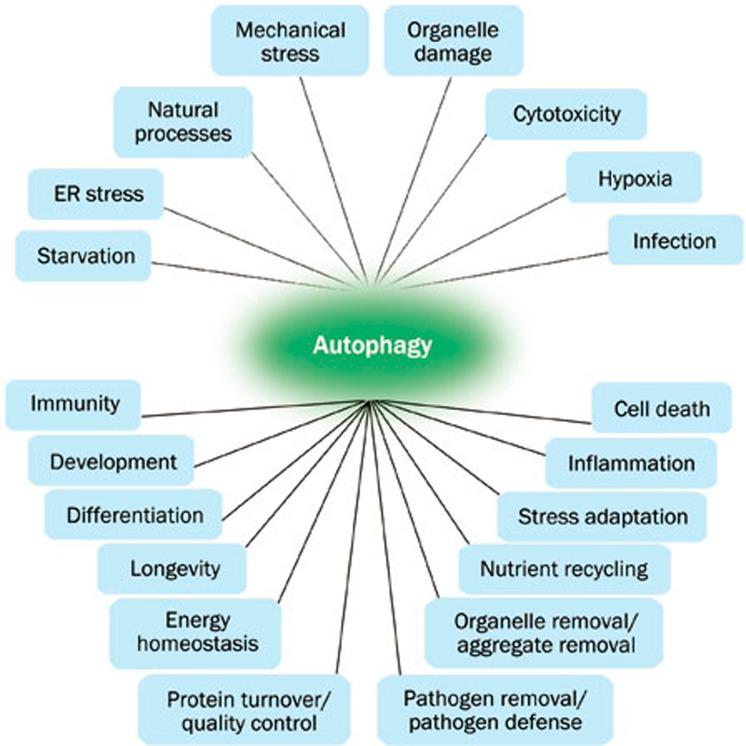
The cell biological phenomenon of autophagy has attracted increasing attention in recent years, partly as a consequence of the discovery of key components of its cellular machinery. Autophagy plays a crucial role in a myriad of cellular functions. Autophagy has its own regulatory mechanisms, but this process is not isolated. Autophagy is coordinated with other cellular activities to maintain cell homeostasis. Autophagy is critical for a range of human physiological processes. The multifunctional roles of autophagy are explained by its ability to interact with several key components of various cell pathways. In this review, we focus on the coordination between autophagy and other physiological processes, including the ubiquitin-proteasome system (UPS), energy homeostasis, aging, programmed cell death, the immune responses, microbial invasion and inflammation. The insights gained from investigating autophagic networks should increase our understanding of their roles in human diseases and their potential as targets for therapeutic intervention.
近年来,自噬的细胞生物学现象引起了越来越多的关注,部分原因是其细胞机制的关键成分的发现。自噬在无数的细胞功能中起着至关重要的作用。自噬有其自身的调节机制,但这个过程并不是孤立的。自噬与其他细胞活动相协调,以维持细胞内稳态。自噬对于一系列人体生理过程至关重要。自噬与各种细胞途径的几个关键成分相互作用的能力解释了其多功能性作用。在这篇综述中,我们重点讨论了自噬与其他生理过程之间的协调,包括泛素-蛋白酶体系统 (UPS)、能量平衡、衰老、程序性细胞死亡、免疫反应、微生物入侵和炎症。通过研究自噬网络获得的见解应该提高我们对其在人类疾病中的作用及其作为治疗干预靶点的潜力的理解。

 Zotero 插件