
CYP2D6 基因型依赖性术后患者羟考酮代谢。
CYP2D6 genotype dependent oxycodone metabolism in postoperative patients.
机构信息
Department of Anaesthesiology and Pain Medicine, Inselspital, University of Bern, Bern, Switzerland.
出版信息
PLoS One. 2013;8(3):e60239. doi: 10.1371/journal.pone.0060239. Epub 2013 Mar 28.
BACKGROUND
The impact of polymorphic cytochrome P450 CYP2D6 enzyme on oxycodone's metabolism and clinical efficacy is currently being discussed. However, there are only spare data from postoperative settings. The hypothesis of this study is that genotype dependent CYP2D6 activity influences plasma concentrations of oxycodone and its metabolites and impacts analgesic consumption.
METHODS
Patients received oxycodone 0.05 mg/kg before emerging from anesthesia and patient-controlled analgesia (PCA) for the subsequent 48 postoperative hours. Blood samples were drawn at 30, 90 and 180 minutes after the initial oxycodone dose. Plasma concentrations of oxycodone and its metabolites oxymorphone, noroxycodone and noroxymorphone were analyzed by liquid chromatography-mass spectrometry with electrospray ionization. CYP2D6 genotyping was performed and 121 patients were allocated to the following genotype groups: PM (poor metabolizer: no functionally active CYP2D6 allele), HZ/IM (heterozygous subjects, intermediate metabolizers with decreased CYP2D6 activity), EM (extensive metabolizers, normal CYP2D6 activity) and UM (ultrarapid metabolizers, increased CYP2D6 activity). Primary endpoint was the genotype dependent metabolite ratio of plasma concentrations oxymorphone/oxycodone. Secondary endpoint was the genotype dependent analgesic consumption with calculation of equianalgesic doses compared to the standard non-CYP dependent opioid piritramide.
RESULTS
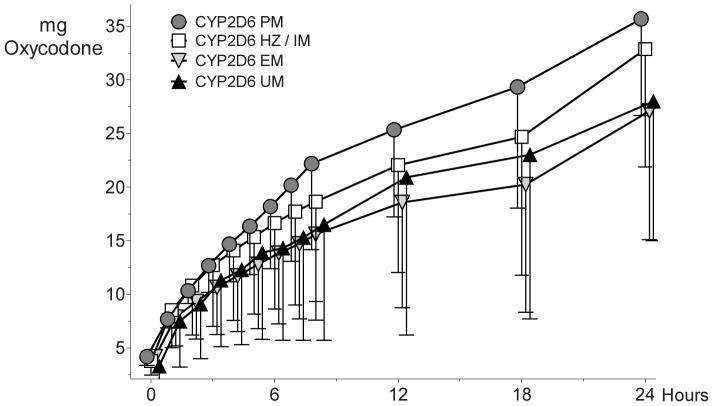
Metabolism differed between CYP2D6 genotypes. Mean (95%-CI) oxymophone/oxycodone ratios were 0.10 (0.02/0.19), 0.13 (0.11/0.16), 0.18 (0.16/0.20) and 0.28 (0.07/0.49) in PM, HZ/IM, EM and UM, respectively (p = 0.005). Oxycodone consumption up to the 12(th) hour was highest in PM (p = 0.005), resulting in lowest equianalgesic doses of piritramide versus oxycodone for PM (1.6 (1.4/1.8); EM and UM 2.2 (2.1/2.3); p<0.001). Pain scores did not differ between genotypes.
CONCLUSIONS
In this postoperative setting, the number of functionally active CYP2D6 alleles had an impact on oxycodone metabolism. The genotype also impacted analgesic consumption, thereby causing variation of equianalgesic doses piritramide : oxycodone. Different analgesic needs by genotypes were met by PCA technology in this postoperative cohort.
背景
细胞色素 P450 CYP2D6 酶的多态性对羟考酮的代谢和临床疗效的影响目前正在讨论中。然而,只有术后环境的零星数据。本研究的假设是,依赖于基因型的 CYP2D6 活性会影响羟考酮及其代谢物的血浆浓度,并影响镇痛药物的消耗。
方法
患者在麻醉苏醒后接受 0.05mg/kg 的羟考酮,并在随后的 48 小时内接受患者自控镇痛(PCA)。在初始羟考酮剂量后 30、90 和 180 分钟采集血样。采用液相色谱-质谱联用技术(电喷雾电离)分析羟考酮及其代谢物羟吗啡酮、去甲羟考酮和去甲羟吗啡酮的血浆浓度。进行 CYP2D6 基因分型,将 121 名患者分为以下基因型组:PM(弱代谢者:无功能活性 CYP2D6 等位基因)、HZ/IM(杂合子,CYP2D6 活性降低的中间代谢者)、EM(广泛代谢者,正常 CYP2D6 活性)和 UM(超快代谢者,增加 CYP2D6 活性)。主要终点是代谢产物羟吗啡酮/羟考酮的基因型依赖性血浆浓度比值。次要终点是基因型依赖性镇痛药物消耗,并与非 CYP 依赖性阿片类药物哌替啶的等效镇痛剂量进行比较。
结果
CYP2D6 基因型之间的代谢存在差异。PM、HZ/IM、EM 和 UM 组的平均(95%CI)羟吗啡酮/羟考酮比值分别为 0.10(0.02/0.19)、0.13(0.11/0.16)、0.18(0.16/0.20)和 0.28(0.07/0.49)(p=0.005)。PM 组的羟考酮消耗至第 12 小时最高(p=0.005),导致 PM 组的哌替啶与羟考酮的等效镇痛剂量最低(1.6(1.4/1.8);EM 和 UM 为 2.2(2.1/2.3);p<0.001)。基因型之间的疼痛评分无差异。
结论
在这种术后环境中,功能活性 CYP2D6 等位基因的数量对羟考酮的代谢有影响。基因型还影响镇痛药物的消耗,从而导致哌替啶与羟考酮的等效镇痛剂量发生变化。在这个术后队列中,通过 PCA 技术满足了不同基因型的不同镇痛需求。


 Zotero 插件