
SUVmax与原发性肿瘤病理特征的相关性以及肿瘤/淋巴结SUVmax比值在预测可切除非小细胞肺癌患者淋巴结转移中的价值。
The correlation of SUVmax with pathological characteristics of primary tumor and the value of Tumor/ Lymph node SUVmax ratio for predicting metastasis to lymph nodes in resected NSCLC patients.
作者信息
Koksal Deniz, Demirag Funda, Bayiz Hulya, Ozmen Ozlem, Tatci Ebru, Berktas Bahadir, Aydoğdu Koray, Yekeler Erdal
机构信息
Chest Diseases Clinic, Ataturk Chest Diseases and Chest Surgery Education and Research Hospital, Ankara, Turkey.
出版信息
J Cardiothorac Surg. 2013 Apr 4;8:63. doi: 10.1186/1749-8090-8-63.
BACKGROUND
We aimed to investigate the correlation of maximum standardized uptake value (SUVmax) with pathological characteristics of primary tumor and to determine a Tumor/ Lymph node (T/LN) SUVmax ratio predicting metastasis to lymph nodes in NSCLC patients.
METHODS
Eighty-one NSCLC patients who had PET/CT examination at initial staging and subsequently underwent surgical resection were retrospectively evaluated. There were 100 PET/CT positive mediastinal or hilar lymph node stations. Pathological characteristics of the tumor such as largest tumor diameter, tumor histology, differentiation, number of mitosis, degree of stromal inflammation, necrosis; etiology of PET/CT positive lymph node stations; SUVmax of primary tumor and positive lymph node stations were recorded. A T/LN SUVmax ratio was calculated for each lymph node station.
RESULTS
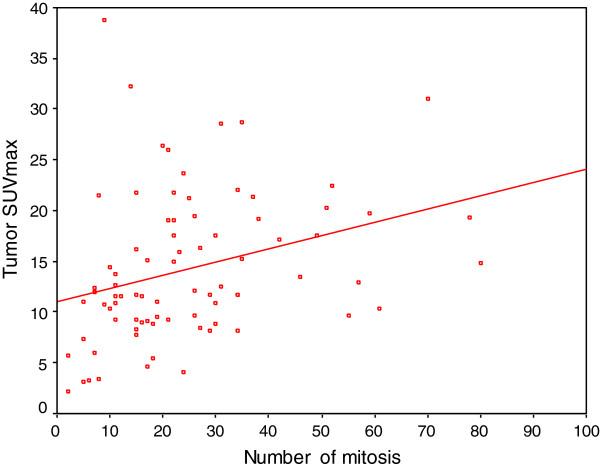
SUVmax of the primary tumor was positively correlated with the largest tumor diameter (p=0.001, r=0.374), number of mitosis (p<0.001, r=0.405), and postoperative pathological stage (p=0.007, r=0.298). Patients with squamous cell carcinoma had a statistically significant higher mean SUVmax, number of mitosis and advanced N stages compared to adenocarcinoma. The etiology of 100 PET/CT positive lymph node stations were metastasis in 14, anthracosis in 40, reactive in 39, granulomatous in 4, and silicosis in 3 patients. A T/LN SUVmax ratio of 5 or lower was suggestive for a malignant lymph node with a sensitivity of 92.8% and specificity of 47%.
CONCLUSIONS
SUVmax of a primary tumor is related to certain pathological characteristics, such as largest diameter, histology, and number of mitosis. A T/LN SUVmax ratio lower than 5 predicts the metastasis to lymph nodes with a high sensitivity.
背景
我们旨在研究最大标准化摄取值(SUVmax)与原发性肿瘤病理特征之间的相关性,并确定一个预测非小细胞肺癌(NSCLC)患者淋巴结转移的肿瘤/淋巴结(T/LN)SUVmax比值。
方法
回顾性评估81例在初始分期时进行了PET/CT检查并随后接受手术切除的NSCLC患者。有100个PET/CT阳性的纵隔或肺门淋巴结站。记录肿瘤的病理特征,如最大肿瘤直径、肿瘤组织学、分化程度、有丝分裂数、间质炎症程度、坏死情况;PET/CT阳性淋巴结站的病因;原发性肿瘤和阳性淋巴结站的SUVmax。为每个淋巴结站计算T/LN SUVmax比值。
结果
原发性肿瘤的SUVmax与最大肿瘤直径(p = 0.001,r = 0.374)、有丝分裂数(p < 0.001,r = 0.405)和术后病理分期(p = 0.007,r = 0.298)呈正相关。与腺癌相比,鳞状细胞癌患者的平均SUVmax、有丝分裂数和N分期较高,差异有统计学意义。100个PET/CT阳性淋巴结站的病因分别为转移14例、炭末沉着症40例、反应性39例、肉芽肿性4例、矽肺3例。T/LN SUVmax比值≤5提示为恶性淋巴结,敏感性为92.8%,特异性为47%。
结论
原发性肿瘤的SUVmax与某些病理特征相关,如最大直径、组织学和有丝分裂数。T/LN SUVmax比值低于5对淋巴结转移具有较高的预测敏感性。

 Zotero 插件