
腹侧纹状体对奖励的反应活动:双相 I 型和 II 型障碍的差异。
Ventral striatum activity in response to reward: differences between bipolar I and II disorders.
机构信息
MRC Center for Neuropsychiatric Genetics and Genomics, Institute of Psychological Medicine and Clinical Neurosciences, Cardiff University, UK.
出版信息
Am J Psychiatry. 2013 May;170(5):533-41. doi: 10.1176/appi.ajp.2012.12020169.
OBJECTIVE
Little is known about the neurobiology of bipolar II disorder. While bipolar I disorder is associated with abnormally elevated activity in response to reward in the ventral striatum, a key component of reward circuitry, no studies have compared reward circuitry function in bipolar I and bipolar II disorders. Furthermore, associations among reward circuitry activity, reward sensitivity, and striatal volume remain underexplored in bipolar and healthy individuals. The authors examined reward activity in the ventral striatum in participants with bipolar I and II disorders and healthy individuals, the relationships between ventral striatal activity and reward sensitivity across all participants, and between-group differences in striatal gray matter volume and relationships with ventral striatal activity across all participants.
METHOD
Twenty healthy comparison subjects and 32 euthymic bipolar I (N=17) and bipolar II (N=15) patients underwent a neuroimaging reward paradigm during functional MRI scanning, structural scanning, and completed psychometric and clinical assessments.
RESULTS
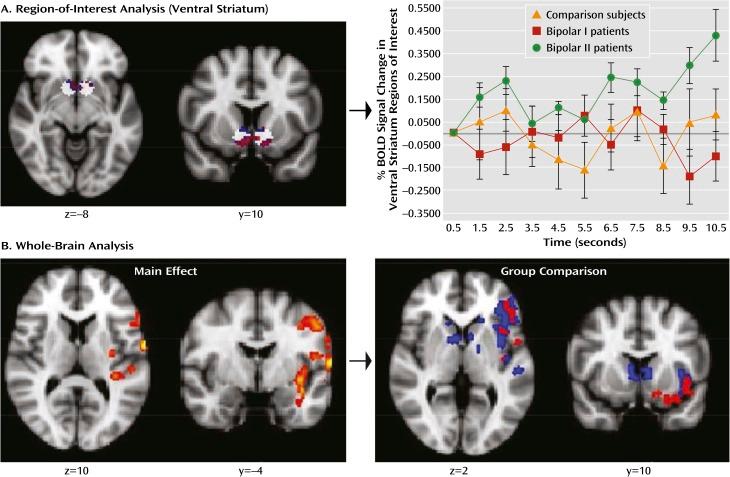
Region-of-interest analyses revealed significant ventral striatal activity in all participants during reward anticipation that was significantly greater in bipolar II patients compared with the other groups. Ventral striatal activity during reward anticipation correlated positively with reward sensitivity and fun seeking across all participants. Bipolar II patients had significantly greater left putamen volume than bipolar I patients, and left putamen volume correlated positively with left ventral striatal activity to reward anticipation in all participants.
CONCLUSIONS
Abnormally elevated ventral striatal activity during reward anticipation may be a potential biomarker of bipolar II disorder. These findings highlight the importance of adopting a dimensional approach in the study of neural mechanisms supporting key pathophysiological processes that may cut across psychiatric disorders.
目的
双相情感障碍的神经生物学机制知之甚少。虽然双相 I 型障碍与腹侧纹状体(奖励回路的关键组成部分)对奖励的异常高反应性有关,但尚无研究比较过双相 I 型和双相 II 型障碍的奖励回路功能。此外,在双相情感障碍患者和健康个体中,奖励回路活动、奖励敏感性和纹状体体积之间的关联仍未得到充分探索。作者研究了双相 I 型和 II 型障碍患者以及健康个体的腹侧纹状体的奖励活动,所有参与者中腹侧纹状体活动与奖励敏感性之间的关系,以及各组之间纹状体灰质体积的差异和所有参与者中腹侧纹状体活动之间的关系。
方法
20 名健康对照者和 32 名双相 I 型(N=17)和双相 II 型(N=15)患者在功能磁共振成像扫描期间接受了神经影像学奖励范式、结构扫描,并完成了心理测量和临床评估。
结果
感兴趣区域分析显示,所有参与者在奖励预期期间腹侧纹状体活动显著,双相 II 型患者的活动显著高于其他组。奖励预期期间的腹侧纹状体活动与所有参与者的奖励敏感性和寻求乐趣呈正相关。与双相 I 型患者相比,双相 II 型患者的左侧壳核体积明显更大,且所有参与者的左侧壳核体积与左侧腹侧纹状体对奖励预期的活动呈正相关。
结论
奖励预期期间异常升高的腹侧纹状体活动可能是双相 II 型障碍的潜在生物标志物。这些发现强调了在研究支持可能跨越精神障碍的关键病理生理过程的神经机制时采用维度方法的重要性。

 Zotero 插件