
通过全基因组测序鉴定前列腺癌患者循环中与肿瘤相关的拷贝数变化。
Tumor-associated copy number changes in the circulation of patients with prostate cancer identified through whole-genome sequencing.
机构信息
Institute of Human Genetics, Medical University of Graz, Harrachgasse 21/8, A-8010 Graz, Austria.
Department of Urology, Medical University of Graz, Auenbruggerplatz 5/6, A-8036 Graz, Austria.
出版信息
Genome Med. 2013 Apr 5;5(4):30. doi: 10.1186/gm434. eCollection 2013.
BACKGROUND
Patients with prostate cancer may present with metastatic or recurrent disease despite initial curative treatment. The propensity of metastatic prostate cancer to spread to the bone has limited repeated sampling of tumor deposits. Hence, considerably less is understood about this lethal metastatic disease, as it is not commonly studied. Here we explored whole-genome sequencing of plasma DNA to scan the tumor genomes of these patients non-invasively.
METHODS
We wanted to make whole-genome analysis from plasma DNA amenable to clinical routine applications and developed an approach based on a benchtop high-throughput platform, that is, Illuminas MiSeq instrument. We performed whole-genome sequencing from plasma at a shallow sequencing depth to establish a genome-wide copy number profile of the tumor at low costs within 2 days. In parallel, we sequenced a panel of 55 high-interest genes and 38 introns with frequent fusion breakpoints such as the TMPRSS2-ERG fusion with high coverage. After intensive testing of our approach with samples from 25 individuals without cancer we analyzed 13 plasma samples derived from five patients with castration resistant (CRPC) and four patients with castration sensitive prostate cancer (CSPC).
RESULTS
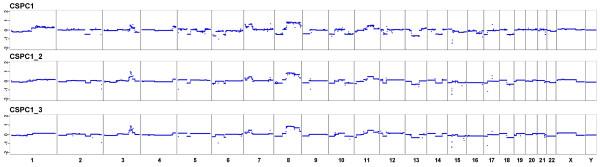
The genome-wide profiling in the plasma of our patients revealed multiple copy number aberrations including those previously reported in prostate tumors, such as losses in 8p and gains in 8q. High-level copy number gains in the AR locus were observed in patients with CRPC but not with CSPC disease. We identified the TMPRSS2-ERG rearrangement associated 3-Mbp deletion on chromosome 21 and found corresponding fusion plasma fragments in these cases. In an index case multiregional sequencing of the primary tumor identified different copy number changes in each sector, suggesting multifocal disease. Our plasma analyses of this index case, performed 13 years after resection of the primary tumor, revealed novel chromosomal rearrangements, which were stable in serial plasma analyses over a 9-month period, which is consistent with the presence of one metastatic clone.
CONCLUSIONS
The genomic landscape of prostate cancer can be established by non-invasive means from plasma DNA. Our approach provides specific genomic signatures within 2 days which may therefore serve as 'liquid biopsy'.
背景
尽管初始治疗具有治愈性,但前列腺癌患者仍可能出现转移性或复发性疾病。转移性前列腺癌倾向于扩散到骨骼,这限制了对肿瘤沉积物的反复采样。因此,由于这种致命的转移性疾病通常没有得到研究,人们对其了解甚少。在这里,我们探索了对血浆 DNA 进行全基因组测序,以便非侵入性地扫描这些患者的肿瘤基因组。
方法
我们希望使基于高通量平台(即 Illuminas MiSeq 仪器)的血浆 DNA 的全基因组分析适用于临床常规应用,并开发了一种方法。我们在浅测序深度下对血浆进行全基因组测序,以在 2 天内以低成本建立肿瘤的全基因组拷贝数图谱。同时,我们对 55 个高关注度基因和 38 个常发生融合断点的内含子进行了测序,例如 TMPRSS2-ERG 融合,覆盖率很高。在对 25 名无癌症个体的样本进行了方法的深入测试后,我们分析了来自 5 名去势抵抗性(CRPC)和 4 名去势敏感性前列腺癌(CSPC)患者的 13 个血浆样本。
结果
我们的患者血浆中的全基因组图谱显示了多个拷贝数异常,包括以前在前列腺肿瘤中报道过的异常,例如 8p 缺失和 8q 增益。在 CRPC 患者中观察到 AR 基因座高水平的拷贝数增益,但在 CSPC 疾病中未观察到。我们鉴定了与 TMPRSS2-ERG 重排相关的 21 号染色体上的 3-Mbp 缺失,并在这些病例中发现了相应的融合血浆片段。在一个指数病例中,对原发性肿瘤的多区域测序确定了每个区域的不同拷贝数变化,表明存在多灶性疾病。我们对该指数病例的血浆分析是在原发性肿瘤切除 13 年后进行的,揭示了新的染色体重排,这些重排在 9 个月的时间内通过连续的血浆分析是稳定的,这与一个转移性克隆的存在一致。
结论
可以通过从血浆 DNA 进行非侵入性手段建立前列腺癌的基因组图谱。我们的方法在 2 天内提供了特定的基因组特征,因此可以作为“液体活检”。


 Zotero 插件