
鉴定和表征两个小麦糖原合酶激酶 3/ SGS3 样激酶。
Identification and characterization of two wheat Glycogen Synthase Kinase 3/ SHAGGY-like kinases.
机构信息
Cell Biology, Faculty of Biology, University of Freiburg, Schaenzlestr 1, D-79104 Freiburg, Germany.
出版信息
BMC Plant Biol. 2013 Apr 18;13:64. doi: 10.1186/1471-2229-13-64.
BACKGROUND
Plant Glycogen Synthase Kinase 3/ SHAGGY-like kinases (GSKs) have been implicated in numerous biological processes ranging from embryonic, flower, stomata development to stress and wound responses. They are key regulators of brassinosteroid signaling and are also involved in the cross-talk between auxin and brassinosteroid pathways. In contrast to the human genome that contains two genes, plant GSKs are encoded by a multigene family. Little is known about Liliopsida resp. Poaceae in comparison to Brassicaceae GSKs. Here, we report the identification and structural characterization of two GSK homologs named TaSK1 and TaSK2 in the hexaploid wheat genome as well as a widespread phylogenetic analysis of land plant GSKs.
RESULTS
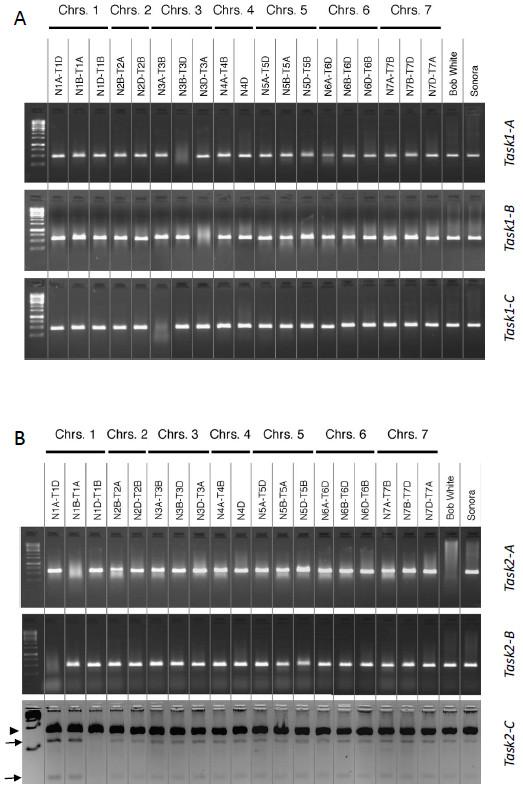
Genomic and cDNA sequence alignments as well as chromosome localization using nullisomic-tetrasomic lines provided strong evidence for three expressed gene copies located on homoeolog chromosomes for TaSK1 as well as for TaSK2. Predicted proteins displayed a clear GSK signature. In vitro kinase assays showed that TaSK1 and TaSK2 possessed kinase activity. A phylogenetic analysis of land plant GSKs indicated that TaSK1 and TaSK2 belong to clade II of plant GSKs, the Arabidopsis members of which are all involved in Brassinosteroid signaling. Based on a single ancestral gene in the last common ancestor of all land plants, paralogs were acquired and retained through paleopolyploidization events, resulting in six to eight genes in angiosperms. More recent duplication events have increased the number up to ten in some lineages.
CONCLUSIONS
To account for plant diversity in terms of functionality, morphology and development, attention has to be devoted to Liliopsida resp Poaceae GSKs in addition to Arabidopsis GSKs. In this study, molecular characterization, chromosome localization, kinase activity test and phylogenetic analysis (1) clarified the homologous/paralogous versus homoeologous status of TaSK sequences, (2) pointed out their affiliation to the GSK multigene family, (3) showed a functional kinase activity, (4) allowed a classification in clade II, members of which are involved in BR signaling and (5) allowed to gain information on acquisition and retention of GSK paralogs in angiosperms in the context of whole genome duplication events. Our results provide a framework to explore Liliopsida resp Poaceae GSKs functions in development.
背景
植物糖原合成酶激酶 3/类 SHAGGY 激酶(GSKs)参与了从胚胎、花、气孔发育到应激和伤口反应等多种生物学过程。它们是油菜素内酯信号转导的关键调节剂,也参与了生长素和油菜素内酯途径的交叉对话。与包含两个基因的人类基因组相比,植物 GSKs 是由多基因家族编码的。与拟南芥相比,人们对百合科植物或禾本科植物 GSKs 的了解较少。在这里,我们报告了在六倍体小麦基因组中鉴定和结构表征两个 GSK 同源物 TaSK1 和 TaSK2 的情况,以及对陆地植物 GSKs 的广泛系统发育分析。
结果
基因组和 cDNA 序列比对以及利用单体-四体系进行的染色体定位为 TaSK1 和 TaSK2 位于同源染色体上的三个表达基因拷贝提供了强有力的证据。预测的蛋白质显示出明显的 GSK 特征。体外激酶测定表明 TaSK1 和 TaSK2 具有激酶活性。陆地植物 GSKs 的系统发育分析表明 TaSK1 和 TaSK2 属于植物 GSKs 的 II 类,拟南芥成员均参与油菜素内酯信号转导。基于所有陆地植物最后共同祖先中的单个祖先基因,通过古多倍化事件获得了并保留了旁系同源物,导致被子植物中有六到八个基因。在一些谱系中,最近的重复事件将数量增加到十个。
结论
为了从功能、形态和发育的角度解释植物的多样性,除了拟南芥 GSKs 之外,还必须关注百合科植物或禾本科植物的 GSKs。在这项研究中,分子特征、染色体定位、激酶活性测试和系统发育分析(1)阐明了 TaSK 序列的同源/旁系同源与同源的状态,(2)指出了它们与 GSK 多基因家族的关系,(3)显示了功能性激酶活性,(4)允许在涉及全基因组重复事件的被子植物中分类为 II 类,其成员参与 BR 信号转导,(5)获得了有关 GSK 旁系同源物在被子植物中的获得和保留的信息。我们的研究结果为探索百合科植物或禾本科植物 GSKs 在发育中的功能提供了一个框架。



 Zotero 插件