
返祖基因组学将跗猴置于人猿进化枝上。
Retrophylogenomics place tarsiers on the evolutionary branch of anthropoids.
机构信息
Institute of Experimental Pathology, University of Münster, 48149 Münster, Germany.
出版信息
Sci Rep. 2013;3:1756. doi: 10.1038/srep01756.
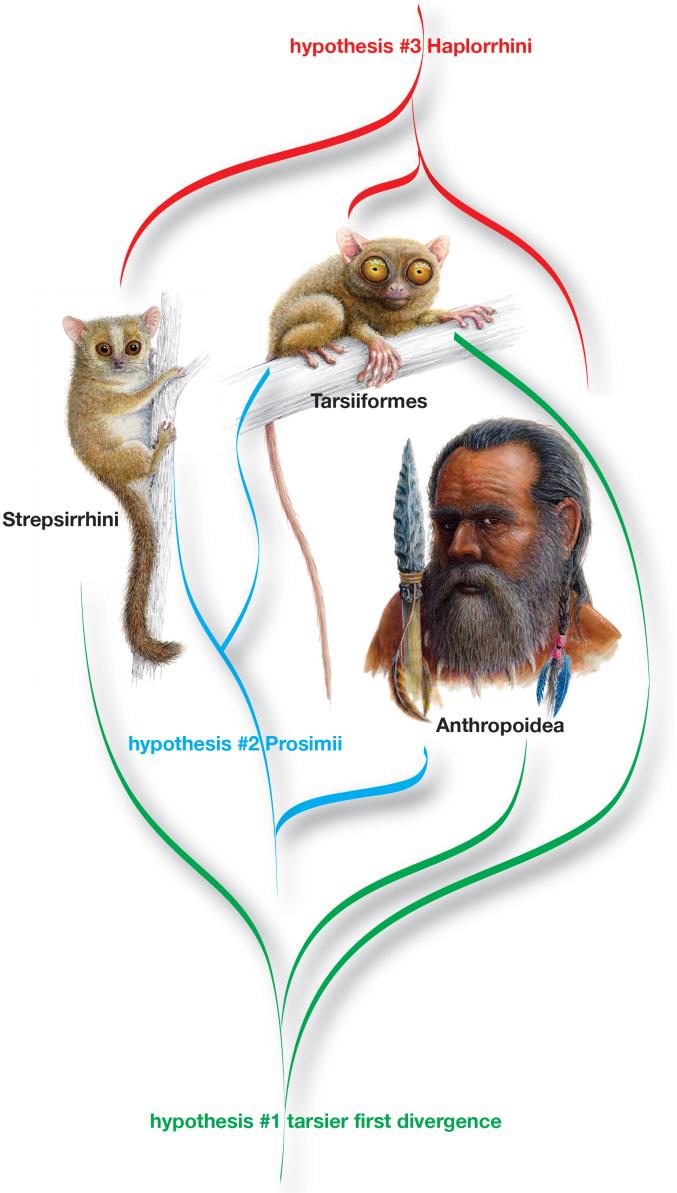
One of the most disputed issues in primate evolution and thus of our own primate roots, is the phylogenetic position of the Southeast Asian tarsier. While much molecular data indicate a basal place in the primate tree shared with strepsirrhines (prosimian monophyly hypothesis), data also exist supporting either an earlier divergence in primates (tarsier-first hypothesis) or a close relationship with anthropoid primates (Haplorrhini hypothesis). The use of retroposon insertions embedded in the Tarsius genome afforded us the unique opportunity to directly test all three hypotheses via three pairwise genome alignments. From millions of retroposons, we found 104 perfect orthologous insertions in both tarsiers and anthropoids to the exclusion of strepsirrhines, providing conflict-free evidence for the Haplorrhini hypothesis, and none supporting either of the other two positions. Thus, tarsiers are clearly the sister group to anthropoids in the clade Haplorrhini.
灵长类进化中最具争议的问题之一,也是我们灵长类动物起源的问题,是东南亚的眼镜猴在灵长类系统发育树中的位置。虽然大量的分子数据表明,它与食虫目动物(原猴类单系假说)共享一个基础分支,但也有数据支持灵长类动物的早期分化(眼镜猴首先分化假说)或与类人猿的密切关系(窄鼻猴假说)。在 Tarsius 基因组中嵌入的反转录转座子的使用,为我们提供了一个独特的机会,通过三个两两基因组比对来直接测试这三个假说。从数百万个反转录转座子中,我们在眼镜猴和类人猿中发现了 104 个完全同源的插入序列,而排除了食虫目动物,为窄鼻猴假说提供了无冲突的证据,而没有任何证据支持其他两个假说。因此,眼镜猴在 Haplorrhini 分支中显然是类人猿的姊妹群。


 Zotero 插件