
立体定向体部放疗治疗局限性前列腺癌:6年的疾病控制和生活质量
Stereotactic body radiotherapy for localized prostate cancer: disease control and quality of life at 6 years.
作者信息
Katz Alan J, Santoro Michael, Diblasio Fred, Ashley Richard
出版信息
Radiat Oncol. 2013 May 13;8:118. doi: 10.1186/1748-717X-8-118.
BACKGROUND
Stereotactic body radiotherapy (SBRT) may yield disease control for prostate cancer in a brief, hypofractionated treatment regimen without increasing treatment toxicity. Our report presents a 6-year update from 304 low- (n = 211), intermediate- (n = 81), and high-risk (n = 12) prostate cancer patients who received CyberKnife SBRT.
METHODS
The median PSA at presentation was 5.8 ng/ml. Fifty-seven patients received neoadjuvant hormonal therapy for up to one year. The first 50 patients received a total dose of 35 Gy in 5 fractions of 7 Gy. The subsequent 254 patients received a total dose of 36.25 Gy in 5 fractions of 7.25 Gy. Toxicity was assessed with the Expanded Prostate Cancer Index Composite questionnaire and the Radiation Therapy Oncology Group urinary and rectal toxicity scale. Biochemical failure was assessed using the nadir + 2 definition.
RESULTS
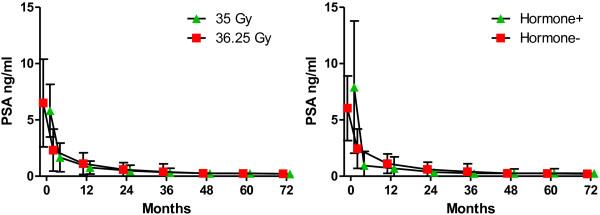
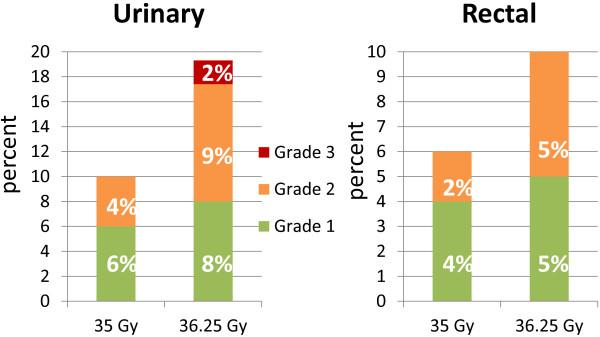
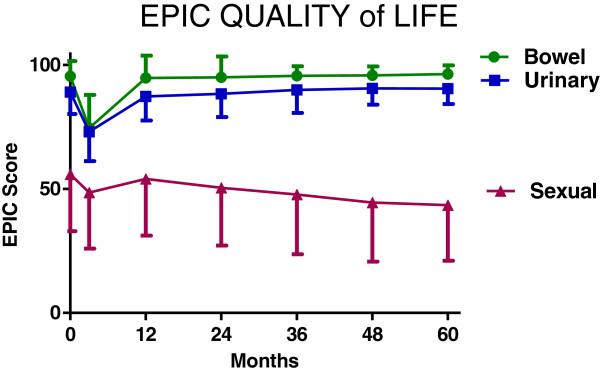
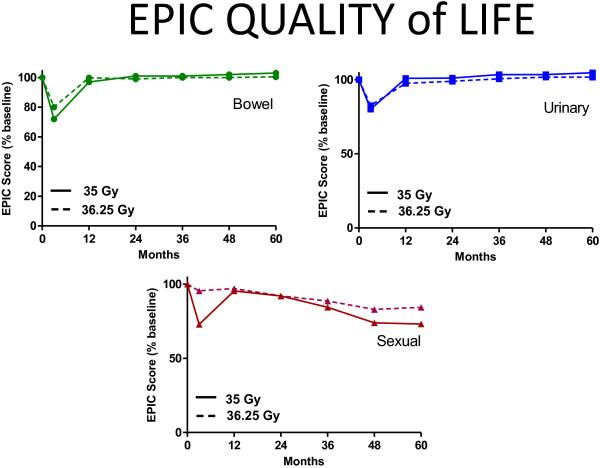
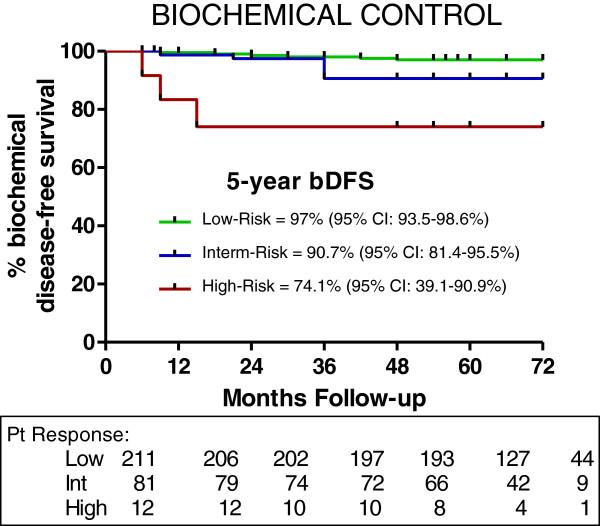
No patients experienced Grade III or IV acute complications. Fewer than 5% of patients experienced any acute Grade II urinary or rectal toxicities. Late urinary Grade II complications were observed in 4% of patients treated to 35 Gy and 9% of patients treated to 36.25 Gy. Five (2%) late Grade III urinary toxicities occurred in patients who were treated with 36.25 Gy. Late Grade II rectal complications were observed in 2% of patients treated to 35 Gy and 5% of patients treated to 36.25 Gy. Bowel and urinary quality of life (QOL) scores initially decreased, but later returned to baseline values. An overall decrease of 20% in the sexual QOL score was observed. QOL in each domain was not differentially affected by dose. For patients that were potent prior to treatment, 75% stated that they remained sexually potent. Actuarial 5-year biochemical recurrence-free survival was 97% for low-risk, 90.7% for intermediate-risk, and 74.1% for high-risk patients. PSA fell to a median of 0.12 ng/ml at 5 years; dose did not influence median PSA levels.
CONCLUSIONS
In this large series with long-term follow-up, we found excellent biochemical control rates and low and acceptable toxicity, outcomes consistent with those reported for from high dose rate brachytherapy (HDR BT). Provided that measures are taken to account for prostate motion, SBRT's distinct advantages over HDR BT include its noninvasiveness and delivery to patients without anesthesia or hospitalization.
背景
立体定向体部放疗(SBRT)可在短疗程、大分割治疗方案中实现前列腺癌的疾病控制,且不增加治疗毒性。我们的报告展示了304例接受射波刀SBRT治疗的低危(n = 211)、中危(n = 81)和高危(n = 12)前列腺癌患者的6年随访结果。
方法
初诊时前列腺特异性抗原(PSA)中位数为5.8 ng/ml。57例患者接受了长达一年的新辅助激素治疗。前50例患者接受了总量35 Gy、分5次、每次7 Gy的照射。随后的254例患者接受了总量36.25 Gy、分5次、每次7.25 Gy的照射。使用扩展前列腺癌指数综合问卷以及放射肿瘤学组的泌尿和直肠毒性量表评估毒性。采用最低点+2定义评估生化失败情况。
结果
无患者发生III级或IV级急性并发症。不到5%的患者出现任何急性II级泌尿或直肠毒性。接受35 Gy照射的患者中4%出现晚期II级泌尿并发症,接受36.25 Gy照射的患者中9%出现该并发症。接受36.25 Gy照射的患者中有5例(2%)发生晚期III级泌尿毒性。接受35 Gy照射的患者中2%出现晚期II级直肠并发症,接受36.25 Gy照射的患者中5%出现该并发症。肠道和泌尿生活质量(QOL)评分最初下降,但随后恢复至基线值。性QOL评分总体下降了20%。各领域的QOL未受剂量的差异影响。对于治疗前有性功能的患者,75%表示仍有性功能。低危患者5年精算无生化复发生存率为97%,中危患者为90.7%,高危患者为74.1%。5年时PSA降至中位数0.12 ng/ml;剂量不影响PSA中位数水平。
结论
在这个长期随访的大型系列研究中,我们发现了出色的生化控制率以及低且可接受的毒性,这些结果与高剂量率近距离放疗(HDR BT)报告的结果一致。如果采取措施考虑前列腺运动,SBRT相对于HDR BT的明显优势包括其非侵入性以及无需麻醉或住院即可为患者实施治疗。
 Zotero 插件