
基于实践的证据:通过挖掘临床记录来分析西洛他唑的安全性。
Practice-based evidence: profiling the safety of cilostazol by text-mining of clinical notes.
机构信息
Division of Vascular Surgery and Cardiovascular Medicine, Stanford University, Stanford, California, United States of America.
出版信息
PLoS One. 2013 May 23;8(5):e63499. doi: 10.1371/journal.pone.0063499. Print 2013.
BACKGROUND
Peripheral arterial disease (PAD) is a growing problem with few available therapies. Cilostazol is the only FDA-approved medication with a class I indication for intermittent claudication, but carries a black box warning due to concerns for increased cardiovascular mortality. To assess the validity of this black box warning, we employed a novel text-analytics pipeline to quantify the adverse events associated with Cilostazol use in a clinical setting, including patients with congestive heart failure (CHF).
METHODS AND RESULTS
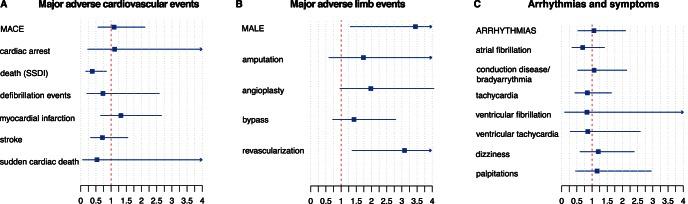
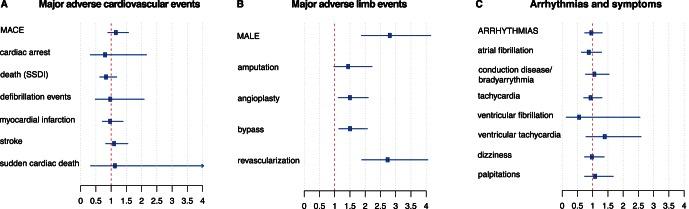
We analyzed the electronic medical records of 1.8 million subjects from the Stanford clinical data warehouse spanning 18 years using a novel text-mining/statistical analytics pipeline. We identified 232 PAD patients taking Cilostazol and created a control group of 1,160 PAD patients not taking this drug using 1:5 propensity-score matching. Over a mean follow up of 4.2 years, we observed no association between Cilostazol use and any major adverse cardiovascular event including stroke (OR = 1.13, CI [0.82, 1.55]), myocardial infarction (OR = 1.00, CI [0.71, 1.39]), or death (OR = 0.86, CI [0.63, 1.18]). Cilostazol was not associated with an increase in any arrhythmic complication. We also identified a subset of CHF patients who were prescribed Cilostazol despite its black box warning, and found that it did not increase mortality in this high-risk group of patients.
CONCLUSIONS
This proof of principle study shows the potential of text-analytics to mine clinical data warehouses to uncover 'natural experiments' such as the use of Cilostazol in CHF patients. We envision this method will have broad applications for examining difficult to test clinical hypotheses and to aid in post-marketing drug safety surveillance. Moreover, our observations argue for a prospective study to examine the validity of a drug safety warning that may be unnecessarily limiting the use of an efficacious therapy.
背景
外周动脉疾病(PAD)是一个日益严重的问题,可用的治疗方法很少。西洛他唑是唯一一种获得美国食品和药物管理局(FDA)批准的用于间歇性跛行的 I 类药物,但由于担心心血管死亡率增加,它带有黑框警告。为了评估这个黑框警告的有效性,我们采用了一种新的文本分析管道,在临床环境中量化与西洛他唑使用相关的不良事件,包括充血性心力衰竭(CHF)患者。
方法和结果
我们使用一种新的文本挖掘/统计分析管道,分析了斯坦福临床数据仓库中 18 年来 180 万受试者的电子病历。我们确定了 232 名服用西洛他唑的 PAD 患者,并使用 1:5 的倾向评分匹配创建了一个未服用该药物的 1160 名 PAD 患者的对照组。在平均 4.2 年的随访中,我们没有观察到西洛他唑的使用与任何主要不良心血管事件(包括中风、心肌梗死或死亡)之间的关联,包括中风(OR=1.13,CI[0.82,1.55])、心肌梗死(OR=1.00,CI[0.71,1.39])或死亡(OR=0.86,CI[0.63,1.18])。西洛他唑与心律失常并发症的增加无关。我们还确定了一组尽管有黑框警告仍被开处西洛他唑的 CHF 患者,发现它并没有增加这些高危患者的死亡率。
结论
这项原理验证研究表明,文本分析有潜力从临床数据仓库中挖掘“自然实验”,例如在 CHF 患者中使用西洛他唑。我们设想这种方法将有广泛的应用,用于检验难以测试的临床假设,并有助于药物上市后安全性监测。此外,我们的观察结果认为需要进行一项前瞻性研究,以检验可能不必要地限制有效治疗方法使用的药物安全警告的有效性。

 Zotero 插件