
鼻腔内给予胰岛素治疗阿尔茨海默病:基础研究和临床证据的综述。
Intranasal insulin as a treatment for Alzheimer's disease: a review of basic research and clinical evidence.
机构信息
Department of Diagnostic and Interventional Neuroradiology, RWTH Aachen University, Pauwelsstr. 30, 52074 Aachen, Germany.
出版信息
CNS Drugs. 2013 Jul;27(7):505-14. doi: 10.1007/s40263-013-0076-8.
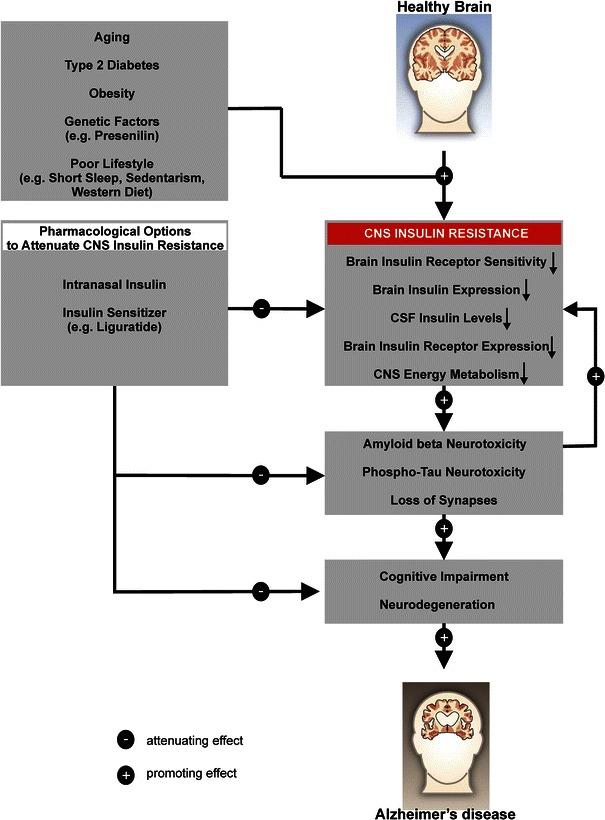
Research in animals and humans has associated Alzheimer's disease (AD) with decreased cerebrospinal fluid levels of insulin in combination with decreased insulin sensitivity (insulin resistance) in the brain. This phenomenon is accompanied by attenuated receptor expression of insulin and insulin-like growth factor, enhanced serine phosphorylation of insulin receptor substrate-1, and impaired transport of insulin across the blood-brain barrier. Moreover, clinical trials have demonstrated that intranasal insulin improves both memory performance and metabolic integrity of the brain in patients suffering from AD or its prodrome, mild cognitive impairment. These results, in conjunction with the finding that insulin mitigates hippocampal synapse vulnerability to beta amyloid, a peptide thought to be causative in the development of AD, provide a strong rationale for hypothesizing that pharmacological strategies bolstering brain insulin signaling, such as intranasal administration of insulin, could have significant potential in the treatment and prevention of AD. With this view in mind, the review at hand will present molecular mechanisms potentially underlying the memory-enhancing and neuroprotective effects of intranasal insulin. Then, we will discuss the results of intranasal insulin studies that have demonstrated that enhancing brain insulin signaling improves memory and learning processes in both cognitively healthy and impaired humans. Finally, we will provide an overview of neuroimaging studies indicating that disturbances in insulin metabolism--such as insulin resistance in obesity, type 2 diabetes and AD--and altered brain responses to insulin are linked to decreased cerebral volume and especially to hippocampal atrophy.
在动物和人类研究中,阿尔茨海默病(AD)与脑脊液中胰岛素水平降低以及大脑中胰岛素敏感性(胰岛素抵抗)降低有关。这种现象伴随着胰岛素和胰岛素样生长因子受体表达减弱,胰岛素受体底物-1丝氨酸磷酸化增强,以及胰岛素穿过血脑屏障的转运受损。此外,临床试验表明,鼻内胰岛素可改善 AD 或其前驱期、轻度认知障碍患者的记忆表现和大脑代谢完整性。这些结果与胰岛素减轻β淀粉样肽引起的海马突触易损性的发现相结合,为假设增强脑胰岛素信号的药物策略(如鼻内给予胰岛素)在 AD 的治疗和预防中有很大的潜力提供了强有力的依据。考虑到这一点,本综述将介绍鼻内胰岛素增强记忆和神经保护作用的潜在分子机制。然后,我们将讨论鼻内胰岛素研究的结果,这些研究表明,增强脑胰岛素信号可以改善认知健康和受损人群的记忆和学习过程。最后,我们将概述神经影像学研究,表明胰岛素代谢紊乱(如肥胖、2 型糖尿病和 AD 中的胰岛素抵抗)和大脑对胰岛素的反应改变与脑体积减少,特别是海马萎缩有关。
 Zotero 插件