
促肾上腺皮质激素释放因子信号在终纹床核中介导应激和奖励的交汇作用中的新角色。
Emerging role for corticotropin releasing factor signaling in the bed nucleus of the stria terminalis at the intersection of stress and reward.
机构信息
Neuroscience Program in Substance Abuse, Department of Molecular Physiology and Biophysics, Vanderbilt Brain Institute , Nashville, TN , USA.
出版信息
Front Psychiatry. 2013 May 29;4:42. doi: 10.3389/fpsyt.2013.00042. eCollection 2013.
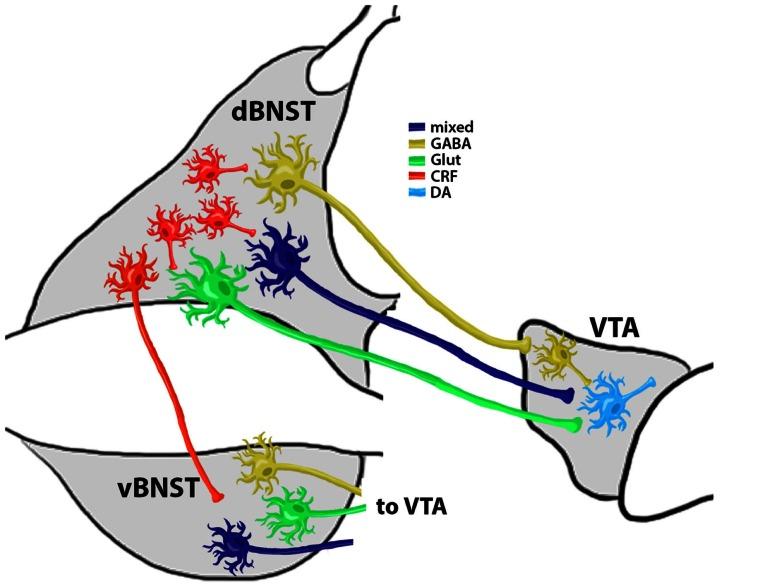
Stress and anxiety play an important role in the development and maintenance of drug and alcohol addiction. The bed nucleus of the stria terminalis (BNST), a brain region involved in the production of long-term stress-related behaviors, plays an important role in animal models of relapse, such as reinstatement to previously extinguished drug-seeking behaviors. While a number of neurotransmitter systems have been suggested to play a role in these behaviors, recent evidence points to the neuropeptide corticotropin releasing factor (CRF) as being critically important in BNST-mediated reinstatement behaviors. Although numerous studies indicate that the BNST is a complex brain region with multiple afferent and efferent systems and a variety of cell types, there has only been limited work to determine how CRF modulates this complex neuronal system at the circuit level. Recent work from our lab and others have begun to unravel these BNST neurocircuits and explore their roles in CRF-related reinstatement behaviors. This review will examine the role of CRF signaling in drug addiction and reinstatement with an emphasis on critical neurocircuitry within the BNST that may offer new insights into treatments for addiction.
压力和焦虑在药物和酒精成瘾的发展和维持中起着重要作用。终纹床核(BNST)是参与产生长期与应激相关行为的脑区,在动物复吸模型中起着重要作用,例如恢复以前消除的觅药行为。虽然有许多神经递质系统被认为在这些行为中起作用,但最近的证据表明神经肽促肾上腺皮质释放因子(CRF)在 BNST 介导的复吸行为中至关重要。尽管许多研究表明 BNST 是一个具有多个传入和传出系统以及多种细胞类型的复杂脑区,但只有有限的工作来确定 CRF 如何在回路水平上调节这个复杂的神经元系统。我们实验室和其他实验室的最近研究开始揭示这些 BNST 神经回路,并探索它们在与 CRF 相关的复吸行为中的作用。这篇综述将探讨 CRF 信号在药物成瘾和复吸中的作用,重点是 BNST 内的关键神经回路,这可能为成瘾治疗提供新的见解。

 Zotero 插件