
斑点热群立克次体诱导的内皮屏障功能障碍期间血管生成素的分隔、功能作用:可能由宿主 tRNA 衍生的小非编码 RNA 介导的证据。
Compartmentalized, functional role of angiogenin during spotted fever group rickettsia-induced endothelial barrier dysfunction: evidence of possible mediation by host tRNA-derived small noncoding RNAs.
机构信息
Department of Pathology, University of Texas Medical Branch at Galveston, Galveston, TX, USA.
出版信息
BMC Infect Dis. 2013 Jun 23;13:285. doi: 10.1186/1471-2334-13-285.
BACKGROUND
Microvascular endothelial barrier dysfunction is the central enigma in spotted fever group (SFG) rickettsioses. Angiogenin (ANG) is one of the earliest identified angiogenic factors, of which some are relevant to the phosphorylation of VE-cadherins that serve as endothelial adherens proteins. Although exogenous ANG is known to translocate into the nucleus of growing endothelial cells (ECs) where it plays a functional role, nuclear ANG is not detected in quiescent ECs. Besides its nuclear role, ANG is thought to play a cytoplasmic role, owing to its RNase activity that cleaves tRNA to produce small RNAs. Recently, such tRNA-derived RNA fragments (tRFs) have been shown to be induced under stress conditions. All these observations raise an intriguing hypothesis about a novel cytoplasmic role of ANG, which is induced upon infection with Rickettsia and generates tRFs that may play roles in SFG rickettsioses.
METHODS
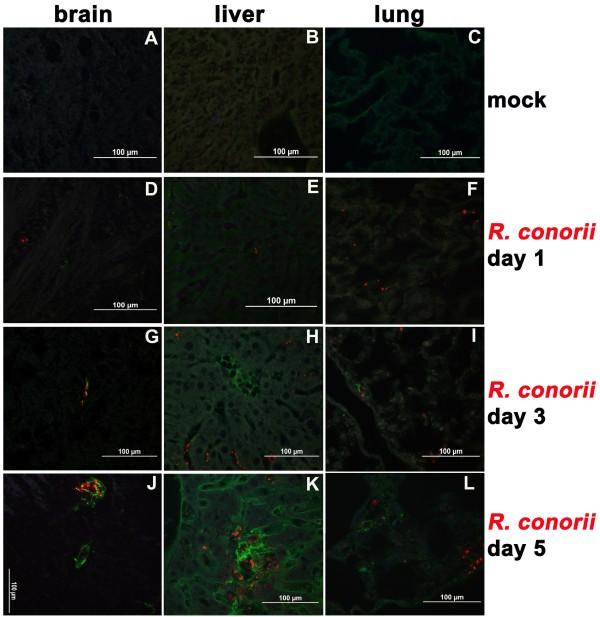
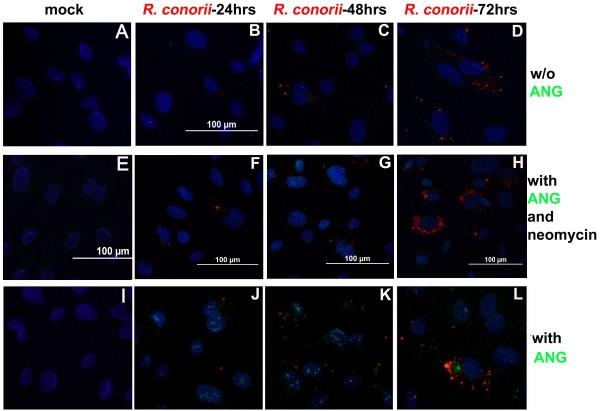
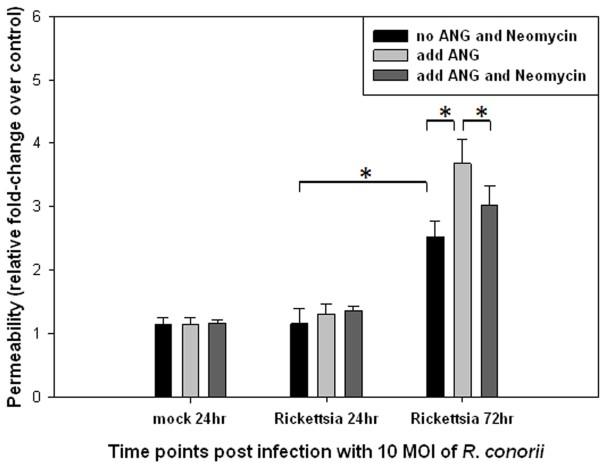
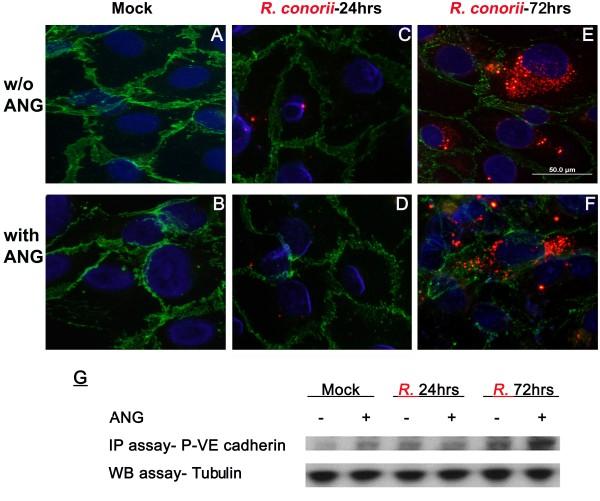
C3H/HeN mice were infected intravenously with a sublethal dose of R. conorii. At days 1, 3, and 5 post infection (p.i.), liver, lung and brain were collected for immunofluorescence (IF) studies of R. conorii and angiogenin (ANG). Human umbilical vein endothelial cells (HUVECs) were infected with R. conorii for 24, 48, and 72 hrs before incubation with 1μg/ml recombinant human ANG (rANG) in normal medium for 2 hrs. HUVEC samples were subjected to IF, exogenous ANG translocation, endothelial permeability, and immunoprecipitation phosphorylation assays. To identify small non-coding RNAs (sncRNAs) upon rickettsial infection, RNAs from pulverized mouse lung tissues and HUVECs were subjected to library preparation and deep sequencing analysis using an Illumina 2000 instrument. Identified sncRNAs were confirmed by Northern hybridization, and their target mRNAs were predicted in silico using BLAST and RNA hybrid programs.
RESULTS
In the present study, we have demonstrated endothelial up-regulation of ANG, co-localized with SFG rickettsial infection in vivo. We also have provided direct evidence that rickettsial infection sensitizes human ECs to the translocation of exogenous ANG in a compartmentalized pattern at different times post-infection. Typically, exogenous ANG translocates into the nucleus at 24 hrs and to the cytoplasm at 72 hrs post-infection. The ANG cytoplasmic translocation enhances phosphorylation and destabilization of VE-cadherin and attenuates endothelial barrier function. Of note, deep sequencing analysis detected tRFs, mostly derived from the 5'-halves of host tRNAs, that are induced by ANG. Northern hybridization validates the two most abundantly cloned tRFs derived from tRNA-ValGTG and tRNA-GlyGCC, in both mouse tissues and human cells. Bioinformatics analysis predicted that these tRFs may interact with transcripts associated with the endothelial barrier, the host cell inflammatory response, and autophagy.
CONCLUSIONS
Our data provide new insight into the role of compartmentalized ANG during SFG rickettsioses, and highlight its possible mediation through tRFs.
背景
微血管内皮屏障功能障碍是斑点热群(SFG)立克次体的核心难题。血管生成素(ANG)是最早发现的血管生成因子之一,其中一些与作为内皮黏附蛋白的 VE-钙黏蛋白的磷酸化有关。尽管外源性 ANG 已知可转位到生长中的内皮细胞(EC)的核内,在核内发挥功能作用,但在静止的 EC 中未检测到核内 ANG。除了其核内作用外,ANG 被认为在细胞质中发挥作用,这是由于其 RNA 酶活性可切割 tRNA 产生小 RNA。最近,人们发现这些 tRNA 衍生的 RNA 片段(tRFs)在应激条件下被诱导。所有这些观察结果都提出了一个有趣的假设,即 ANG 在受到立克次体感染后会产生一种新的细胞质作用,并产生 tRFs,这些 tRFs可能在 SFG 立克次体病中发挥作用。
方法
用亚致死剂量的 R. conorii 静脉感染 C3H/HeN 小鼠。在感染后第 1、3 和 5 天,收集肝、肺和脑组织,进行 R. conorii 和血管生成素(ANG)的免疫荧光(IF)研究。在感染 R. conorii 24、48 和 72 小时后,将人脐静脉内皮细胞(HUVEC)孵育在正常培养基中 1μg/ml 重组人 ANG(rANG)2 小时。对 HUVEC 样本进行 IF、外源性 ANG 转位、内皮通透性和免疫沉淀磷酸化测定。为了鉴定立克次体感染后的小非编码 RNA(sncRNA),用 Illumina 2000 仪器对粉碎的鼠肺组织和 HUVEC 中的 RNA 进行文库制备和深度测序分析。通过 Northern 杂交验证了鉴定出的 sncRNA,并使用 BLAST 和 RNA hybrid 程序在计算机中预测其靶 mRNA。
结果
在本研究中,我们已经证明了内皮细胞 ANG 的上调,与体内 SFG 立克次体感染共定位。我们还提供了直接证据,表明立克次体感染使人类 ECs 在感染后不同时间以分隔的模式对外源性 ANG 的转位敏感。通常,外源性 ANG 在 24 小时内转位到核内,在 72 小时后转位到细胞质。ANG 细胞质转位增强了 VE-钙黏蛋白的磷酸化和不稳定性,并减弱了内皮屏障功能。值得注意的是,深度测序分析检测到 tRFs,主要来自宿主 tRNA 的 5'-半部分,这些 tRFs被 ANG 诱导。Northern 杂交验证了来自 tRNA-ValGTG 和 tRNA-GlyGCC 的两个最丰富克隆的 tRFs,在小鼠组织和人细胞中均存在。生物信息学分析预测,这些 tRFs 可能与内皮屏障、宿主细胞炎症反应和自噬相关的转录本相互作用。
结论
我们的数据为 SFG 立克次体病期间 ANG 的分隔作用提供了新的见解,并强调了其可能通过 tRFs 介导。


 Zotero 插件