
髓核分泌的CCL20可促进表达CCR6的Th17细胞向退变的椎间盘组织募集。
CCL20 Secretion from the Nucleus Pulposus Improves the Recruitment of CCR6-Expressing Th17 Cells to Degenerated IVD Tissues.
作者信息
Zhang Wen, Nie Lin, Wang Yan, Wang Xu-Ping, Zhao Hua, Dongol Samina, Maharjan Sailendra, Cheng Lei
机构信息
Department of Orthopedics, Qilu Hospital, Shandong University, Jinan, Shandong, China.
出版信息
PLoS One. 2013 Jun 18;8(6):e66286. doi: 10.1371/journal.pone.0066286. Print 2013.
BACKGROUND
Studies elucidated that Th17 cells are important contributors to the pathogenesis of many immune-mediated diseases, and IL-17A is present in pathologic intervertebral disc (IVD) tissues. However, the mechanisms, how these cells traffic into the degenerate discs are not clear.
MATERIALS AND METHODS
The samples collected from 53 patients had been divided into 3 groups: Group P (annulus fibrosus was intact), Group E (annulus fibrosus was reptured) and normal control. Immunohistochemistry was used to detect the expression of CCL20, CCR6, IL-17A, TNF-α and CD4 in IVD tissues. Moreover, nucleus pulposus (NP) cells had been cultured in the presence and absence of Th17 associated cytokines. The supernatants were detected for CCL20 concentrations by ELISA, and the NP cells for the expression of CCL20 mRNA. Additionally, peripheral blood (PB) samples had undergone detection for the expression of CCR6 mRNA and the proportion of IL-17-producing cells, including the surface expression of CCR6.
RESULTS
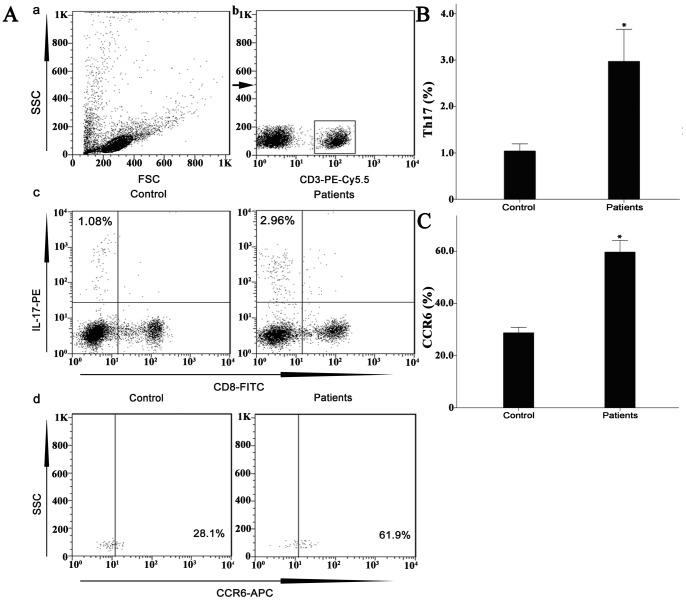
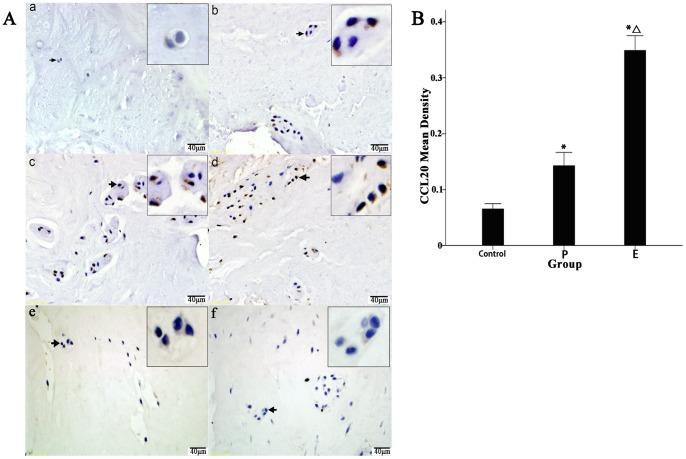
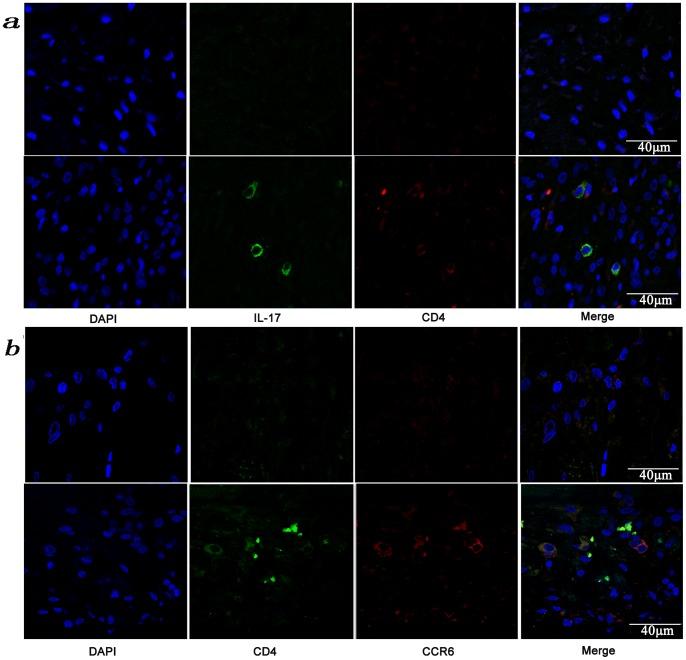
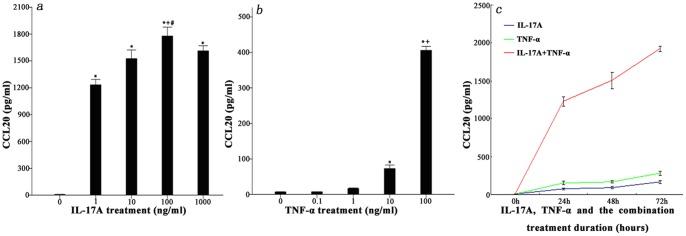
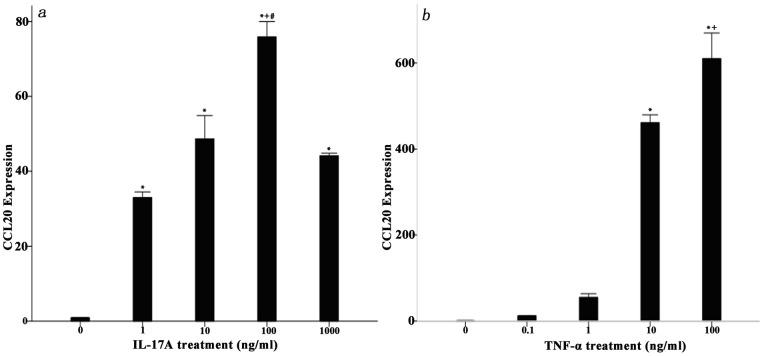
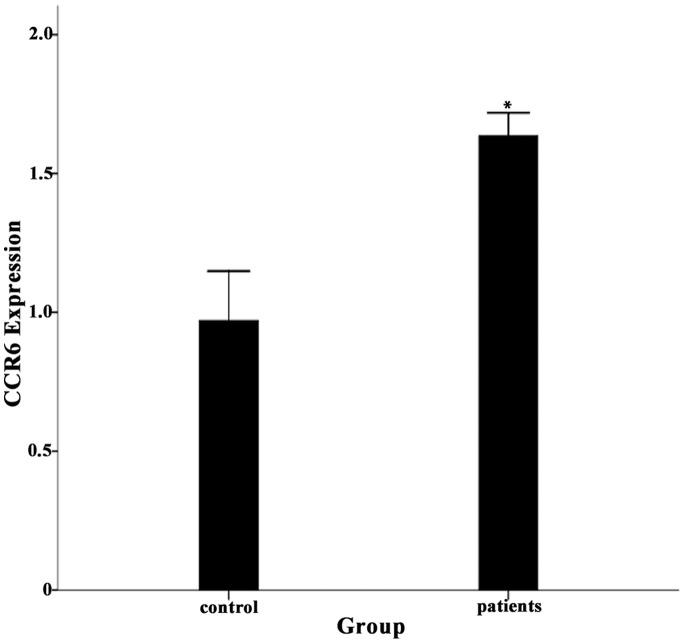
Immunohistochemistry revealed that CCL20 and TNF-α were expressed in degenerated NP cells. Double-labeled immunofluorescence elaborated, IL-17-producing cells (CD4(+)IL-17A(+) and CD4(+)CCR6(+)) appeared in the Group E samples, but no traces or expression in Group P and normal control. IL-17A and TNF-α, alone or combined, could enhance CCL20 secretion in a dose-dependent manner, which was obtained through RT-PCR results. There was a notable difference of CCR6 mRNA expression between patients and normal controls. In comparison to controls, flow cytometry data indicated that the proportion of IL-17-producing cells and the CCR6 expression in PB were significantly increased.
CONCLUSION
Our results provide a potential explanation for involvement of the CCL20-CCR6 system in the trafficking of IL-17-producing cells to degenerated IVD tissues. Additionally, our results explain the contribution of Th17 associated cytokines to the development of degenerated discs via the up-regulation of CCL20 secretion from NP cells, which forms a positive chemotactic feedback loop.
背景
研究表明,Th17细胞是许多免疫介导疾病发病机制的重要促成因素,且白细胞介素-17A(IL-17A)存在于病理性椎间盘(IVD)组织中。然而,这些细胞如何进入退变椎间盘的机制尚不清楚。
材料与方法
从53例患者采集的样本分为3组:P组(纤维环完整)、E组(纤维环破裂)和正常对照组。采用免疫组织化学法检测IVD组织中CC趋化因子配体20(CCL20)、CC趋化因子受体6(CCR6)、IL-17A、肿瘤坏死因子-α(TNF-α)和CD4的表达。此外,在有和没有Th17相关细胞因子存在的情况下培养髓核(NP)细胞。通过酶联免疫吸附测定法检测上清液中CCL20浓度,检测NP细胞中CCL20 mRNA的表达。另外,对外周血(PB)样本进行CCR6 mRNA表达以及产生IL-17细胞比例的检测,包括CCR6的表面表达。
结果
免疫组织化学显示,CCL20和TNF-α在退变的NP细胞中表达。双重免疫荧光显示,产生IL-17的细胞(CD4(+)IL-17A(+)和CD4(+)CCR6(+))出现在E组样本中,但在P组和正常对照组中未发现踪迹或表达。通过逆转录聚合酶链反应结果可知,IL-17A和TNF-α单独或联合使用均可剂量依赖性地增强CCL20分泌。患者与正常对照组之间CCR6 mRNA表达存在显著差异。流式细胞术数据表明,与对照组相比,PB中产生IL-17细胞的比例和CCR6表达显著增加。
结论
我们的结果为CCL20-CCR6系统参与产生IL-17的细胞向退变IVD组织的迁移提供了一种可能的解释。此外,我们的结果解释了Th17相关细胞因子通过上调NP细胞CCL20分泌对退变椎间盘发展的作用,这形成了一个正向趋化反馈环。

 Zotero 插件