
基于微腔阵列系统的肺癌患者循环肿瘤细胞的大小分离。
Size-based isolation of circulating tumor cells in lung cancer patients using a microcavity array system.
机构信息
Division of Biotechnology and Life Science, Institute of Engineering, Tokyo University of Agriculture and Technology, Tokyo, Japan.
出版信息
PLoS One. 2013 Jun 28;8(6):e67466. doi: 10.1371/journal.pone.0067466. Print 2013.
BACKGROUND
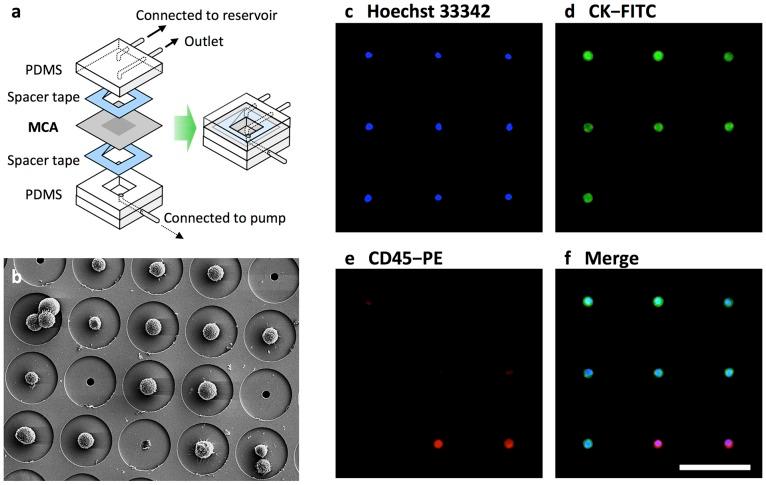
Epithelial cell adhesion molecule (EpCAM)-based enumeration of circulating tumor cells (CTC) has prognostic value in patients with solid tumors, such as advanced breast, colon, and prostate cancer. However, poor sensitivity has been reported for non-small cell lung cancer (NSCLC). To address this problem, we developed a microcavity array (MCA) system integrated with a miniaturized device for CTC isolation without relying on EpCAM expression. Here, we report the results of a clinical study on CTCs of advanced lung cancer patients in which we compared the MCA system with the CellSearch system, which employs the conventional EpCAM-based method.
METHODS
Paired peripheral blood samples were collected from 43 metastatic lung cancer patients to enumerate CTCs using the CellSearch system according to the manufacturer's protocol and the MCA system by immunolabeling and cytomorphological analysis. The presence of CTCs was assessed blindly and independently by both systems.
RESULTS
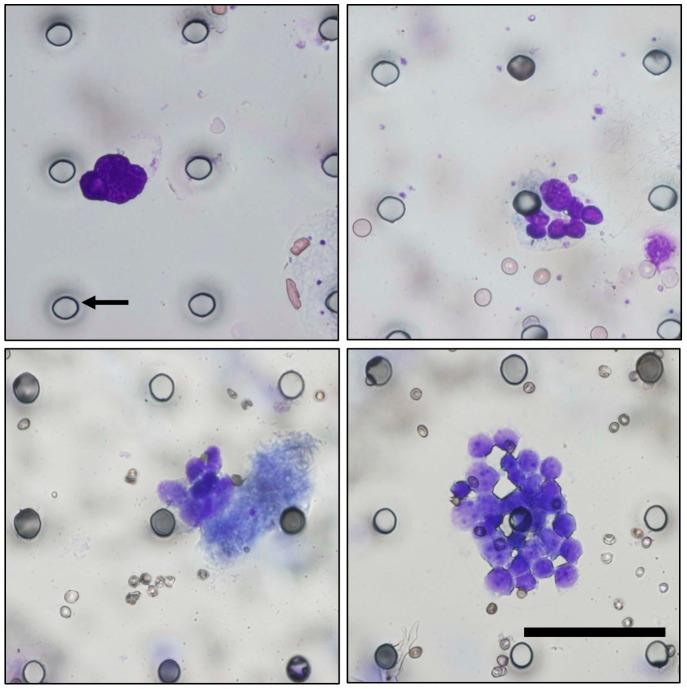
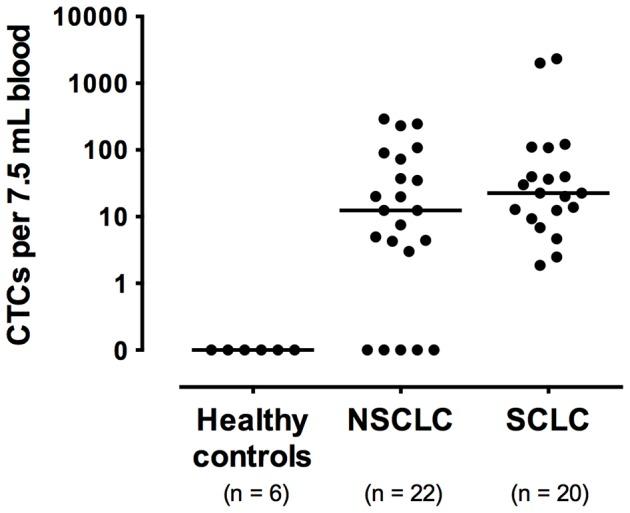
CTCs were detected in 17 of 22 NSCLC patients using the MCA system versus 7 of 22 patients using the CellSearch system. On the other hand, CTCs were detected in 20 of 21 small cell lung cancer (SCLC) patients using the MCA system versus 12 of 21 patients using the CellSearch system. Significantly more CTCs in NSCLC patients were detected by the MCA system (median 13, range 0-291 cells/7.5 mL) than by the CellSearch system (median 0, range 0-37 cells/7.5 ml) demonstrating statistical superiority (p = 0.0015). Statistical significance was not reached in SCLC though the trend favoring the MCA system over the CellSearch system was observed (p = 0.2888). The MCA system also isolated CTC clusters from patients who had been identified as CTC negative using the CellSearch system.
CONCLUSIONS
The MCA system has a potential to isolate significantly more CTCs and CTC clusters in advanced lung cancer patients compared to the CellSearch system.
背景
上皮细胞黏附分子(EpCAM)计数循环肿瘤细胞(CTC)在乳腺癌、结肠癌和前列腺癌等实体瘤患者中有预后价值。然而,非小细胞肺癌(NSCLC)的检测灵敏度较差。为了解决这个问题,我们开发了一种微腔阵列(MCA)系统,该系统集成了一种小型设备,用于 CTC 分离,而不依赖于 EpCAM 的表达。在这里,我们报告了一项针对晚期肺癌患者 CTC 的临床研究结果,我们将 MCA 系统与 CellSearch 系统进行了比较,后者采用了传统的基于 EpCAM 的方法。
方法
对 43 名转移性肺癌患者的配对外周血样本进行采集,使用 CellSearch 系统按照制造商的方案和 MCA 系统通过免疫标记和细胞形态学分析来计数 CTC。通过这两个系统进行盲法和独立评估 CTC 的存在。
结果
MCA 系统在 22 名 NSCLC 患者中检测到 17 名患者存在 CTC,而 CellSearch 系统在 22 名患者中检测到 7 名患者存在 CTC。另一方面,MCA 系统在 21 名小细胞肺癌(SCLC)患者中检测到 20 名患者存在 CTC,而 CellSearch 系统在 21 名患者中检测到 12 名患者存在 CTC。与 CellSearch 系统相比,MCA 系统在 NSCLC 患者中检测到的 CTC 明显更多(中位数 13,范围 0-291 个细胞/7.5 毫升),具有统计学优势(p=0.0015)。尽管观察到 MCA 系统优于 CellSearch 系统的趋势,但在 SCLC 中未达到统计学意义(p=0.2888)。MCA 系统还从使用 CellSearch 系统被确定为 CTC 阴性的患者中分离出 CTC 簇。
结论
与 CellSearch 系统相比,MCA 系统在晚期肺癌患者中具有分离出更多 CTC 和 CTC 簇的潜力。

 Zotero 插件