
3Omics:一个基于网络的系统生物学工具,用于分析、整合和可视化人类转录组学、蛋白质组学和代谢组学数据。
3Omics: a web-based systems biology tool for analysis, integration and visualization of human transcriptomic, proteomic and metabolomic data.
作者信息
Kuo Tien-Chueh, Tian Tze-Feng, Tseng Yufeng Jane
机构信息
Graduate Institute of Biomedical Electronics and Bioinformatics, National Taiwan University, Taipei, Taiwan.
出版信息
BMC Syst Biol. 2013 Jul 23;7:64. doi: 10.1186/1752-0509-7-64.
BACKGROUND
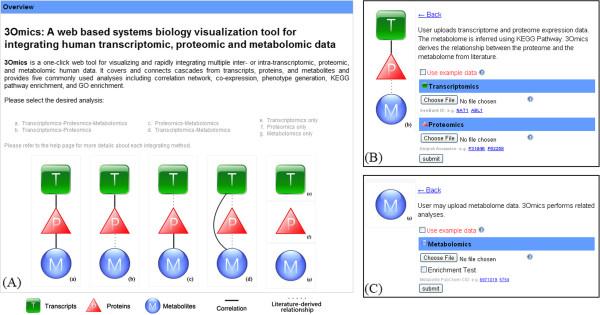
Integrative and comparative analyses of multiple transcriptomics, proteomics and metabolomics datasets require an intensive knowledge of tools and background concepts. Thus, it is challenging for users to perform such analyses, highlighting the need for a single tool for such purposes. The 3Omics one-click web tool was developed to visualize and rapidly integrate multiple human inter- or intra-transcriptomic, proteomic, and metabolomic data by combining five commonly used analyses: correlation networking, coexpression, phenotyping, pathway enrichment, and GO (Gene Ontology) enrichment.
RESULTS
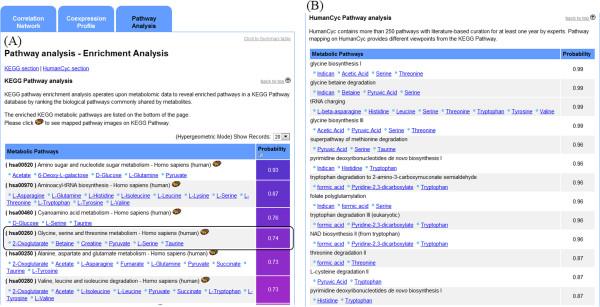
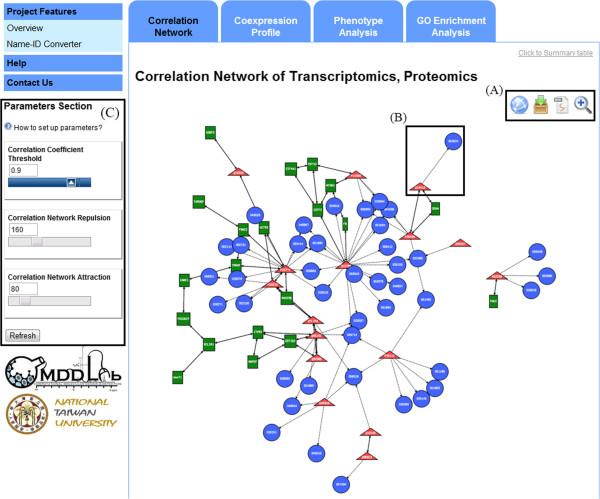
3Omics generates inter-omic correlation networks to visualize relationships in data with respect to time or experimental conditions for all transcripts, proteins and metabolites. If only two of three omics datasets are input, then 3Omics supplements the missing transcript, protein or metabolite information related to the input data by text-mining the PubMed database. 3Omics' coexpression analysis assists in revealing functions shared among different omics datasets. 3Omics' phenotype analysis integrates Online Mendelian Inheritance in Man with available transcript or protein data. Pathway enrichment analysis on metabolomics data by 3Omics reveals enriched pathways in the KEGG/HumanCyc database. 3Omics performs statistical Gene Ontology-based functional enrichment analyses to display significantly overrepresented GO terms in transcriptomic experiments. Although the principal application of 3Omics is the integration of multiple omics datasets, it is also capable of analyzing individual omics datasets. The information obtained from the analyses of 3Omics in Case Studies 1 and 2 are also in accordance with comprehensive findings in the literature.
CONCLUSIONS
3Omics incorporates the advantages and functionality of existing software into a single platform, thereby simplifying data analysis and enabling the user to perform a one-click integrated analysis. Visualization and analysis results are downloadable for further user customization and analysis. The 3Omics software can be freely accessed at http://3omics.cmdm.tw.
背景
对多个转录组学、蛋白质组学和代谢组学数据集进行综合和比较分析需要深入了解相关工具和背景概念。因此,用户进行此类分析具有挑战性,这凸显了为此目的开发单一工具的必要性。3Omics一键式网络工具旨在通过结合相关性网络分析、共表达分析、表型分析、通路富集分析和基因本体(GO)富集分析这五种常用分析方法,对多种人类转录组间或转录组内、蛋白质组和代谢组数据进行可视化并快速整合。
结果
3Omics生成组学间相关性网络,以可视化所有转录本、蛋白质和代谢物在时间或实验条件方面的数据关系。如果仅输入三个组学数据集中的两个,那么3Omics会通过对PubMed数据库进行文本挖掘,补充与输入数据相关的缺失转录本、蛋白质或代谢物信息。3Omics的共表达分析有助于揭示不同组学数据集之间共享的功能。3Omics的表型分析将《人类孟德尔遗传在线》与可用的转录本或蛋白质数据整合在一起。3Omics对代谢组学数据进行的通路富集分析揭示了KEGG/人类代谢途径数据库中富集的通路。3Omics基于基因本体进行统计功能富集分析,以显示转录组实验中显著过度表达的GO术语。尽管3Omics的主要应用是整合多个组学数据集,但它也能够分析单个组学数据集。在案例研究1和2中从3Omics分析获得的信息也与文献中的综合研究结果一致。
结论
3Omics将现有软件的优点和功能整合到一个单一平台中,从而简化了数据分析,并使用户能够进行一键式综合分析。可视化和分析结果可下载,以供用户进一步定制和分析。可通过http://3omics.cmdm.tw免费访问3Omics软件。


 Zotero 插件