
在应激和正常条件下酵母细胞中线粒体动力学的作用。
Roles of mitochondrial dynamics under stressful and normal conditions in yeast cells.
机构信息
Belozersky Institute of Physico-Chemical Biology, Moscow State University, Vorobyevy Gory 1, Moscow 119992, Russia.
出版信息
Oxid Med Cell Longev. 2013;2013:139491. doi: 10.1155/2013/139491. Epub 2013 Jul 14.
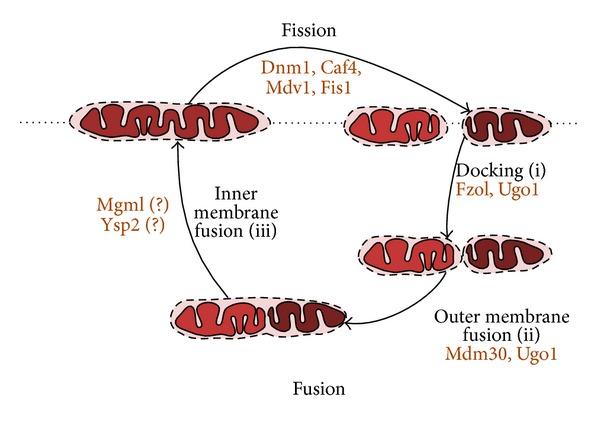
Eukaryotic cells contain dynamic mitochondrial filaments: they fuse and divide. Here we summarize data on the protein machinery driving mitochondrial dynamics in yeast and also discuss the factors that affect the fusion-fission balance. Fission is a general stress response of cells, and in the case of yeast this response appears to be prosurvival. At the same time, even under normal conditions yeast mitochondria undergo continuous cycles of fusion and fission. This seems to be a futile cycle and also expensive from the energy point of view. Why does it exist? Benefits might be the same as in the case of sexual reproduction. Indeed, mixing and separating of mitochondrial content allows mitochondrial DNA to segregate and recombine randomly, leading to high variation in the numbers of mutations per individual mitochondrion. This opens a possibility for effective purifying selection-elimination of mitochondria highly contaminated by deleterious mutations. The beneficial action presumes a mechanism for removal of defective mitochondria. We argue that selective mitochondrial autophagy or asymmetrical distribution of mitochondria during cell division could be at the core of such mechanism.
真核细胞含有动态的线粒体丝
它们融合和分裂。在这里,我们总结了驱动酵母中线粒体动力学的蛋白质机制的数据,并讨论了影响融合-分裂平衡的因素。分裂是细胞的一般应激反应,而在酵母的情况下,这种反应似乎是有利于生存的。同时,即使在正常条件下,酵母线粒体也经历着不断的融合和分裂循环。这似乎是一种徒劳的循环,从能量的角度来看也是昂贵的。它为什么存在?好处可能与有性生殖相同。事实上,线粒体内容的混合和分离允许线粒体 DNA 随机分离和重组,导致每个线粒体个体中突变数量的高度变异。这为有效的净化选择——消除受有害突变严重污染的线粒体提供了可能性。有益的作用假定了一种去除有缺陷线粒体的机制。我们认为,选择性的线粒体自噬或细胞分裂过程中线粒体的不对称分布可能是这种机制的核心。

 Zotero 插件