
评价三种人细胞系中来自复印机的纳米颗粒的细胞毒性、遗传毒性和炎症反应。
Evaluation of cytotoxic, genotoxic and inflammatory responses of nanoparticles from photocopiers in three human cell lines.
机构信息
Department of Work Environment, One University Avenue, University of Massachusetts Lowell, Lowell, MA 0185, USA.
出版信息
Part Fibre Toxicol. 2013 Aug 22;10:42. doi: 10.1186/1743-8977-10-42.
BACKGROUND
Photocopiers emit nanoparticles with complex chemical composition. Short-term exposures to modest nanoparticle concentrations triggered upper airway inflammation and oxidative stress in healthy human volunteers in a recent study. To further understand the toxicological properties of copier-emitted nanoparticles, we studied in-vitro their ability to induce cytotoxicity, pro-inflammatory cytokine release, DNA damage, and apoptosis in relevant human cell lines.
METHODS
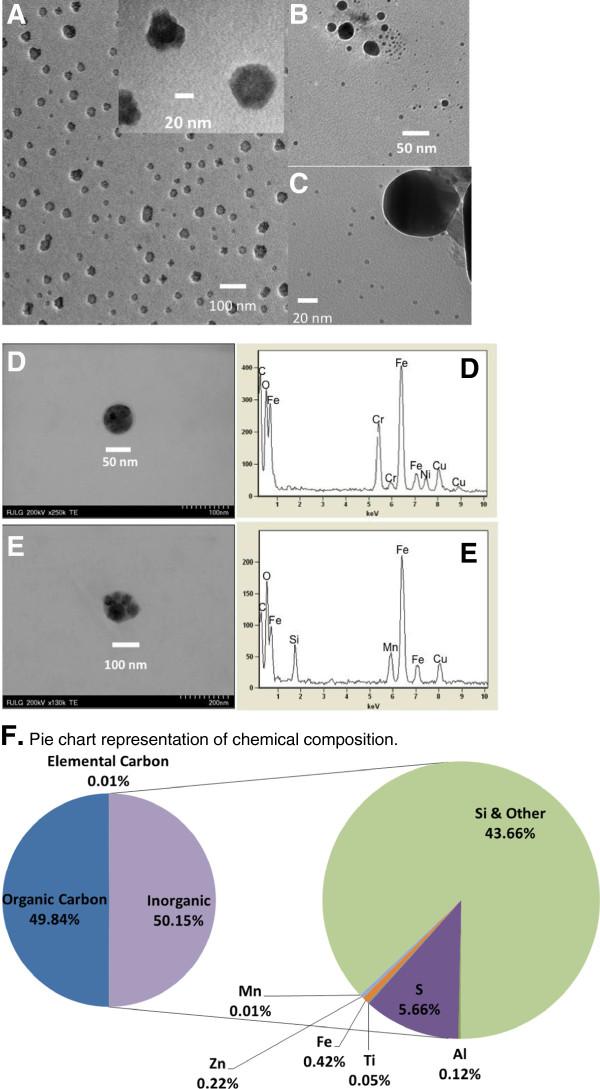
Three cell types were used: THP-1, primary human nasal- and small airway epithelial cells. Following collection in a large volume photocopy center, nanoparticles were extracted, dispersed and characterized in the cell culture medium. Cells were doped at 30, 100 and 300 μg/mL administered doses for up to 24 hrs. Estimated dose delivered to cells, was ~10% and 22% of the administered dose at 6 and 24 hrs, respectively. Gene expression analysis of key biomarkers was performed using real time quantitative PCR (RT-qPCR) in THP-1 cells at 5 μg nanoparticles/mL for 6-hr exposure for confirmation purposes.
RESULTS
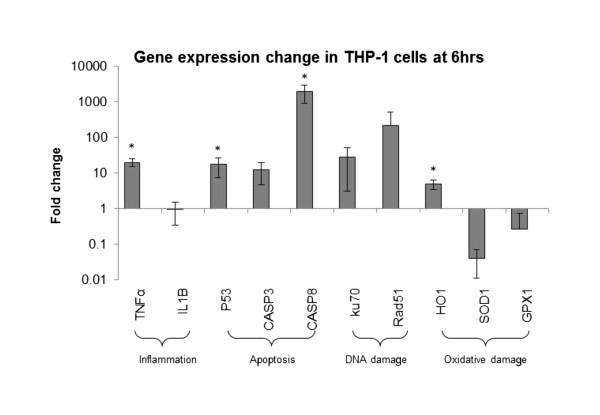
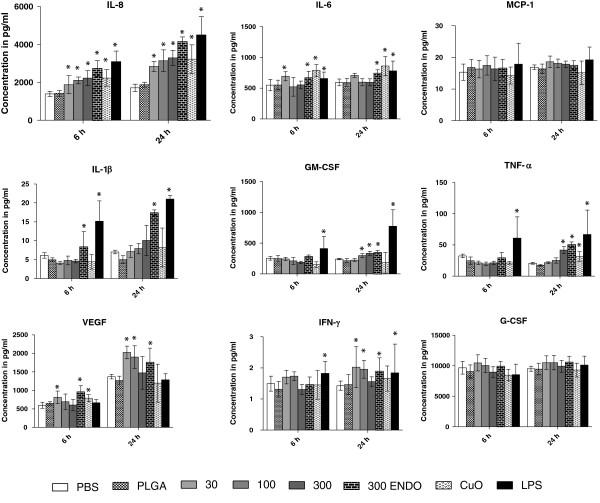
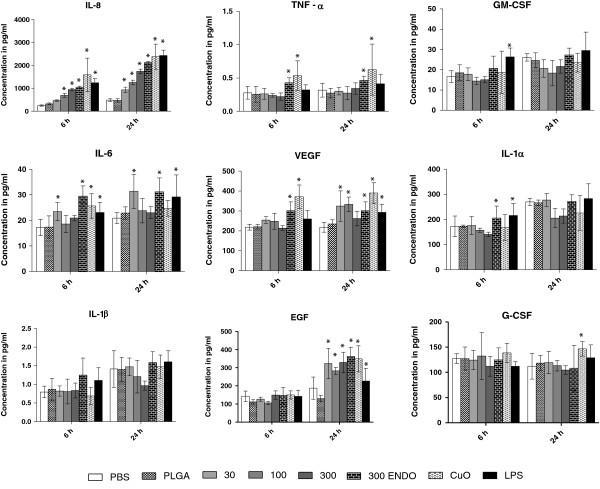
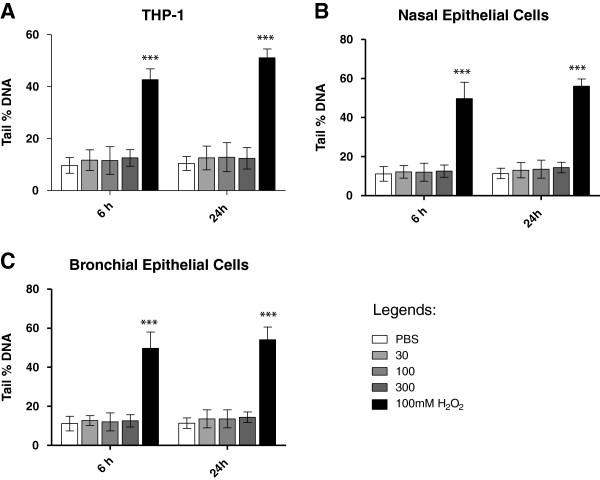
Multiple cytokines, GM-CSF, IL-1β, IL-6, IL-8, IFNγ, MCP-1, TNF-α and VEGF, were significantly elevated in THP-1 cells in a dose-dependent manner. Gene expression analysis confirmed up-regulation of the TNF-α gene in THP-1 cells, consistent with cytokine findings. In both primary epithelial cells, cytokines IL-8, VEGF, EGF, IL-1α, TNF-α, IL-6 and GM-CSF were significantly elevated. Apoptosis was induced in all cell lines in a dose-dependent manner, consistent with the significant up-regulation of key apoptosis-regulating genes P53 and Casp8 in THP-1 cells. No significant DNA damage was found at any concentration with the comet assay. Up-regulation of key DNA damage and repair genes, Ku70 and Rad51, were also observed in THP-1 cells, albeit not statistically significant. Significant up-regulation of the key gene HO1 for oxidative stress, implicates oxidative stress induced by nanoparticles.
CONCLUSIONS
Copier-emitted nanoparticles induced the release of pro-inflammatory cytokines, apoptosis and modest cytotoxicity but no DNA damage in all three-human cell lines. Taken together with gene expression data in THP-1 cells, we conclude that these nanoparticles are directly responsible for inflammation observed in human volunteers. Further toxicological evaluations of these nanoparticles, including across different toner formulations, are warranted.
背景
复印机排放的纳米颗粒具有复杂的化学成分。最近的一项研究表明,健康的人类志愿者在短期暴露于适度的纳米颗粒浓度下,会引发上呼吸道炎症和氧化应激。为了进一步了解复印机排放的纳米颗粒的毒理学特性,我们研究了它们在体外诱导细胞毒性、促炎细胞因子释放、DNA 损伤和细胞凋亡的能力,使用了三种细胞类型:THP-1 细胞、原代人鼻腔和小气道上皮细胞。在大型复印机中心收集纳米颗粒后,将其提取、分散并在细胞培养液中进行了表征。细胞以 30、100 和 300μg/mL 的给药剂量处理 24 小时。在 6 和 24 小时时,估计细胞内的有效剂量分别为给药剂量的 10%和 22%。为了验证目的,使用实时定量 PCR(RT-qPCR)在 THP-1 细胞中进行了关键生物标志物的基因表达分析,结果:GM-CSF、IL-1β、IL-6、IL-8、IFNγ、MCP-1、TNF-α和 VEGF 等多种细胞因子在 THP-1 细胞中呈剂量依赖性显著升高。THP-1 细胞的 TNF-α基因表达分析证实了该基因的上调,与细胞因子的发现一致。在两种原代上皮细胞中,细胞因子 IL-8、VEGF、EGF、IL-1α、TNF-α、IL-6 和 GM-CSF 均显著升高。细胞凋亡在所有细胞系中均呈剂量依赖性诱导,与 THP-1 细胞中关键凋亡调节基因 P53 和 Casp8 的显著上调一致。彗星试验未发现任何浓度的明显 DNA 损伤。THP-1 细胞中关键 DNA 损伤和修复基因 Ku70 和 Rad51 的上调也被观察到,但没有统计学意义。关键基因 HO1 的上调表明纳米颗粒诱导了氧化应激。结论:复印机排放的纳米颗粒在三种人类细胞系中诱导了促炎细胞因子的释放、细胞凋亡和适度的细胞毒性,但没有 DNA 损伤。结合 THP-1 细胞中的基因表达数据,我们得出结论,这些纳米颗粒直接导致了人类志愿者中观察到的炎症。需要进一步对这些纳米颗粒进行毒理学评估,包括不同的碳粉配方。




 Zotero 插件