
KCNQ2 基因突变对 M 型 Kv7 钾电流的影响。
Effects of KCNQ2 gene truncation on M-type Kv7 potassium currents.
机构信息
Wolfson Centre for Age Related Disease, King's College London, London, United Kingdom.
出版信息
PLoS One. 2013 Aug 20;8(8):e71809. doi: 10.1371/journal.pone.0071809. eCollection 2013.
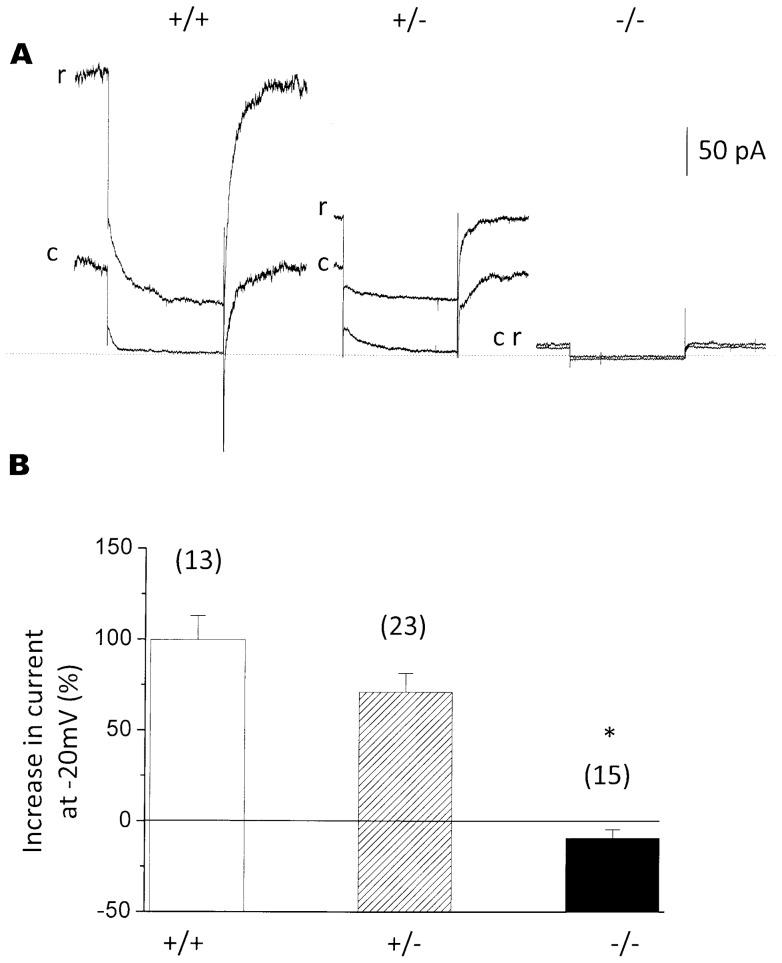
The KCNQ2 gene product, Kv7.2, is a subunit of the M-channel, a low-threshold voltage-gated K(+) channel that regulates mammalian and human neuronal excitability. Spontaneous mutations one of the KCNQ2 genes cause disorders of neural excitability such as Benign Familial Neonatal Seizures. However there appear to be no reports in which both human KCNQ2 genes are mutated. We therefore asked what happens to M-channel function when both KCNQ2 genes are disrupted. We addressed this using sympathetic neurons isolated from mice in which the KCNQ2 gene was truncated at a position corresponding to the second transmembrane domain of the Kv7.2 protein. Since homozygote KCNQ2-/- mice die postnatally, experiments were largely restricted to neurons from late embryos. Quantitative PCR revealed an absence of KCNQ2 mRNA in ganglia from KCNQ2-/- embryos but 100-120% increase of KCNQ3 and KCNQ5 mRNAs; KCNQ2+/- ganglia showed ∼30% less KCNQ2 mRNA than wild-type (+/+) ganglia but 40-50% more KCNQ3 and KCNQ5 mRNA. Neurons from KCNQ2-/- embryos showed a complete absence of M-current, even after applying the Kv7 channel enhancer, retigabine. Neurons from heterozygote KCNQ2+/- embryos had ∼60% reduced M-current. In contrast, M-currents in neurons from adult KCNQ2+/- mice were no smaller than those in neurons from wild-type mice. Measurements of tetraethylammonium block did not indicate an increased expression of Kv7.5-containing subunits, implying a compensatory increase in Kv7.2 expression from the remaining KCNQ2 gene. We conclude that mouse embryonic M-channels have an absolute requirement for Kv7.2 subunits for functionality, that the reduced M-channel activity in heterozygote KCNQ2+/- mouse embryos results primarily from a gene-dosage effect, and that there is a compensatory increase in Kv7.2 expression in adult mice.
KCNQ2 基因产物 Kv7.2 是 M 通道的亚基,M 通道是一种低阈值电压门控 K(+)通道,调节哺乳动物和人类神经元的兴奋性。KCNQ2 基因之一的自发突变会导致神经兴奋性障碍,如良性家族性新生儿癫痫。然而,似乎没有报道称两个 KCNQ2 基因都发生了突变。因此,我们想知道当两个 KCNQ2 基因都被破坏时,M 通道的功能会发生什么变化。我们使用在 Kv7.2 蛋白的第二个跨膜结构域处被截断的 KCNQ2 基因的小鼠分离出的交感神经元来解决这个问题。由于纯合子 KCNQ2-/- 小鼠在出生后死亡,因此实验主要限于晚期胚胎的神经元。定量 PCR 显示 KCNQ2-/- 胚胎神经节中没有 KCNQ2 mRNA,但 KCNQ3 和 KCNQ5 mRNA 增加了 100-120%;KCNQ2+/- 神经节中的 KCNQ2 mRNA 比野生型 (+/+) 神经节少 30%,但 KCNQ3 和 KCNQ5 mRNA 多 40-50%。KCNQ2-/- 胚胎的神经元甚至在应用 Kv7 通道增强剂 retigabine 后也完全没有 M 电流。KCNQ2+/- 胚胎神经元的 M 电流减少了约 60%。相比之下,成年 KCNQ2+/- 小鼠神经元的 M 电流与野生型小鼠神经元的 M 电流没有差异。四乙铵阻断测量并未表明含有 Kv7.5 的亚基表达增加,这意味着剩余 KCNQ2 基因的 Kv7.2 表达代偿性增加。我们得出结论,小鼠胚胎 M 通道的功能绝对需要 Kv7.2 亚基,杂合子 KCNQ2+/- 小鼠胚胎中 M 通道活性降低主要是由于基因剂量效应,并且在成年小鼠中 Kv7.2 表达代偿性增加。


 Zotero 插件