
日本 2 型糖尿病发病率的系统评价和荟萃分析。
Incidence of type 2 diabetes in Japan: a systematic review and meta-analysis.
机构信息
Department of Diabetes Research, Diabetes Research Center, National Center for Global Health and Medicine, Tokyo, Japan.
出版信息
PLoS One. 2013 Sep 6;8(9):e74699. doi: 10.1371/journal.pone.0074699. eCollection 2013.
BACKGROUND
The definition of incident type 2 diabetes varies across studies; hence, the actual incidence of type 2 diabetes in Japan is unclear. Here, we reviewed the various definitions of incident type 2 diabetes used in previous epidemiologic studies and estimated the diabetes incidence rate in Japan.
METHODS
We searched for related literature in the MEDLINE, EMBASE, and Ichushi databases through September 2012. Two reviewers selected studies that evaluated incident type 2 diabetes in the Japanese population.
RESULTS
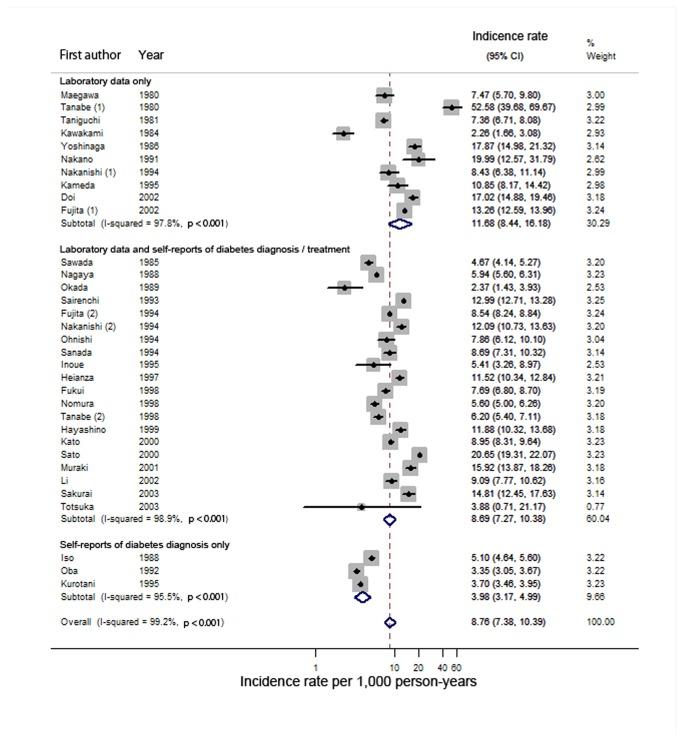
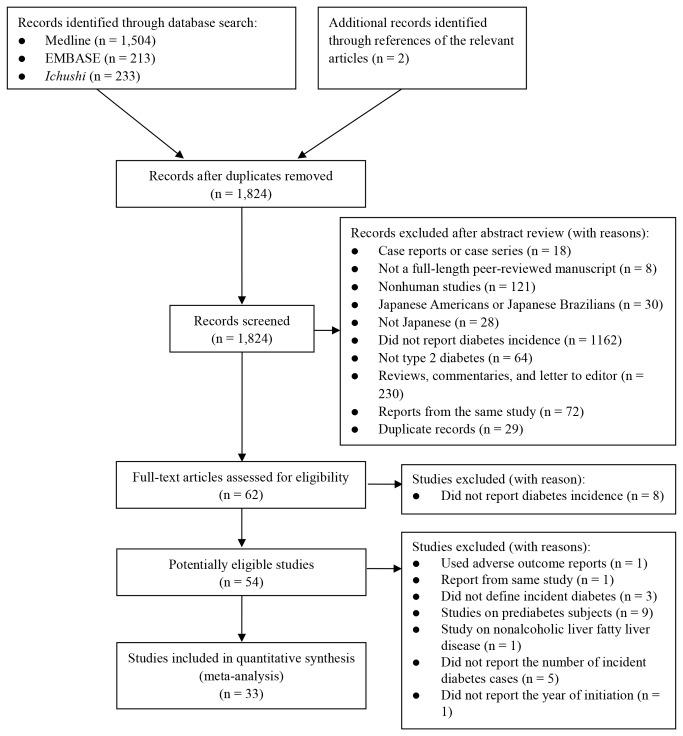
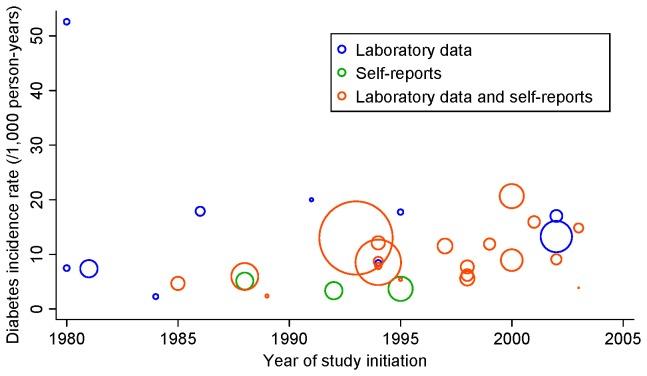
From 1824 relevant articles, we included 33 studies with 386,803 participants. The follow-up period ranged from 2.3 to 14 years and the studies were initiated between 1980 and 2003. The random-effects model indicated that the pooled incidence rate of diabetes was 8.8 (95% confidence interval, 7.4-10.4) per 1000 person-years. We observed a high degree of heterogeneity in the results (I(2) = 99.2%; p < 0.001), with incidence rates ranging from 2.3 to 52.6 per 1000 person-years. Three studies based their definition of incident type 2 diabetes on self-reports only, 10 on laboratory data only, and 20 on self-reports and laboratory data. Compared with studies defining diabetes using laboratory data (n = 30; pooled incidence rate = 9.6; 95% confidence interval = 8.3-11.1), studies based on self-reports alone tended to show a lower incidence rate (n = 3; pooled incidence rate = 4.0; 95% confidence interval = 3.2-5.0; p for interaction < 0.001). However, stratified analyses could not entirely explain the heterogeneity in the results.
CONCLUSIONS
Our systematic review and meta-analysis indicated the presence of a high degree of heterogeneity, which suggests that there is a considerable amount of uncertainty regarding the incidence of type 2 diabetes in Japan. They also suggested that laboratory data may be important for the accurate estimation of the incidence of type 2 diabetes.
背景
2 型糖尿病的发病类型在不同的研究中有所不同;因此,日本 2 型糖尿病的实际发病率尚不清楚。在这里,我们回顾了以往流行病学研究中使用的各种 2 型糖尿病发病类型的定义,并估计了日本的糖尿病发病率。
方法
我们通过 MEDLINE、EMBASE 和 Ichushi 数据库检索了截至 2012 年 9 月的相关文献。两名评审员选择了评估日本人群 2 型糖尿病发病情况的研究。
结果
从 1824 篇相关文章中,我们纳入了 33 项研究,共计 386803 名参与者。随访时间从 2.3 年到 14 年不等,研究开始时间为 1980 年至 2003 年。随机效应模型显示,糖尿病的累积发病率为 8.8(95%置信区间:7.4-10.4)/1000 人年。结果存在高度异质性(I²=99.2%;p<0.001),发病率范围为 2.3-52.6/1000 人年。有 3 项研究仅基于自我报告来定义 2 型糖尿病发病,10 项研究仅基于实验室数据,20 项研究同时基于自我报告和实验室数据。与使用实验室数据定义糖尿病的研究(n=30;累积发病率=9.6;95%置信区间:8.3-11.1)相比,仅基于自我报告的研究往往显示出较低的发病率(n=3;累积发病率=4.0;95%置信区间:3.2-5.0;p 交互作用<0.001)。然而,分层分析并不能完全解释结果的异质性。
结论
我们的系统评价和荟萃分析表明,存在高度异质性,这表明日本 2 型糖尿病的发病率存在很大的不确定性。它们还表明,实验室数据对于准确估计 2 型糖尿病的发病率可能很重要。
 Zotero 插件