
沙特阿拉伯成人创伤性脑损伤的原因及模式:对伤害预防的启示
Causes and patterns of adult traumatic head injuries in Saudi Arabia: implications for injury prevention.
作者信息
Al-Habib Amro, A-Shail Abdulaziz, Alaqeel Ahmed, Zamakhshary Mohammed, Al-Bedah Khalid, Alqunai Mansur, Al-Enazi Saleem
机构信息
Dr. Ahmed Alqeel, King Saud University,, Division of Neurosurgery,, Department of Surgery,, College of Medicine, 285136, Riyadh 11323 Saudi Arabia,
出版信息
Ann Saudi Med. 2013 Jul-Aug;33(4):351-5. doi: 10.5144/0256-4947.2013.351.
BACKGROUND AND OBJECTIVES
Data on the epidemiology of traumatic head injuries (THI) is essential for any organized prevention program. Such data are few in the developing world. Our primary goal was to study the causes, descriptive features, and outcomes of THI in adults in Saudi Arabia.
DESIGN AND SETTINGS
The present study is a retrospective review.
METHODS
This retrospective review included all consecutive cases of adults with THI ( > 18 years) who were admitted to a major trauma centre in Riyadh, Saudi Arabia, from May 2001 to July 2010. Patients were identified through a trauma database, which includes cases that required hospital admission or died in the emergency department.
RESULTS
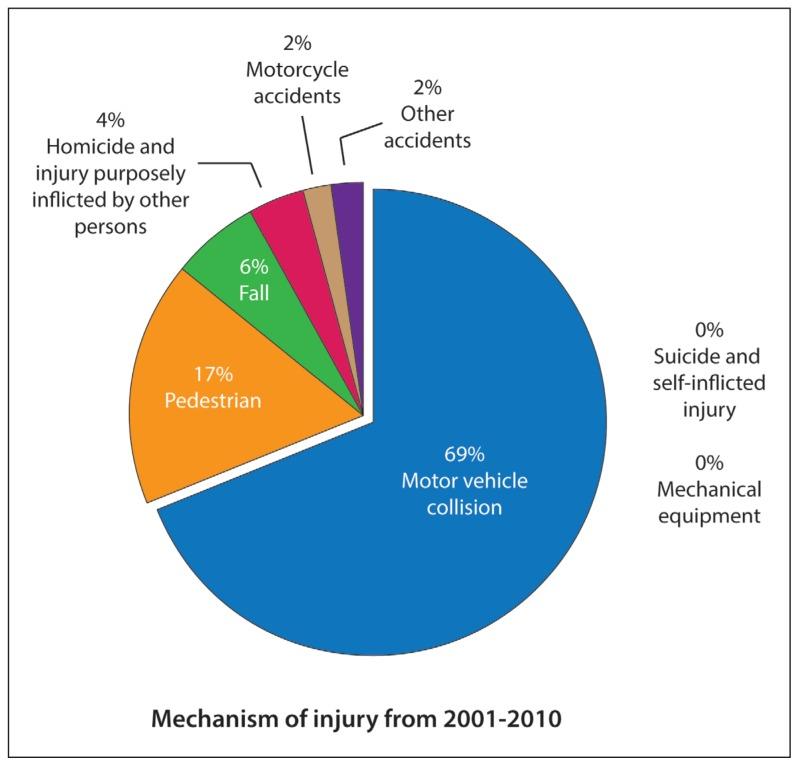
A total of 1870 patients met the inclusion criteria with a mean age of 32.6 years and a male predominance (91.2%). Most injuries were secondary to motor vehicle collisions (MVC; 69.4%). Pedestrian injuries were second (16.8%) and had 40% risk of mortality (odds ratio 0.62, 95% CI 0.48-0.8). Most patients (56.7%) had a severe THI (Glasgow coma score, GCS < 8). The overall mortality rate was 30%. Mortality was significantly associated with older age (P=.0001), lower GCS (P=.0001), and a higher injury severity score (ISS; P=.0001).
CONCLUSION
The most common causes of hospital admission following injury were MVC and pedestrian injuries. Both were also the most common causes for injury-related deaths. Safety on the roads should be the primary target for any organized injury prevention programs to be successful.
背景与目的
创伤性颅脑损伤(THI)的流行病学数据对于任何有组织的预防计划都至关重要。在发展中世界,此类数据很少。我们的主要目标是研究沙特阿拉伯成年人THI的病因、描述性特征及预后。
设计与环境
本研究为回顾性研究。
方法
这项回顾性研究纳入了2001年5月至2010年7月期间入住沙特阿拉伯利雅得一家主要创伤中心的所有连续成年THI患者(年龄>18岁)。通过创伤数据库识别患者,该数据库包括需要住院治疗或在急诊科死亡的病例。
结果
共有1870名患者符合纳入标准,平均年龄32.6岁,男性占主导(91.2%)。大多数损伤继发于机动车碰撞(MVC;69.4%)。行人受伤居第二位(16.8%),死亡率为40%(比值比0.62,95%置信区间0.48 - 0.8)。大多数患者(56.7%)患有重度THI(格拉斯哥昏迷评分,GCS<8)。总死亡率为30%。死亡率与年龄较大(P = 0.0001)、GCS较低(P = 0.0001)和损伤严重程度评分较高(ISS;P = 0.0001)显著相关。
结论
受伤后住院的最常见原因是MVC和行人受伤。这两者也是与损伤相关死亡的最常见原因。道路安全应成为任何成功的有组织损伤预防计划的主要目标。
 Zotero 插件