
生存素多态性与肿瘤易感性的关联:荟萃分析。
Association of survivin polymorphisms with tumor susceptibility: a meta-analysis.
机构信息
Department of Forensic Medicine, Faculty of Basic Medical Sciences, Chongqing Medical University, Chongqing, China.
出版信息
PLoS One. 2013 Sep 30;8(9):e74778. doi: 10.1371/journal.pone.0074778. eCollection 2013.
BACKGROUND
The survivin polymorphisms have been shown to confer genetic susceptibility to various tumors, but the results are inconsistent. In order to accomplish a more precise estimation of the relationship, a meta-analysis was performed.
RESULTS
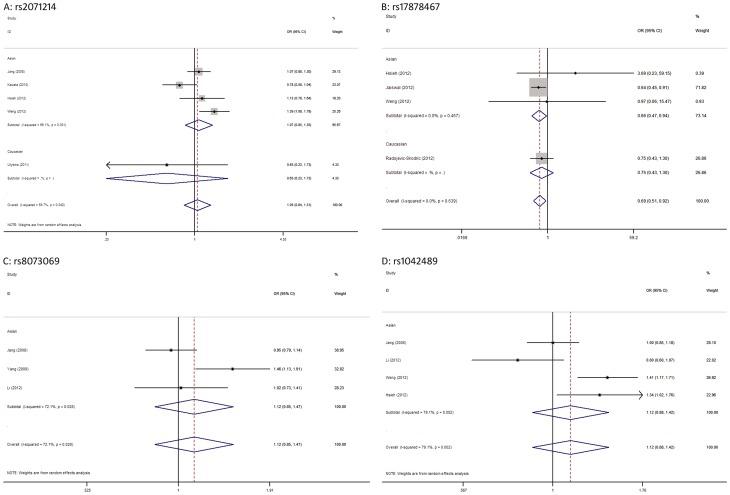
For rs9904341, a significantly increased tumor risk was found in overall meta-analysis under C/C vs. G/G (OR = 1.40, 95% CI = 1.13-1.74, p = 0.002), dominant (OR = 1.18, 95% CI = 1.01-1.38, p = 0.039) and recessive (OR = 1.34, 95% CI = 1.13-1.58, p = 0.001) genetic models and Asians group. In subgroup analyses of tumor types, we found a significant association between this SNP and an increased risk of gastric, colorectal, bladder and other tumors as well as a decreased risk of hepatocellular cancer. For rs17878467, a significantly decreased tumor risk was identified in overall meta-analysis for allele contrast (T vs. C: OR = 0.69, 95% CI = 0.51-0.92, p = 0.012), C/T vs. C/C (OR = 0.61, 95% CI = 0.42-0.88, p = 0.009) and dominant (OR = 0.62, 95% CI = 0.43-0.88, p = 0.007) genetic models and Asians group. For rs2071214, we found a significant association between this SNP and an increased tumor risk in overall meta-analysis under G/G vs. A/A (OR = 1.51, 95% CI = 1.04-2.18, p = 0.029) and recessive (OR = 1.54, 95% CI = 1.07-2.22, p = 0.020) genetic models and Asians group. Besides, there was a significant association of rs8073069 with an increased tumor risk under recessive genetic model (OR = 1.37, 95% CI = 1.01-1.84, p = 0.040), while no significant association between rs1042489 and tumor risk was detected.
CONCLUSIONS
The survivin rs9904341 most likely contributed to increased susceptibility to tumor in Asians as well as to gastric, colorectal and bladder cancers. As for rs17878467, the T allele might be a protective factor for tumor, especially in Asians. Moreover, the survivin rs8073069 and rs2071214 seemed to be associated with an increased tumor risk in Asians, while there was no association between the survivin rs1042489 and tumor risk.
背景
生存素多态性已被证明与各种肿瘤的遗传易感性有关,但结果不一致。为了更准确地评估这种关系,我们进行了荟萃分析。
结果
对于 rs9904341,在总体荟萃分析中,C/C 与 G/G 相比(OR=1.40,95%CI=1.13-1.74,p=0.002)、显性(OR=1.18,95%CI=1.01-1.38,p=0.039)和隐性(OR=1.34,95%CI=1.13-1.58,p=0.001)遗传模型以及亚洲人群中,肿瘤风险显著增加。在肿瘤类型的亚组分析中,我们发现该 SNP 与胃癌、结直肠癌、膀胱癌等肿瘤的风险增加以及肝癌风险降低之间存在显著关联。对于 rs17878467,在总体荟萃分析中,等位基因对比(T 与 C:OR=0.69,95%CI=0.51-0.92,p=0.012)、C/T 与 C/C(OR=0.61,95%CI=0.42-0.88,p=0.009)和显性(OR=0.62,95%CI=0.43-0.88,p=0.007)遗传模型以及亚洲人群中,肿瘤风险显著降低。对于 rs2071214,我们发现该 SNP 与总体荟萃分析中 G/G 与 A/A 相比(OR=1.51,95%CI=1.04-2.18,p=0.029)和隐性(OR=1.54,95%CI=1.07-2.22,p=0.020)遗传模型以及亚洲人群中肿瘤风险增加之间存在显著关联。此外,rs8073069 与隐性遗传模型下的肿瘤风险增加之间存在显著关联(OR=1.37,95%CI=1.01-1.84,p=0.040),而 rs1042489 与肿瘤风险之间无显著关联。
结论
生存素 rs9904341 可能导致亚洲人群以及胃癌、结直肠癌和膀胱癌易患肿瘤,而 rs17878467 的 T 等位基因可能是肿瘤的保护因素,尤其是在亚洲人群中。此外,生存素 rs8073069 和 rs2071214 似乎与亚洲人群的肿瘤风险增加有关,而生存素 rs1042489 与肿瘤风险无关。


 Zotero 插件