
祖先二氯二苯基三氯乙烷 (DDT) 暴露促进肥胖的表观遗传跨代遗传。
Ancestral dichlorodiphenyltrichloroethane (DDT) exposure promotes epigenetic transgenerational inheritance of obesity.
机构信息
Center for Reproductive Biology, School of Biological Sciences, Washington State University, Pullman, WA 99164-4236, USA.
出版信息
BMC Med. 2013 Oct 23;11:228. doi: 10.1186/1741-7015-11-228.
BACKGROUND
Ancestral environmental exposures to a variety of environmental factors and toxicants have been shown to promote the epigenetic transgenerational inheritance of adult onset disease. The present work examined the potential transgenerational actions of the insecticide dichlorodiphenyltrichloroethane (DDT) on obesity and associated disease.
METHODS
Outbred gestating female rats were transiently exposed to a vehicle control or DDT and the F1 generation offspring bred to generate the F2 generation and F2 generation bred to generate the F3 generation. The F1 and F3 generation control and DDT lineage rats were aged and various pathologies investigated. The F3 generation male sperm were collected to investigate methylation between the control and DDT lineage male sperm.
RESULTS
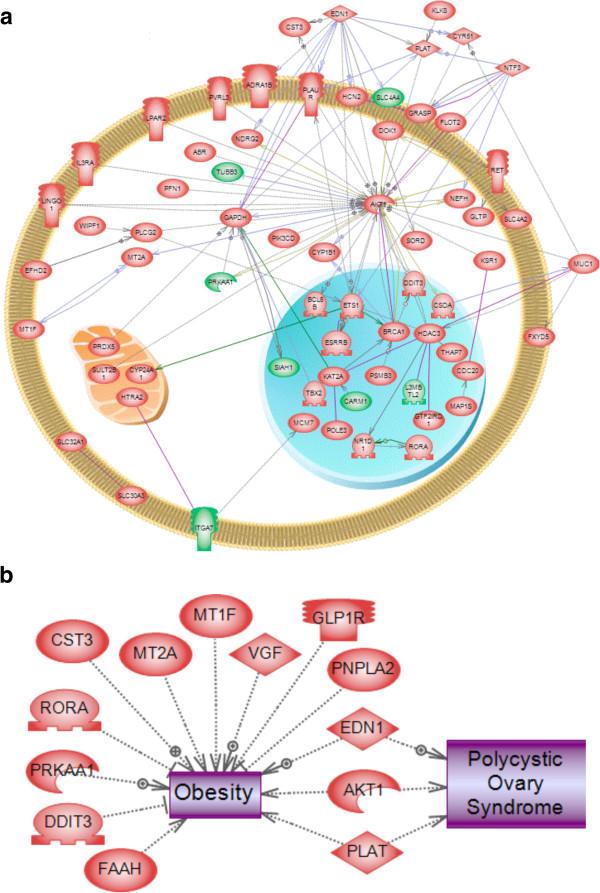
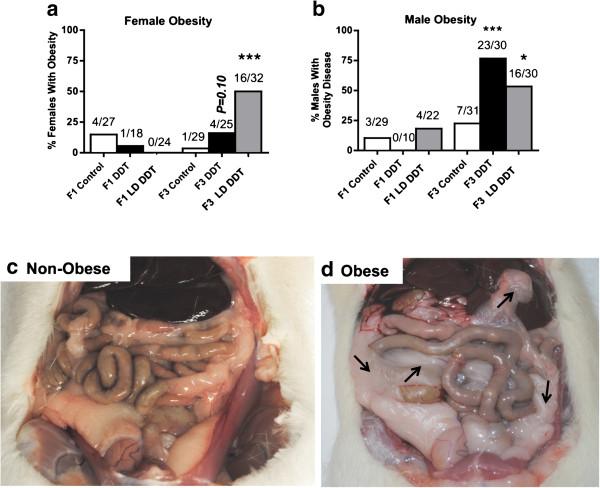
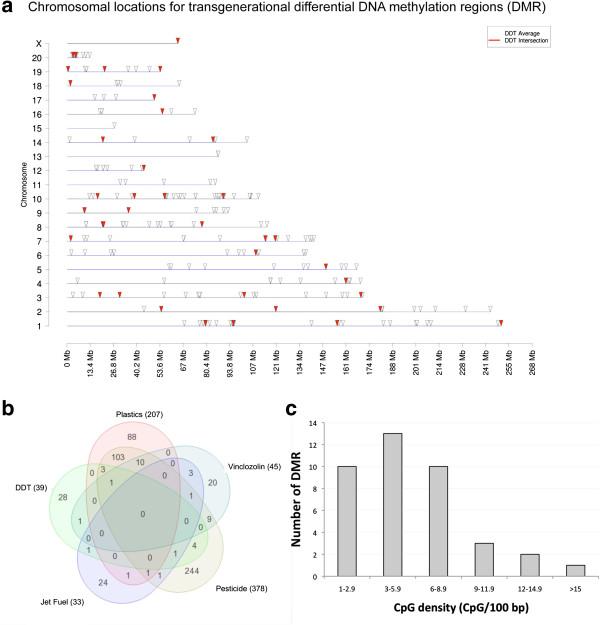
The F1 generation offspring (directly exposed as a fetus) derived from the F0 generation exposed gestating female rats were not found to develop obesity. The F1 generation DDT lineage animals did develop kidney disease, prostate disease, ovary disease and tumor development as adults. Interestingly, the F3 generation (great grand-offspring) had over 50% of males and females develop obesity. Several transgenerational diseases previously shown to be associated with metabolic syndrome and obesity were observed in the testis, ovary and kidney. The transgenerational transmission of disease was through both female (egg) and male (sperm) germlines. F3 generation sperm epimutations, differential DNA methylation regions (DMR), induced by DDT were identified. A number of the genes associated with the DMR have previously been shown to be associated with obesity.
CONCLUSIONS
Observations indicate ancestral exposure to DDT can promote obesity and associated disease transgenerationally. The etiology of disease such as obesity may be in part due to environmentally induced epigenetic transgenerational inheritance.
背景
多种环境因素和毒物的祖先环境暴露已被证明可促进成年发病的表观遗传跨代遗传。本研究探讨了杀虫剂滴滴涕(DDT)对肥胖症及相关疾病的潜在跨代作用。
方法
将杂交孕鼠短暂暴露于载体对照或 DDT 中,然后将 F1 代后代繁殖以产生 F2 代,再将 F2 代繁殖以产生 F3 代。对 F1 和 F3 代对照和 DDT 系大鼠进行老化,并研究各种病变。收集 F3 代雄性精子,以研究对照和 DDT 系雄性精子之间的甲基化。
结果
F1 代(作为胎儿直接暴露)后代未发现肥胖。F1 代 DDT 系动物成年后确实患有肾病、前列腺疾病、卵巢疾病和肿瘤发展。有趣的是,F3 代(曾孙代)有超过 50%的雄性和雌性出现肥胖。在睾丸、卵巢和肾脏中观察到几种与代谢综合征和肥胖相关的跨代疾病。疾病的跨代传播是通过雌性(卵子)和雄性(精子)生殖细胞。鉴定出由 DDT 诱导的 F3 代精子表观遗传突变、差异 DNA 甲基化区域(DMR)。与 DMR 相关的许多基因先前已被证明与肥胖有关。
结论
观察结果表明,祖先暴露于 DDT 可促进肥胖症及其相关疾病的跨代遗传。肥胖等疾病的病因部分可能是由于环境诱导的表观遗传跨代遗传。


 Zotero 插件