
采用贝叶斯网络方法评估 HLA-DRB1、INS-VNTR 和 PTPN22 基因与 1 型糖尿病风险的关联。
Assessment of type 1 diabetes risk conferred by HLA-DRB1, INS-VNTR and PTPN22 genes using the Bayesian network approach.
机构信息
Department of Endocrinology and Diabetes, University Campus Bio-Medico, Rome, Italy ; Department of Gynecology, University Campus Bio-Medico, Rome, Italy.
出版信息
PLoS One. 2013 Nov 18;8(11):e79506. doi: 10.1371/journal.pone.0079506. eCollection 2013.
BACKGROUND
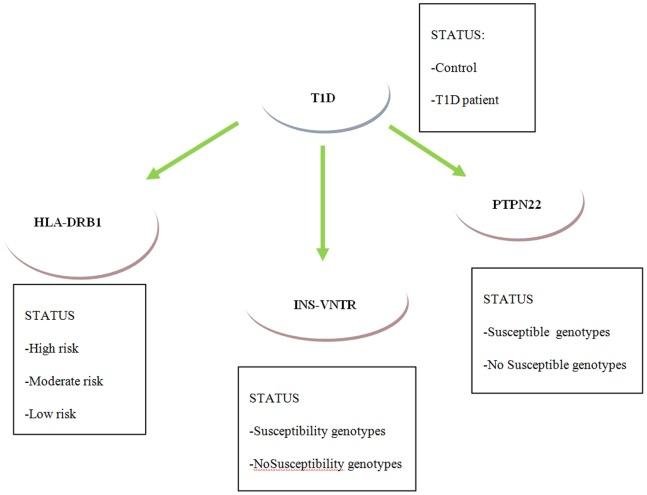
Determining genetic risk is a fundamental prerequisite for the implementation of primary prevention trials for type 1 diabetes (T1D). The aim of this study was to assess the risk conferred by HLA-DRB1, INS-VNTR and PTPN22 single genes on the onset of T1D and the joint risk conferred by all these three susceptibility loci using the Bayesian Network (BN) approach in both population-based case-control and family clustering data sets.
METHODOLOGY/PRINCIPAL FINDINGS: A case-control French cohort, consisting of 868 T1D patients and 73 French control subjects, a French family data set consisting of 1694 T1D patients and 2340 controls were analysed. We studied both samples separately applying the BN probabilistic approach, that is a graphical model that encodes probabilistic relationships among variables of interest. As expected HLA-DRB1 is the most relevant susceptibility gene. We proved that INS and PTPN22 genes marginally influence T1D risk in all risk HLA-DRB1 genotype categories. The absolute risk conferred by carrying simultaneously high, moderate or low risk HLA-DRB1 genotypes together with at risk INS and PTPN22 genotypes, was 11.5%, 1.7% and 0.1% in the case-control sample and 19.8%, 6.6% and 2.2% in the family cohort, respectively.
CONCLUSIONS/SIGNIFICANCE: This work represents, to the best of our knowledge, the first study based on both case-control and family data sets, showing the joint effect of HLA, INS and PTPN22 in a T1D Caucasian population with a wide range of age at T1D onset, adding new insights to previous findings regarding data sets consisting of patients and controls <15 years at onset.
背景
确定遗传风险是实施 1 型糖尿病(T1D)一级预防试验的基本前提。本研究旨在评估 HLA-DRB1、INS-VNTR 和 PTPN22 单基因对 T1D 发病的风险,并使用贝叶斯网络(BN)方法在基于人群的病例对照和家族聚类数据集评估所有这三个易感基因座的联合风险。
方法/主要发现:本研究分析了一个法国的病例对照队列,包含 868 名 T1D 患者和 73 名法国对照者,以及一个包含 1694 名 T1D 患者和 2340 名对照者的法国家族数据集。我们分别对这两个样本进行了分析,应用了 BN 概率方法,这是一种图形模型,可以编码感兴趣的变量之间的概率关系。正如预期的那样,HLA-DRB1 是最相关的易感基因。我们证明 INS 和 PTPN22 基因在所有高危 HLA-DRB1 基因型类别中都对 T1D 风险产生轻微影响。在病例对照样本中,同时携带高危、中危或低危 HLA-DRB1 基因型以及高危 INS 和 PTPN22 基因型的个体所面临的绝对风险分别为 11.5%、1.7%和 0.1%,在家族队列中分别为 19.8%、6.6%和 2.2%。
结论/意义:这项工作是首次基于病例对照和家族数据集的研究,证明了 HLA、INS 和 PTPN22 之间的联合作用在一个具有广泛 T1D 发病年龄的白种人 T1D 人群中,这为以前关于发病年龄<15 岁的患者和对照者数据集的发现提供了新的见解。
 Zotero 插件