
处理动态模型中的不确定性:布鲁氏锥虫戊糖磷酸途径。
Handling uncertainty in dynamic models: the pentose phosphate pathway in Trypanosoma brucei.
机构信息
Wellcome Trust Centre for Molecular Parasitology, Institute of Infection, Immunity and Inflammation and Glasgow Polyomics, College of Medical, Veterinary and Life Sciences, University of Glasgow, Glasgow, United Kingdom ; Systems and Synthetic Biology Group, Department of Chemical and Biological Engineering, Chalmers University of Technology, Gothenburg, Sweden.
出版信息
PLoS Comput Biol. 2013;9(12):e1003371. doi: 10.1371/journal.pcbi.1003371. Epub 2013 Dec 5.
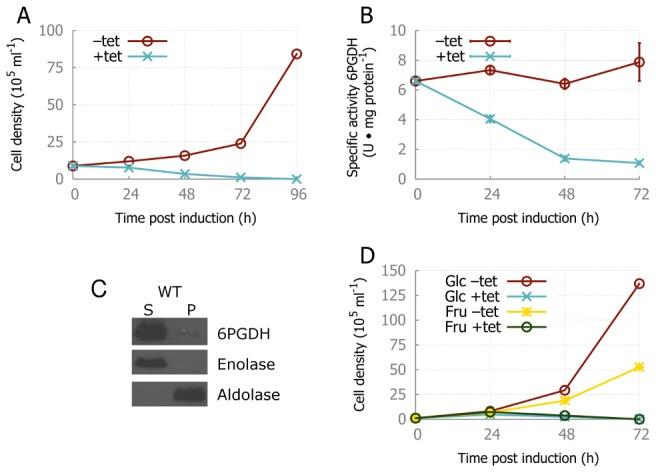
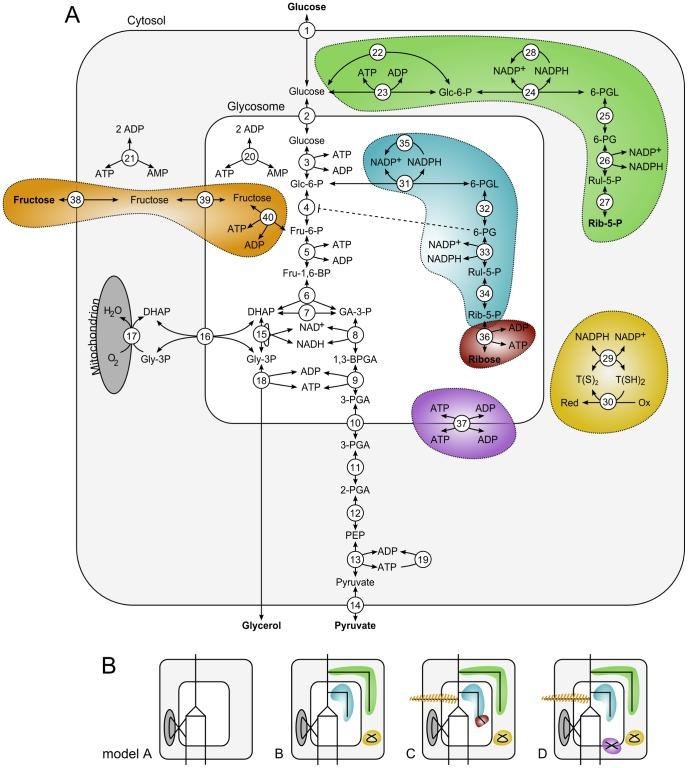
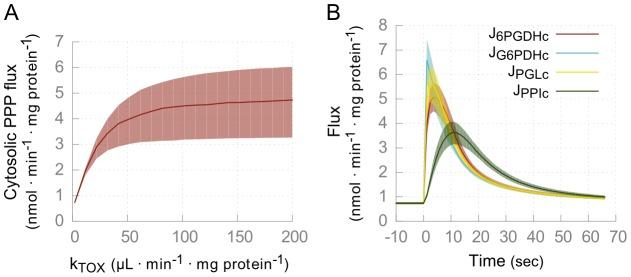
Dynamic models of metabolism can be useful in identifying potential drug targets, especially in unicellular organisms. A model of glycolysis in the causative agent of human African trypanosomiasis, Trypanosoma brucei, has already shown the utility of this approach. Here we add the pentose phosphate pathway (PPP) of T. brucei to the glycolytic model. The PPP is localized to both the cytosol and the glycosome and adding it to the glycolytic model without further adjustments leads to a draining of the essential bound-phosphate moiety within the glycosome. This phosphate "leak" must be resolved for the model to be a reasonable representation of parasite physiology. Two main types of theoretical solution to the problem could be identified: (i) including additional enzymatic reactions in the glycosome, or (ii) adding a mechanism to transfer bound phosphates between cytosol and glycosome. One example of the first type of solution would be the presence of a glycosomal ribokinase to regenerate ATP from ribose 5-phosphate and ADP. Experimental characterization of ribokinase in T. brucei showed that very low enzyme levels are sufficient for parasite survival, indicating that other mechanisms are required in controlling the phosphate leak. Examples of the second type would involve the presence of an ATP:ADP exchanger or recently described permeability pores in the glycosomal membrane, although the current absence of identified genes encoding such molecules impedes experimental testing by genetic manipulation. Confronted with this uncertainty, we present a modeling strategy that identifies robust predictions in the context of incomplete system characterization. We illustrate this strategy by exploring the mechanism underlying the essential function of one of the PPP enzymes, and validate it by confirming the model predictions experimentally.
代谢的动态模型可用于鉴定潜在的药物靶点,尤其是在单细胞生物中。人类非洲锥虫病病原体——布氏锥虫的糖酵解模型已经显示了这种方法的实用性。在这里,我们将布氏锥虫的戊糖磷酸途径 (PPP) 添加到糖酵解模型中。PPP 存在于细胞质和糖蜜体中,如果不加进一步调整就将其添加到糖酵解模型中,会导致糖蜜体中必需的结合磷酸盐部分耗尽。为了使该模型能够合理地代表寄生虫生理学,必须解决这种磷酸盐“泄漏”问题。可以确定两种主要类型的理论解决方案:(i) 在糖蜜体中包含额外的酶反应,或 (ii) 添加一种在细胞质和糖蜜体之间转移结合磷酸盐的机制。第一种解决方案的一个例子是存在糖蜜体核酮糖激酶,可将核糖 5-磷酸和 ADP 转化为 ATP。对布氏锥虫核酮糖激酶的实验表征表明,极低的酶水平足以维持寄生虫的生存,这表明需要其他机制来控制磷酸盐泄漏。第二种解决方案的例子涉及存在 ATP:ADP 交换器或最近在糖蜜体膜中描述的通透性孔,尽管目前缺乏编码此类分子的基因,阻碍了通过遗传操作进行实验测试。面对这种不确定性,我们提出了一种建模策略,可以在系统特征不完全的情况下确定稳健的预测。我们通过探索 PPP 酶之一的必需功能的机制来阐明这种策略,并通过实验验证模型预测来验证其有效性。



 Zotero 插件