
β -arrestins 在心脏 G 蛋白偶联受体信号转导和功能中的作用:是“罪犯同伙”还是“好警察,坏警察”?
βArrestins in cardiac G protein-coupled receptor signaling and function: partners in crime or "good cop, bad cop"?
机构信息
The Laboratory for the Study of Neurohormonal Control of the Circulation, Department of Pharmaceutical Sciences, Nova Southeastern University College of Pharmacy, Fort Lauderdale, FL 33328, USA.
出版信息
Int J Mol Sci. 2013 Dec 18;14(12):24726-41. doi: 10.3390/ijms141224726.
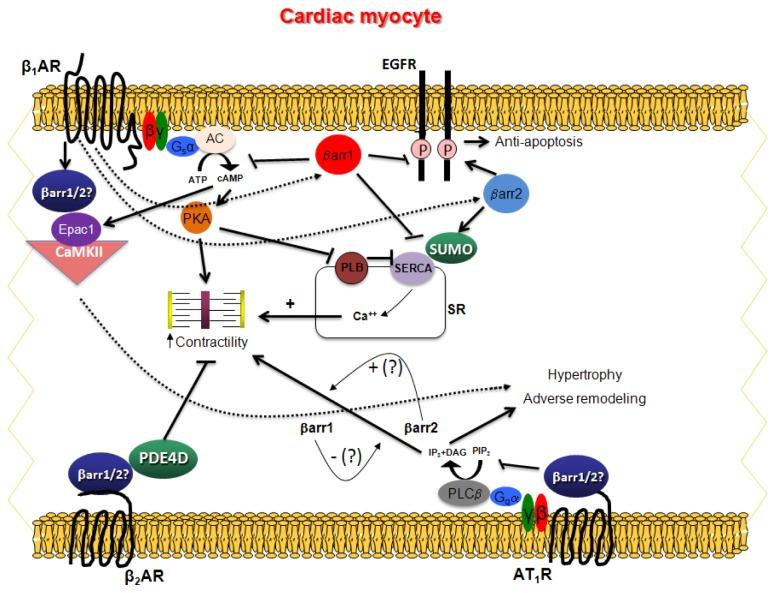
βArrestin (βarr)-1 and -2 (βarrs) (or Arrestin-2 and -3, respectively) are universal G protein-coupled receptor (GPCR) adapter proteins expressed abundantly in extra-retinal tissues, including the myocardium. Both were discovered in the lab of the 2012 Nobel Prize in Chemistry co-laureate Robert Lefkowitz, initially as terminators of signaling from the β-adrenergic receptor (βAR), a process known as functional desensitization. They are now known to switch GPCR signaling from G protein-dependent to G protein-independent, which, in the case of βARs and angiotensin II type 1 receptor (AT1R), might be beneficial, e.g., anti-apoptotic, for the heart. However, the specific role(s) of each βarr isoform in cardiac GPCR signaling and function (or dysfunction in disease), remain unknown. The current consensus is that, whereas both βarr isoforms can desensitize and internalize cardiac GPCRs, they play quite different (even opposing in certain instances) roles in the G protein-independent signaling pathways they initiate in the cardiovascular system, including in the myocardium. The present review will discuss the current knowledge in the field of βarrs and their roles in GPCR signaling and function in the heart, focusing on the three most important, for cardiac physiology, GPCR types (β1AR, β2AR & AT1R), and will also highlight important questions that currently remain unanswered.
β-arrestin(βarr)-1 和 -2(βarrs)(或分别为 Arrestin-2 和 -3)是普遍存在的 G 蛋白偶联受体(GPCR)衔接蛋白,在包括心肌在内的眼外组织中大量表达。这两种蛋白最初都是由 2012 年诺贝尔化学奖共同得主罗伯特·莱夫科维茨(Robert Lefkowitz)实验室发现的,最初被认为是β-肾上腺素能受体(βAR)信号传递的终结者,这个过程被称为功能脱敏。现在已知它们将 GPCR 信号从 G 蛋白依赖性转换为 G 蛋白独立性,对于βAR 和血管紧张素 II 型 1 受体(AT1R)等情况,这可能是有益的,例如,对心脏具有抗凋亡作用。然而,每种βarr 同工型在心脏 GPCR 信号和功能(或疾病中的功能障碍)中的具体作用仍然未知。目前的共识是,虽然两种βarr 同工型都可以使心脏 GPCR 脱敏和内化,但它们在它们在心血管系统中启动的非 G 蛋白依赖性信号通路中发挥着非常不同的作用(在某些情况下甚至是相反的),包括在心肌中。本综述将讨论βarrs 及其在心脏 GPCR 信号和功能中的作用的当前知识,重点讨论对心脏生理学最重要的三种 GPCR 类型(β1AR、β2AR 和 AT1R),并强调目前尚未解决的重要问题。
 Zotero 插件