
头颈部癌症患者放化疗后循环 microRNAs 的变化。
Changes in circulating microRNAs after radiochemotherapy in head and neck cancer patients.
机构信息
Research Unit Radiation Cytogenetics, Helmholtz Center Munich, Ingolstaedter Landstr 1, 85764, Neuherberg, Germany.
出版信息
Radiat Oncol. 2013 Dec 28;8:296. doi: 10.1186/1748-717X-8-296.
INTRODUCTION
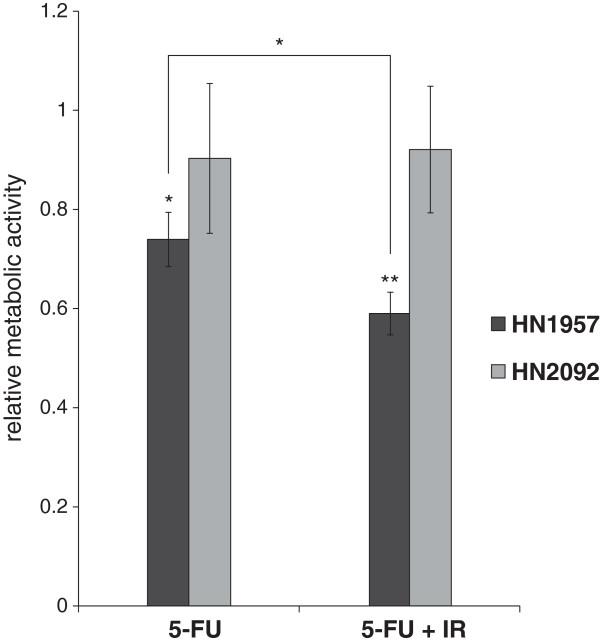
Circulating microRNAs (miRNAs) are easily accessible and have already proven to be useful as prognostic markers in cancer patients. However, their origin and function in the circulation is still under discussion. In the present study we analyzed changes in the miRNAs in blood plasma of head and neck squamous cell carcinoma (HNSCC) patients in response to radiochemotherapy and compared them to the changes in a cell culture model of primary HNSCC cells undergoing simulated anti-cancer therapy.
MATERIALS AND METHODS
MiRNA-profiles were analyzed by qRT-PCR arrays in paired blood plasma samples of HNSCC patients before therapy and after two days of treatment. Candidate miRNAs were validated by single qRT-PCR assays. An in vitro radiochemotherapy model using primary HNSCC cell cultures was established to test the possible tumor origin of the circulating miRNAs. Microarray analysis was performed on primary HNSCC cell cultures followed by validation of deregulated miRNAs via qRT-PCR.
RESULTS
Unsupervised clustering of the expression profiles using the six most regulated miRNAs (miR-425-5p, miR-21-5p, miR-106b-5p, miR-590-5p, miR-574-3p, miR-885-3p) significantly (p = 0.012) separated plasma samples collected prior to treatment from plasma samples collected after two days of radiochemotherapy. MiRNA profiling of primary HNSCC cell cultures treated in vitro with radiochemotherapy revealed differentially expressed miRNAs that were also observed to be therapy-responsive in blood plasma of the patients (miR-425-5p, miR-21-5p, miR-106b-5p, miR-93-5p) and are therefore likely to stem from the tumor. Of these candidate marker miRNAs we were able to validate by qRT-PCR a deregulation of eight plasma miRNAs as well as miR-425-5p and miR-93-5p in primary HNSCC cultures after radiochemotherapy.
CONCLUSION
Changes in the abundance of circulating miRNAs during radiochemotherapy reflect the therapy response of primary HNSCC cells after an in vitro treatment. Therefore, the responsive miRNAs (miR-425-5p, miR-93-5p) may represent novel biomarkers for therapy monitoring. The prognostic value of this exciting observation requires confirmation using an independent patient cohort that includes clinical follow-up data.
简介
循环 microRNAs(miRNAs)易于获取,并且已被证明可作为癌症患者的预后标志物。然而,它们在循环中的起源和功能仍在讨论中。本研究分析了头颈鳞状细胞癌(HNSCC)患者接受放化疗后血浆中 miRNAs 的变化,并将其与原发性 HNSCC 细胞的体外细胞培养模型中接受模拟抗癌治疗的变化进行了比较。
材料和方法
采用 qRT-PCR 阵列分析 HNSCC 患者治疗前和治疗后两天配对血浆样本中的 miRNA 谱。通过单 qRT-PCR 检测验证候选 miRNA。建立了使用原发性 HNSCC 细胞培养物的体外放化疗模型,以测试循环 miRNAs 的可能肿瘤来源。对原发性 HNSCC 细胞培养物进行微阵列分析,然后通过 qRT-PCR 验证下调的 miRNA。
结果
使用表达谱中最受调控的 6 个 miRNA(miR-425-5p、miR-21-5p、miR-106b-5p、miR-590-5p、miR-574-3p、miR-885-3p)进行无监督聚类,可显著(p=0.012)将治疗前采集的血浆样本与放化疗后两天采集的血浆样本区分开来。体外用放化疗处理的原发性 HNSCC 细胞培养物的 miRNA 分析显示,在患者血浆中观察到治疗反应性的差异表达 miRNA(miR-425-5p、miR-21-5p、miR-106b-5p、miR-93-5p),因此可能源自肿瘤。在这些候选标记 miRNA 中,我们能够通过 qRT-PCR 验证 8 种血浆 miRNA 以及原发性 HNSCC 培养物中 miR-425-5p 和 miR-93-5p 在放化疗后的失调。
结论
放化疗过程中循环 miRNAs 丰度的变化反映了原发性 HNSCC 细胞体外治疗后的治疗反应。因此,反应性 miRNA(miR-425-5p、miR-93-5p)可能代表治疗监测的新生物标志物。这一令人兴奋的观察结果的预后价值需要使用包含临床随访数据的独立患者队列进行验证。


 Zotero 插件