
在普萘洛尔作用下重新激活恐惧记忆可使基底外侧杏仁核而非背侧海马神经元的树突棘恢复到创伤前水平。
Reactivating fear memory under propranolol resets pre-trauma levels of dendritic spines in basolateral amygdala but not dorsal hippocampus neurons.
作者信息
Vetere Gisella, Piserchia Valentina, Borreca Antonella, Novembre Giovanni, Aceti Massimiliano, Ammassari-Teule Martine
机构信息
IRCCS Santa Lucia Foundation Rome, Italy ; Institute of Cell Biology and Neurobiology, National Research Council (CNR) Rome, Italy.
Institute of Cell Biology and Neurobiology, National Research Council (CNR) Rome, Italy.
出版信息
Front Behav Neurosci. 2013 Dec 23;7:211. doi: 10.3389/fnbeh.2013.00211. eCollection 2013.
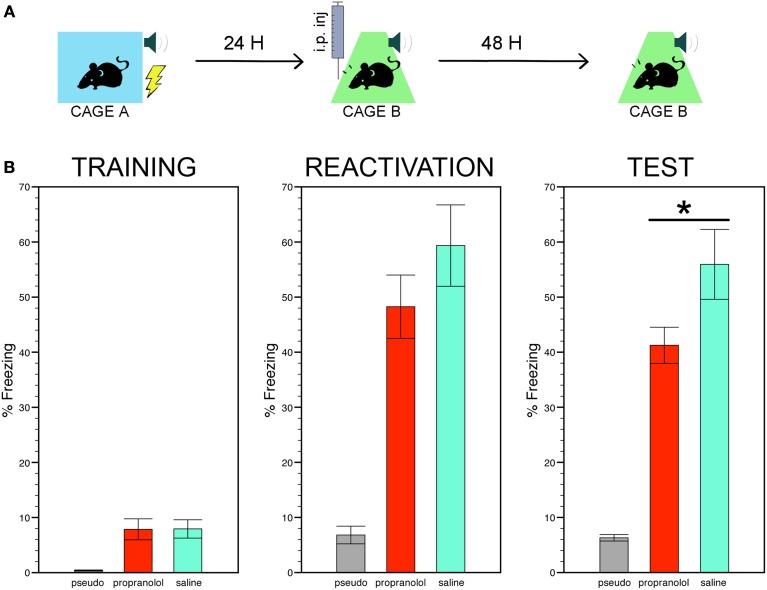
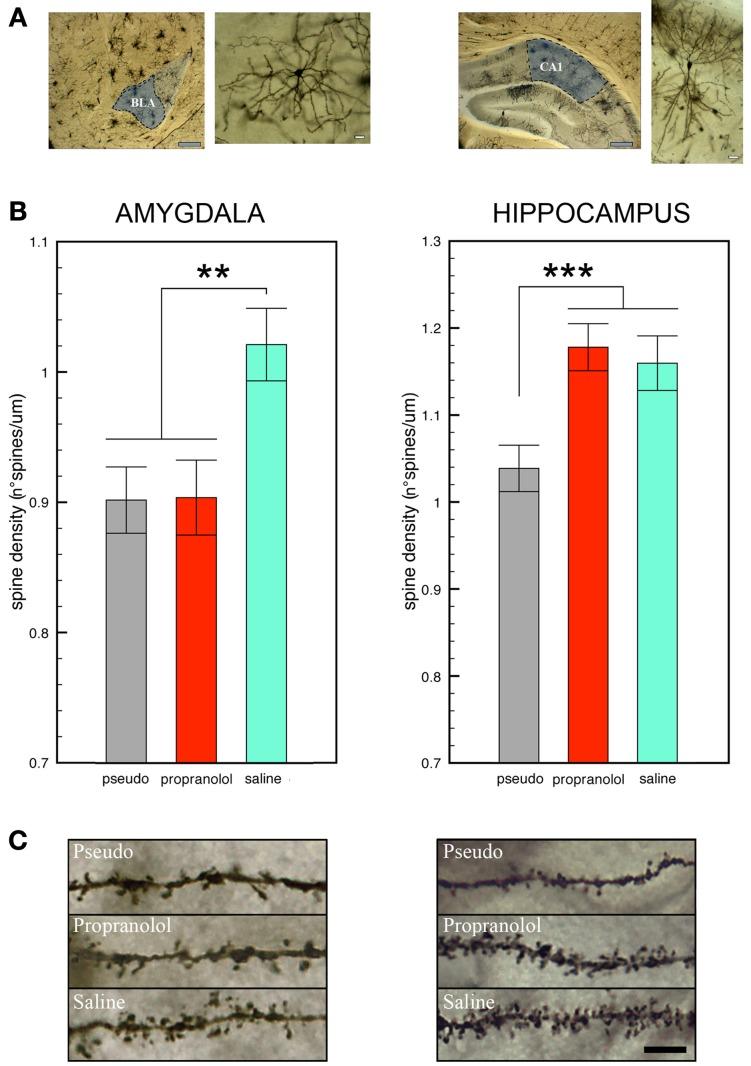
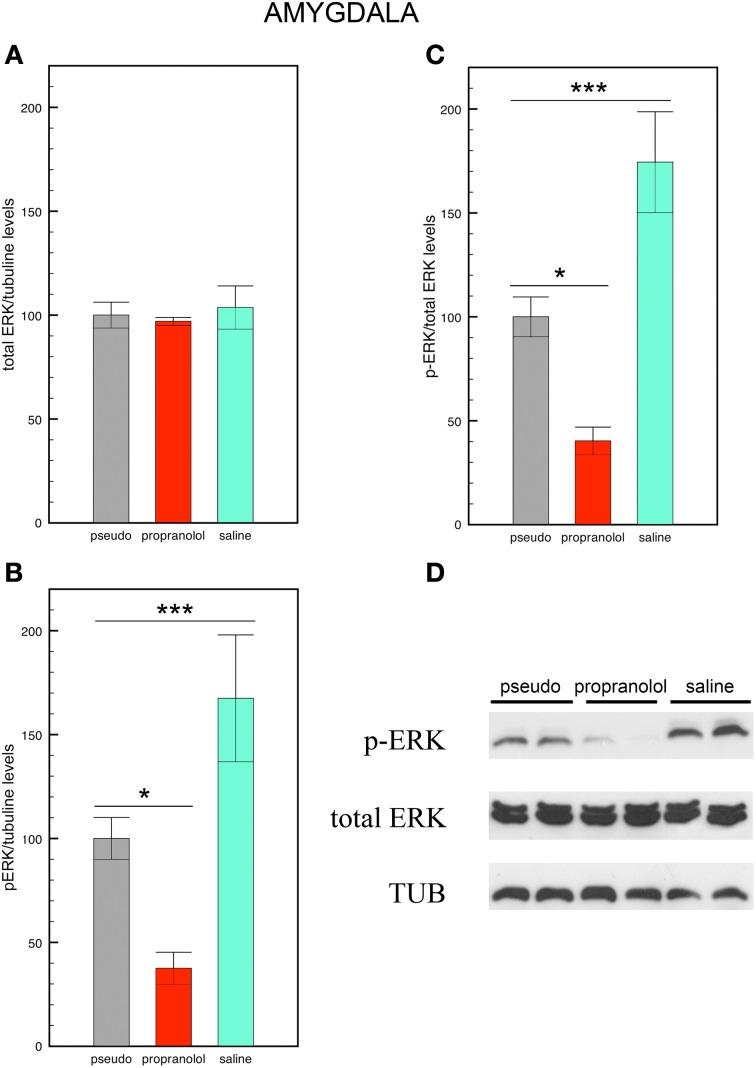
Fear memory enhances connectivity in cortical and limbic circuits but whether treatments disrupting fear reset connectivity to pre-trauma level is unknown. Here we report that C56BL/6J mice exposed to a tone-shock association in context A (conditioning), and briefly re-exposed to the same tone-shock association in context B (reactivation), exhibit strong freezing to the tone alone delivered 48 h later in context B (long term fear memory). This intense fear response is associated with a massive increase in dendritic spines and phospho-Erk (p-ERK) signaling in basolateral amygdala (BLA) but neurons. We then show that propranolol (a central/peripheral β-adrenergic receptor blocker) administered before, but not after, the reactivation trial attenuates long term fear memory assessed drug free 48 h later, and completely prevents the increase in spines and p-ERK signaling in BLA neurons. An increase in spines, but not of p-ERK, was also detected in the dorsal hippocampus (DH) of the conditioned mice. DH spines, however, were unaffected by propranolol suggesting their independence from the ERK/β-ARs cascade. We conclude that propranolol selectively blocks dendritic spines and p-ERK signaling enhancement in the BLA; its effect on fear memory is, however, less pronounced suggesting that the persistence of spines at other brain sites decreases the sensitivity of the fear memory trace to treatments selectively targeting β ARs in the BLA.
恐惧记忆增强了皮质和边缘系统回路的连通性,但破坏恐惧的治疗方法是否能将连通性重置到创伤前水平尚不清楚。在此,我们报告称,C56BL/6J小鼠在情境A中经历了音调-电击关联(条件化),并在情境B中短暂再次经历相同的音调-电击关联(重新激活),在48小时后于情境B中单独呈现音调时表现出强烈的僵住反应(长期恐惧记忆)。这种强烈的恐惧反应与基底外侧杏仁核(BLA)神经元中树突棘和磷酸化细胞外信号调节激酶(p-ERK)信号的大量增加有关。然后我们表明,在重新激活试验之前而非之后给予普萘洛尔(一种中枢/外周β-肾上腺素能受体阻滞剂)可减弱48小时后无药物情况下评估的长期恐惧记忆,并完全阻止BLA神经元中树突棘和p-ERK信号的增加。在条件化小鼠的背侧海马体(DH)中也检测到树突棘增加,但p-ERK未增加。然而,DH中的树突棘不受普萘洛尔影响,表明它们独立于ERK/β-肾上腺素能受体级联反应。我们得出结论,普萘洛尔选择性地阻断BLA中的树突棘和p-ERK信号增强;然而,其对恐惧记忆的影响不太明显,这表明其他脑区树突棘的持续存在降低了恐惧记忆痕迹对选择性靶向BLA中β-肾上腺素能受体的治疗的敏感性。

 Zotero 插件