
利用智能手机检测和绘制水样中汞污染的空间分布图。
Detection and spatial mapping of mercury contamination in water samples using a smart-phone.
机构信息
Electrical Engineering Department, ‡Bioengineering Department, §California NanoSystems Institute (CNSI), ∥Department of Physics & Astronomy, and ⊥Department of Chemistry and Biochemistry, University of California, Los Angeles (UCLA) , Los Angeles, California 90095, United States.
出版信息
ACS Nano. 2014 Feb 25;8(2):1121-9. doi: 10.1021/nn406571t. Epub 2014 Jan 28.
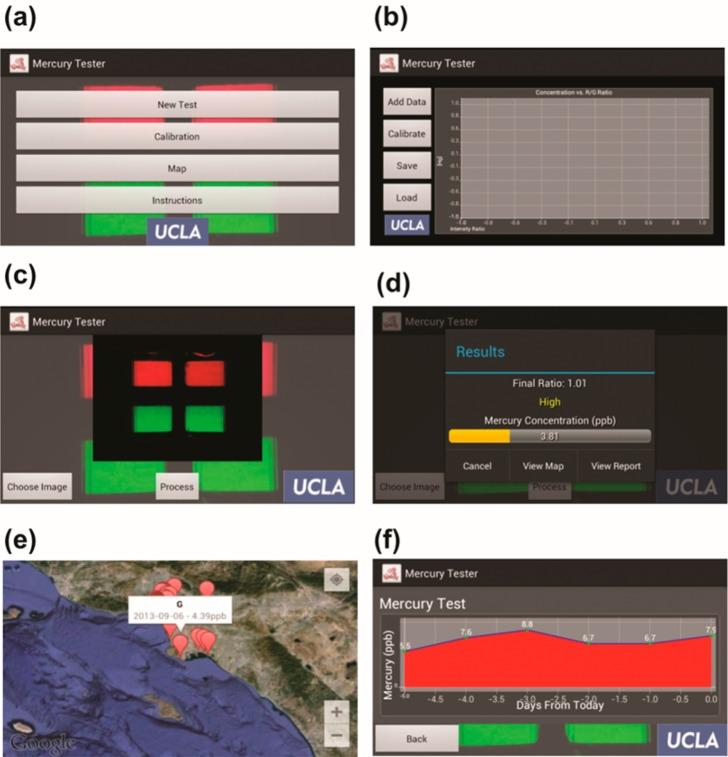
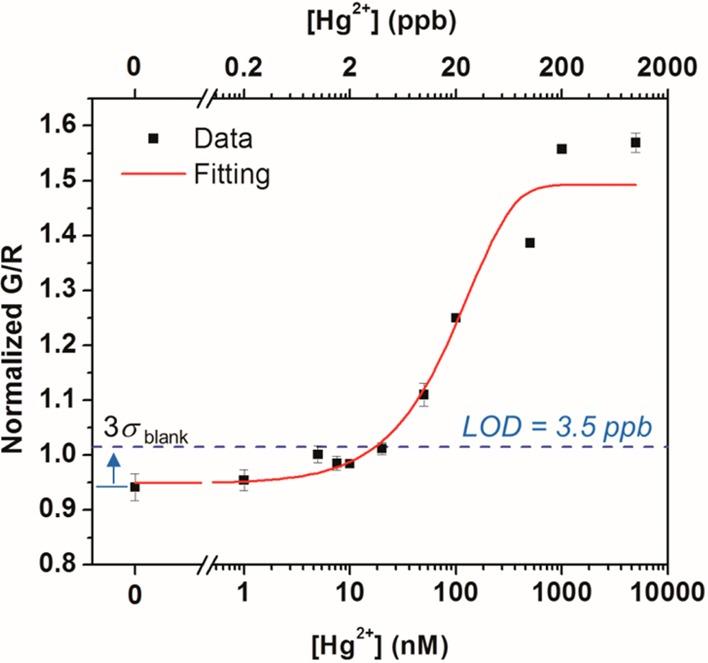
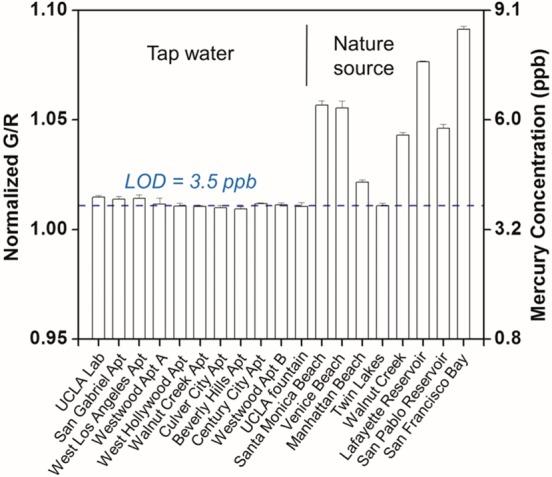
Detection of environmental contamination such as trace-level toxic heavy metal ions mostly relies on bulky and costly analytical instruments. However, a considerable global need exists for portable, rapid, specific, sensitive, and cost-effective detection techniques that can be used in resource-limited and field settings. Here we introduce a smart-phone-based hand-held platform that allows the quantification of mercury(II) ions in water samples with parts per billion (ppb) level of sensitivity. For this task, we created an integrated opto-mechanical attachment to the built-in camera module of a smart-phone to digitally quantify mercury concentration using a plasmonic gold nanoparticle (Au NP) and aptamer based colorimetric transmission assay that is implemented in disposable test tubes. With this smart-phone attachment that weighs <40 g, we quantified mercury(II) ion concentration in water samples by using a two-color ratiometric method employing light-emitting diodes (LEDs) at 523 and 625 nm, where a custom-developed smart application was utilized to process each acquired transmission image on the same phone to achieve a limit of detection of ∼ 3.5 ppb. Using this smart-phone-based detection platform, we generated a mercury contamination map by measuring water samples at over 50 locations in California (USA), taken from city tap water sources, rivers, lakes, and beaches. With its cost-effective design, field-portability, and wireless data connectivity, this sensitive and specific heavy metal detection platform running on cellphones could be rather useful for distributed sensing, tracking, and sharing of water contamination information as a function of both space and time.
环境污染物的检测,如痕量有毒重金属离子,主要依赖于庞大而昂贵的分析仪器。然而,全球相当大的需求是需要便携式、快速、特异性、灵敏和具有成本效益的检测技术,这些技术可以在资源有限和现场环境中使用。在这里,我们介绍了一种基于智能手机的手持式平台,该平台允许以十亿分之几(ppb)的灵敏度定量检测水样中的汞(II)离子。为此,我们创建了一个集成的光机械附件,连接到智能手机的内置摄像头模块,以使用基于等离子体金纳米粒子(Au NP)和适配体的比色传输分析来数字化量化汞浓度,该分析在一次性测试管中实现。通过这个重量<40g 的智能手机附件,我们使用 523nm 和 625nm 的发光二极管(LED)进行双色比率法来定量水样中的汞(II)离子浓度,其中使用了一个定制的智能手机应用程序来处理同一部手机上的每个获取的传输图像,以达到约 3.5ppb 的检测限。使用这个基于智能手机的检测平台,我们通过在加利福尼亚(美国)的 50 多个地点测量来自城市自来水水源、河流、湖泊和海滩的水样,生成了一张汞污染地图。该平台具有成本效益的设计、现场便携性和无线数据连接性,这种运行在手机上的敏感且特异性重金属检测平台可以用于分布式传感、跟踪和共享水污染信息,作为时空函数。


 Zotero 插件