
乳酸杆菌可减少Caco-2细胞在受到TNF-α和沙门氏菌攻击时趋化因子IL-8的产生。
Lactobacilli reduce chemokine IL-8 production in response to TNF-α and Salmonella challenge of Caco-2 cells.
作者信息
Ren Da-Yong, Li Chang, Qin Yan-Qing, Yin Rong-Lan, Du Shou-Wen, Ye Fei, Liu Hong-Feng, Wang Mao-Peng, Sun Yang, Li Xiao, Tian Ming-Yao, Jin Ning-Yi
机构信息
Key Laboratory of Jilin Province for Zoonosis Prevention and Control, Institute of Military Veterinary, Academy of Military Medical Sciences, Changchun 130122, China ; College of Food Science and Engineering, Jilin Agricultural University, Changchun 130118, China.
Key Laboratory of Jilin Province for Zoonosis Prevention and Control, Institute of Military Veterinary, Academy of Military Medical Sciences, Changchun 130122, China.
出版信息
Biomed Res Int. 2013;2013:925219. doi: 10.1155/2013/925219. Epub 2013 Dec 28.
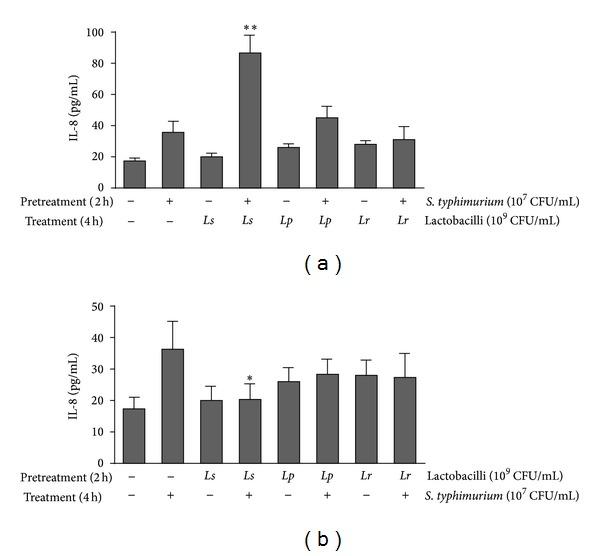
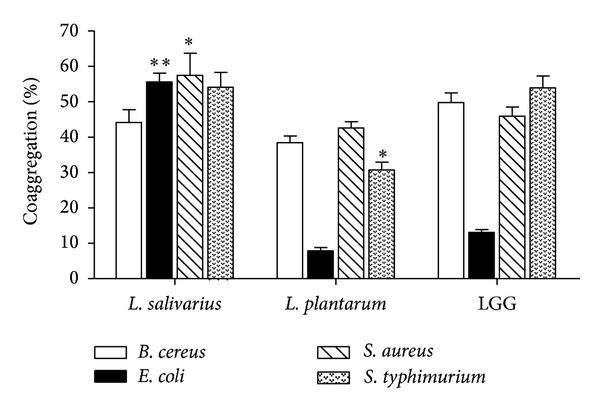
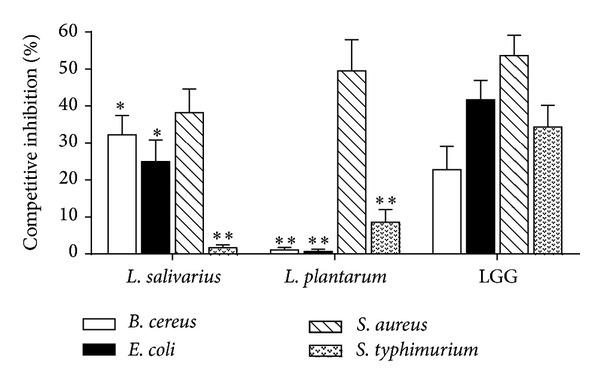
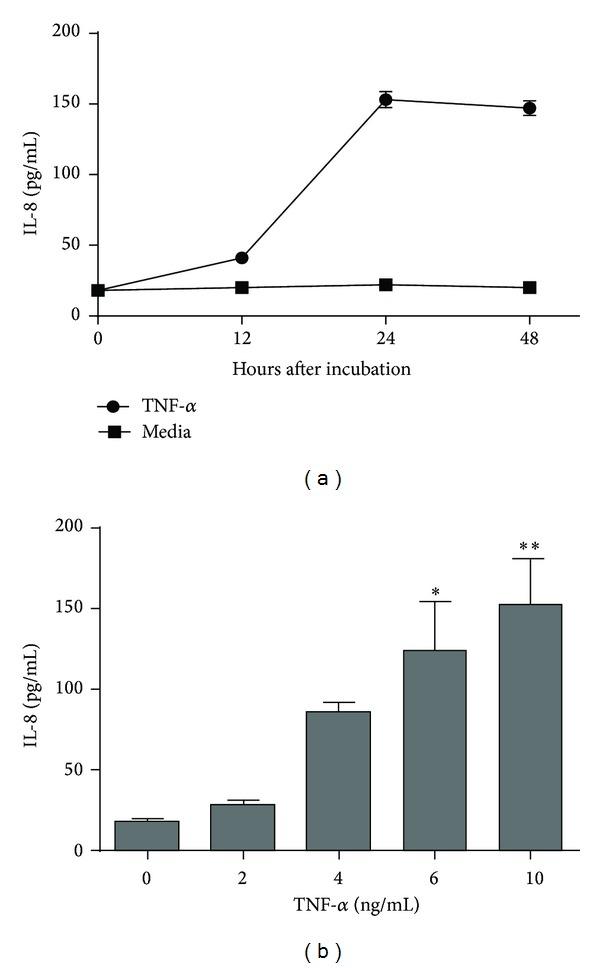
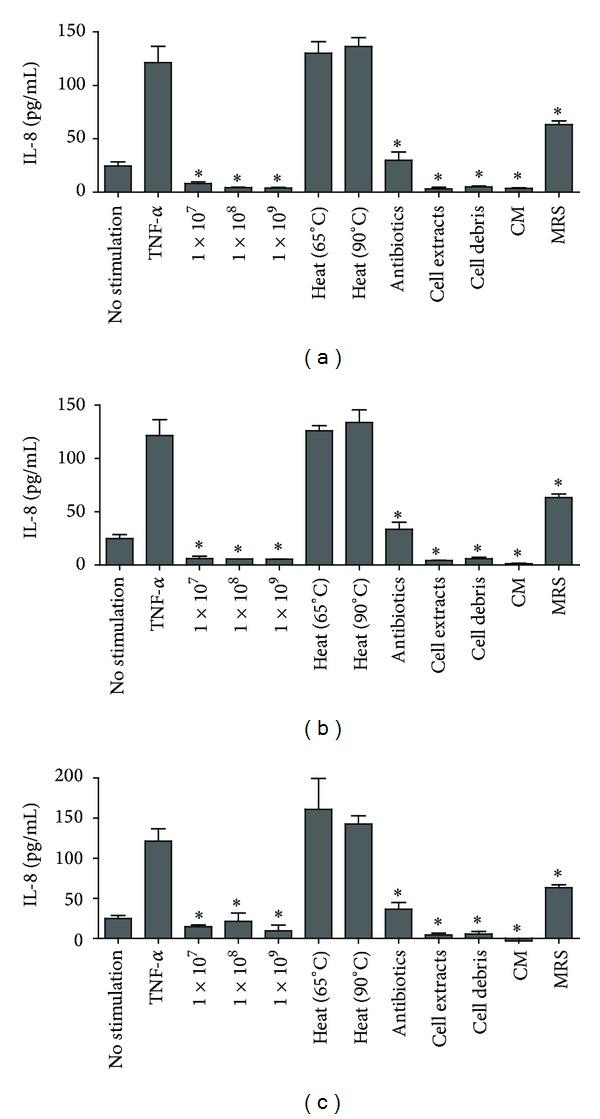
The probiotic properties of two selected lactobacilli strains were assessed. L. salivarius and L. plantarum displayed higher hydrophobicity (48% and 54%, resp.) and coaggregation ability with four pathogens (from 7.9% to 57.5%). L. salivarius and L. plantarum had good inhibitory effects on S. aureus (38.2% and 49.5%, resp.) attachment to Caco-2 cells. Live lactobacilli strains and their conditioned media effectively inhibited IL-8 production (<14.6 pg/mL) in TNF-α-induced Caco-2 cells. Antibiotic-treated and the sonicated lactobacilli also maintained inhibitory effects (IL-8 production from 5.0 to 36.3 pg/mL); however, the heat-treated lactobacilli lost their inhibitory effects (IL-8 production from 130.2 to 161.0 pg/mL). These results suggest that both the structural components and the soluble cellular content of lactobacilli have anti-inflammatory effects. We also found that pretreatment of Caco-2 cells with lactobacilli inhibited S. typhimurium-induced IL-8 production (<27.3 pg/mL). However, lactobacilli did not inhibit IL-8 production in Caco-2 cells pretreated with S. typhimurium. These results suggest that the tested lactobacilli strains are appropriate for preventing inflammatory diseases caused by enteric pathogens but not for therapy. In short, L. salivarius and L. plantarum are potential candidates for the development of microbial ecological agents and functional foods.
对两种选定的乳酸杆菌菌株的益生菌特性进行了评估。唾液乳杆菌和植物乳杆菌表现出更高的疏水性(分别为48%和54%)以及与四种病原体的共聚集能力(从7.9%到57.5%)。唾液乳杆菌和植物乳杆菌对金黄色葡萄球菌黏附于Caco-2细胞具有良好的抑制作用(分别为38.2%和49.5%)。活的乳酸杆菌菌株及其条件培养基可有效抑制TNF-α诱导的Caco-2细胞中IL-8的产生(<14.6 pg/mL)。经抗生素处理和超声处理的乳酸杆菌也保持抑制作用(IL-8产生量为5.0至36.3 pg/mL);然而,经热处理的乳酸杆菌失去了抑制作用(IL-8产生量为130.2至161.0 pg/mL)。这些结果表明,乳酸杆菌的结构成分和可溶性细胞成分均具有抗炎作用。我们还发现,用乳酸杆菌对Caco-2细胞进行预处理可抑制鼠伤寒沙门氏菌诱导的IL-8产生(<27.3 pg/mL)。然而,乳酸杆菌不能抑制用鼠伤寒沙门氏菌预处理的Caco-2细胞中IL-8的产生。这些结果表明,所测试的乳酸杆菌菌株适用于预防由肠道病原体引起的炎症性疾病,但不适用于治疗。简而言之,唾液乳杆菌和植物乳杆菌是开发微生物生态制剂和功能性食品的潜在候选菌株。
 Zotero 插件