
使用截短的引导RNA提高CRISPR-Cas核酸酶的特异性
Improving CRISPR-Cas nuclease specificity using truncated guide RNAs.
作者信息
Fu Yanfang, Sander Jeffry D, Reyon Deepak, Cascio Vincent M, Joung J Keith
机构信息
Molecular Pathology Unit, Massachusetts General Hospital, Charlestown, MA, USA.
Center for Computational and Integrative Biology, Massachusetts General Hospital, Charlestown, MA, USA.
出版信息
Nat Biotechnol. 2014 Mar;32(3):279-284. doi: 10.1038/nbt.2808. Epub 2014 Jan 26.
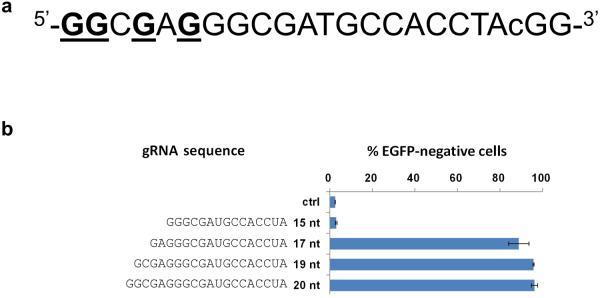
Clustered, regularly interspaced, short palindromic repeat (CRISPR) RNA-guided nucleases (RGNs) are highly efficient genome editing tools. CRISPR-associated 9 (Cas9) RGNs are directed to genomic loci by guide RNAs (gRNAs) containing 20 nucleotides that are complementary to a target DNA sequence. However, RGNs can induce mutations at sites that differ by as many as five nucleotides from the intended target. Here we report that truncated gRNAs, with shorter regions of target complementarity <20 nucleotides in length, can decrease undesired mutagenesis at some off-target sites by 5,000-fold or more without sacrificing on-target genome editing efficiencies. In addition, use of truncated gRNAs can further reduce off-target effects induced by pairs of Cas9 variants that nick DNA (paired nickases). Our results delineate a simple, effective strategy to improve the specificities of Cas9 nucleases or paired nickases.
成簇规律间隔短回文重复序列(CRISPR)RNA引导的核酸酶(RGNs)是高效的基因组编辑工具。CRISPR相关蛋白9(Cas9)RGNs由包含20个核苷酸的引导RNA(gRNAs)引导至基因组位点,这些核苷酸与目标DNA序列互补。然而,RGNs可在与预期靶点相差多达五个核苷酸的位点诱导突变。我们在此报告,截短的gRNAs(与靶点互补区域长度小于20个核苷酸)可在不牺牲靶向基因组编辑效率的情况下,将某些脱靶位点的非预期诱变降低5000倍或更多。此外,使用截短的gRNAs可进一步减少由切割DNA的Cas9变体对(成对切口酶)诱导的脱靶效应。我们的结果描绘了一种简单有效的策略,以提高Cas9核酸酶或成对切口酶的特异性。

 Zotero 插件