
最优的翻译终止需要 eRF1 的 C4 赖氨酸羟化。
Optimal translational termination requires C4 lysyl hydroxylation of eRF1.
机构信息
Centre for Cellular and Molecular Physiology, Oxford University, Roosevelt Drive, Oxford OX3 7BN, UK.
Chemistry Research Laboratory, Oxford University, 12 Mansfield Road, Oxford OX1 3TA, UK.
出版信息
Mol Cell. 2014 Feb 20;53(4):645-54. doi: 10.1016/j.molcel.2013.12.028. Epub 2014 Jan 30.
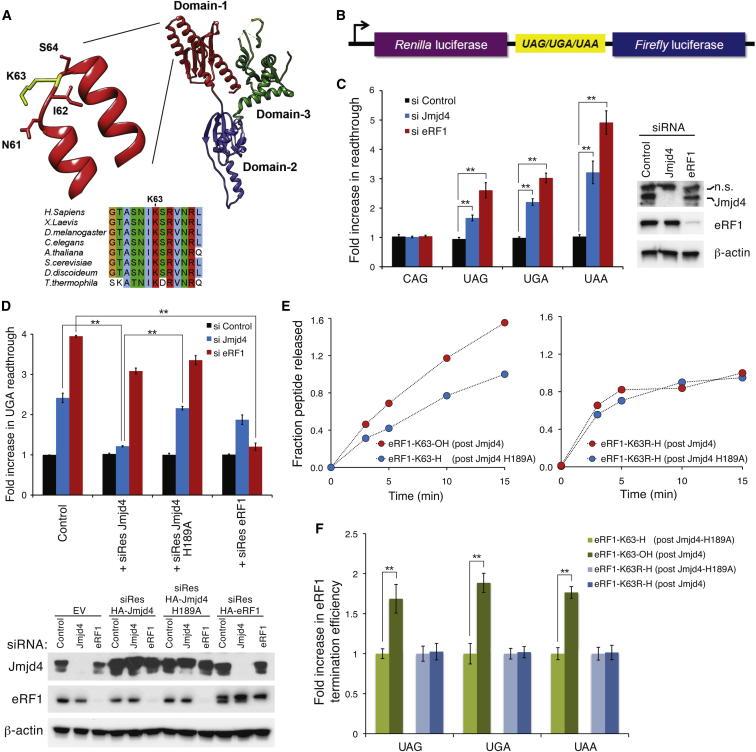
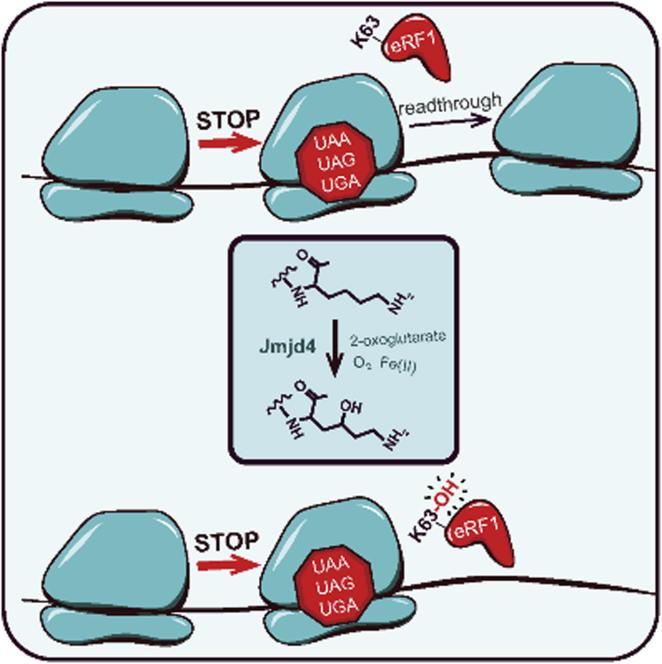
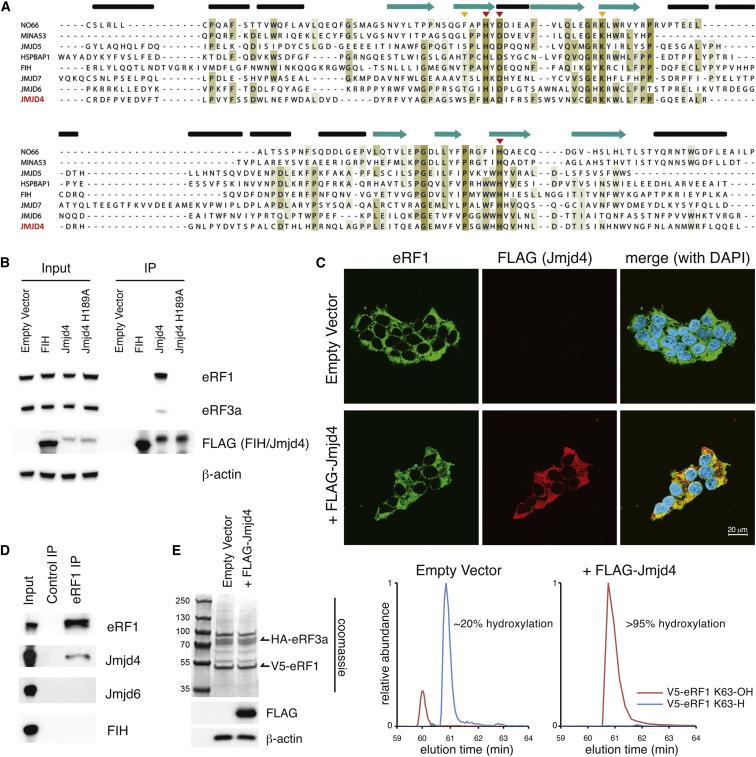
Efficient stop codon recognition and peptidyl-tRNA hydrolysis are essential in order to terminate translational elongation and maintain protein sequence fidelity. Eukaryotic translational termination is mediated by a release factor complex that includes eukaryotic release factor 1 (eRF1) and eRF3. The N terminus of eRF1 contains highly conserved sequence motifs that couple stop codon recognition at the ribosomal A site to peptidyl-tRNA hydrolysis. We reveal that Jumonji domain-containing 4 (Jmjd4), a 2-oxoglutarate- and Fe(II)-dependent oxygenase, catalyzes carbon 4 (C4) lysyl hydroxylation of eRF1. This posttranslational modification takes place at an invariant lysine within the eRF1 NIKS motif and is required for optimal translational termination efficiency. These findings further highlight the role of 2-oxoglutarate/Fe(II) oxygenases in fundamental cellular processes and provide additional evidence that ensuring fidelity of protein translation is a major role of hydroxylation.
高效的终止密码子识别和肽酰-tRNA 水解对于终止翻译延伸和维持蛋白质序列保真度至关重要。真核翻译终止由释放因子复合物介导,该复合物包括真核释放因子 1(eRF1)和 eRF3。eRF1 的 N 端含有高度保守的序列基序,将核糖体 A 位的终止密码子识别与肽酰-tRNA 水解偶联。我们揭示了含有 Jumonji 结构域的 4 型(Jmjd4),一种 2-氧戊二酸和 Fe(II)依赖性加氧酶,催化 eRF1 的 C4 赖氨酸羟化。这种翻译后修饰发生在 eRF1 NIKS 基序内的一个不变的赖氨酸上,对于最佳翻译终止效率是必需的。这些发现进一步强调了 2-氧戊二酸/Fe(II)加氧酶在基本细胞过程中的作用,并提供了额外的证据,表明确保蛋白质翻译保真度是羟化的主要作用。


 Zotero 插件