
孕期用药信息的多种来源及相互冲突信息的后果:一项基于互联网的多国调查
Multiple information sources and consequences of conflicting information about medicine use during pregnancy: a multinational Internet-based survey.
作者信息
Hämeen-Anttila Katri, Nordeng Hedvig, Kokki Esa, Jyrkkä Johanna, Lupattelli Angela, Vainio Kirsti, Enlund Hannes
机构信息
Assessment of Pharmacotherapies, Finnish Medicines Agency, Fimea, Finland.
出版信息
J Med Internet Res. 2014 Feb 20;16(2):e60. doi: 10.2196/jmir.2939.
BACKGROUND
A wide variety of information sources on medicines is available for pregnant women. When using multiple information sources, there is the risk that information will vary or even conflict.
OBJECTIVE
The objective of this multinational study was to analyze the extent to which pregnant women use multiple information sources and the consequences of conflicting information, and to investigate which maternal sociodemographic, lifestyle, and medical factors were associated with these objectives.
METHODS
An anonymous Internet-based questionnaire was made accessible during a period of 2 months, on 1 to 4 Internet websites used by pregnant women in 5 regions (Eastern Europe, Western Europe, Northern Europe, Americas, Australia). A total of 7092 responses were obtained (n=5090 pregnant women; n=2002 women with a child younger than 25 weeks). Descriptive statistics and logistic regression analysis were used.
RESULTS
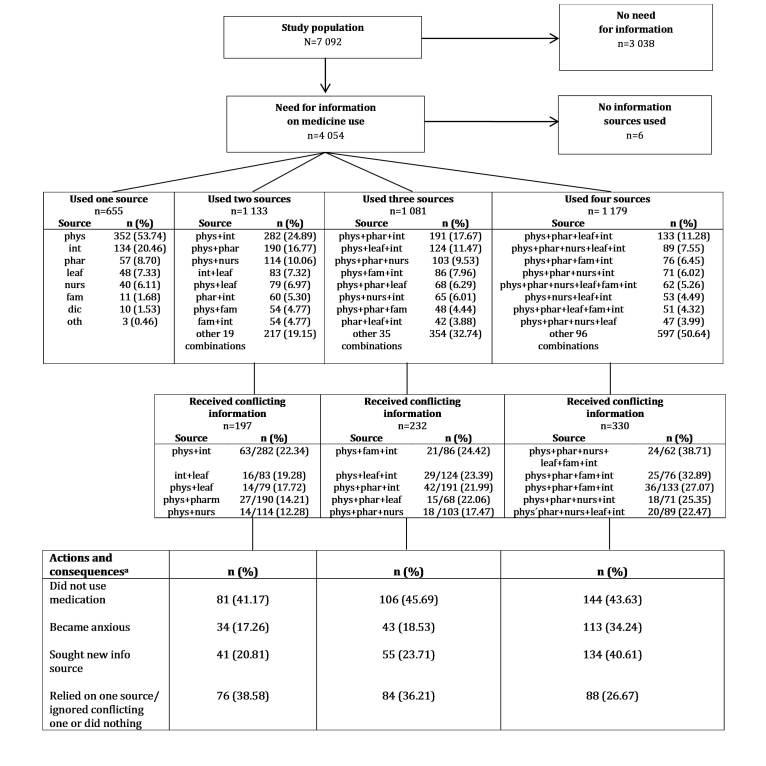
Of the respondents who stated that they needed information, 16.16% (655/4054) used one information source and 83.69% (3393/4054) used multiple information sources. Of respondents who used more than one information source, 22.62% (759/3355) stated that the information was conflicted. According to multivariate logistic regression analysis, factors significantly associated with experiencing conflict in medicine information included being a mother (OR 1.32, 95% CI 1.11-1.58), having university (OR 1.33, 95% CI 1.09-1.63) or other education (OR 1.49, 95% CI 1.09-2.03), residing in Eastern Europe (OR 1.52, 95% CI 1.22-1.89) or Australia (OR 2.28, 95% CI 1.42-3.67), use of 3 (OR 1.29, 95% CI 1.04-1.60) or >4 information sources (OR 1.82, 95% CI 1.49-2.23), and having ≥2 chronic diseases (OR 1.49, 95% CI 1.18-1.89). Because of conflicting information, 43.61% (331/759) decided not to use medication during pregnancy, 30.30% (230/759) sought a new information source, 32.67% (248/759) chose to rely on one source and ignore the conflicting one, 25.03% (190/759) became anxious, and 2.64% (20/759) did nothing. Factors significantly associated with not using medication as a consequence of conflicting information were being pregnant (OR 1.75, 95% CI 1.28-2.41) or experiencing 3-4 health disorders (OR 1.99, 95% CI 1.10-3.58). Women with no chronic diseases were more likely not to take medicines than women with ≥2 chronic diseases (OR 2.22, 95% CI 1.47-3.45). Factors significantly associated with becoming anxious were >4 information sources (OR 2.67, 95% CI 1.70-4.18) and residing in Eastern Europe (OR 0.57, 95% CI 0.36-0.90).
CONCLUSIONS
Almost all the pregnant women used multiple information sources when seeking information on taking medicines during pregnancy and one-fifth obtained conflicting information, leading to anxiety and the decision not to use the medication. Regional, educational, and chronic disease characteristics were associated with experiencing conflicting information and influenced the decision not to use medication or increased anxiety. Accurate and uniform teratology information should be made more available to the public.
背景
孕妇可获取各种各样的药品信息来源。当使用多种信息来源时,存在信息不一致甚至相互冲突的风险。
目的
这项跨国研究的目的是分析孕妇使用多种信息来源的程度以及信息冲突的后果,并调查哪些孕产妇社会人口学、生活方式和医学因素与这些目标相关。
方法
在2个月的时间内,通过5个地区(东欧、西欧、北欧、美洲、澳大利亚)孕妇使用的1至4个互联网网站提供一份匿名的基于互联网的问卷。共获得7092份回复(n = 5090名孕妇;n = 2002名孩子未满25周的女性)。使用描述性统计和逻辑回归分析。
结果
在表示需要信息的受访者中,16.16%(655/4054)使用一种信息来源,83.69%(3393/4054)使用多种信息来源。在使用不止一种信息来源的受访者中,22.62%(759/3355)表示信息存在冲突。根据多变量逻辑回归分析,与经历药品信息冲突显著相关的因素包括身为母亲(比值比1.32,95%置信区间1.11 - 1.58)、拥有大学学历(比值比1.33,95%置信区间1.09 - 1.63)或其他学历(比值比1.49,95%置信区间1.09 - 2.03)、居住在东欧(比值比1.52,95%置信区间1.22 - 1.89)或澳大利亚(比值比2.28,95%置信区间1.42 - 3.67)、使用3种(比值比1.29,95%置信区间1.04 - 1.60)或超过4种信息来源(比值比1.82,95%置信区间1.49 - 2.23),以及患有≥2种慢性病(比值比1.49,95%置信区间1.18 - 1.89)。由于信息冲突,43.61%(331/759)决定在孕期不使用药物,30.30%(230/759)寻求新的信息来源,32.67%(248/759)选择依赖一种来源而忽略冲突的信息,25.03%(190/759)变得焦虑,2.64%(20/759)未采取任何行动。与因信息冲突而不使用药物显著相关的因素是怀孕(比值比1.75,95%置信区间1.28 - 2.41)或患有3 - 4种健康问题(比值比1.99,95%置信区间1.10 - 3.58)。没有慢性病的女性比患有≥2种慢性病的女性更有可能不服用药物(比值比2.22,95%置信区间1.47 - 3.45)。与变得焦虑显著相关的因素是超过4种信息来源(比值比2.67,95%置信区间1.70 - 4.18)和居住在东欧(比值比0.57,95%置信区间0.36 - 0.90)。
结论
几乎所有孕妇在孕期寻求用药信息时都使用多种信息来源,五分之一的人获得了相互冲突的信息,并导致焦虑以及决定不使用药物。地区、教育程度和慢性病特征与经历冲突信息相关,并影响不使用药物的决定或增加焦虑。应向公众提供更准确和统一的致畸学信息。
 Zotero 插件