
德国 2 型糖尿病患者中西格列汀与其他口服降糖药物的真实疗效和耐受性。
Real-life effectiveness and tolerability of vildagliptin and other oral glucose-lowering therapies in patients with type 2 diabetes in Germany.
机构信息
Diabetes Center, Dietersdorfer Weg 2, 35041, Marburg, Germany,
出版信息
Diabetes Ther. 2014 Jun;5(1):183-91. doi: 10.1007/s13300-014-0060-4. Epub 2014 Mar 19.
INTRODUCTION
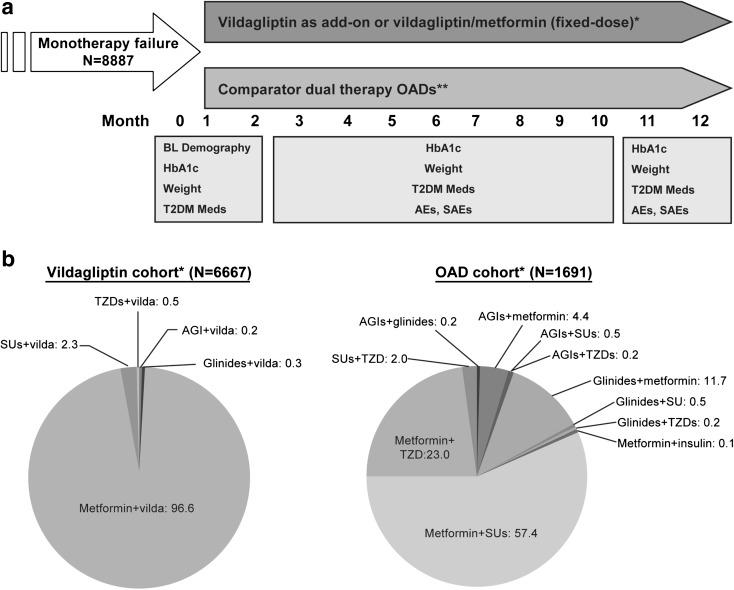
Metformin is an established first-line treatment for patients with type 2 diabetes mellitus (T2DM), but treatment intensification with other oral antidiabetes drugs (OADs) is usually required over time. Effectiveness of diabetes control with vildagliptin and vildagliptin/metformin was a 1-year, large observational study of 45,868 patients with T2DM across 27 countries which assessed effectiveness and safety of vildagliptin as add-on therapy to other OADs versus other comparator OAD combinations. Here, we present the data from Germany.
METHODS
Patients inadequately controlled with monotherapy were eligible only after the add-on treatment was finalized. Patients were assigned to either vildagliptin or comparator OADs [sulfonylureas, thiazolidinediones, glinides, α-glucosidase inhibitors or metformin, excluding dipeptidyl peptidase 4 (DPP-4) inhibitors or glucagon-like peptide-1 mimetic/analogues]. The primary efficacy endpoint was the proportion of patients achieving a glycosylated hemoglobin (HbA1c) reduction of >0.3% without peripheral edema, hypoglycemia, discontinuation due to a gastrointestinal event or weight gain ≥5%. One secondary efficacy endpoint was the proportion of patients achieving HbA1c <7% without hypoglycemia and weight gain. Change in HbA1c from baseline to study endpoint and safety were assessed.
RESULTS
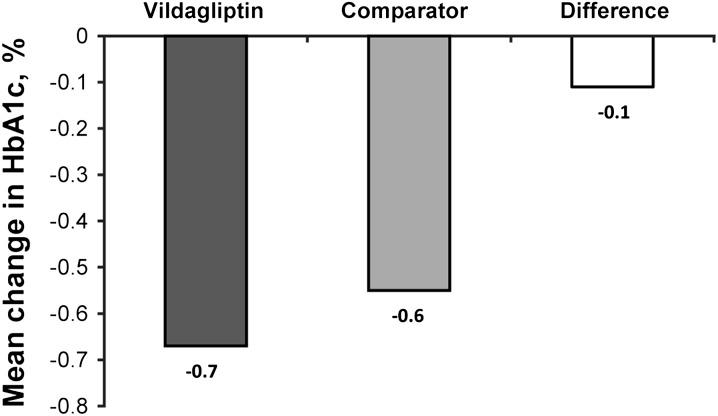
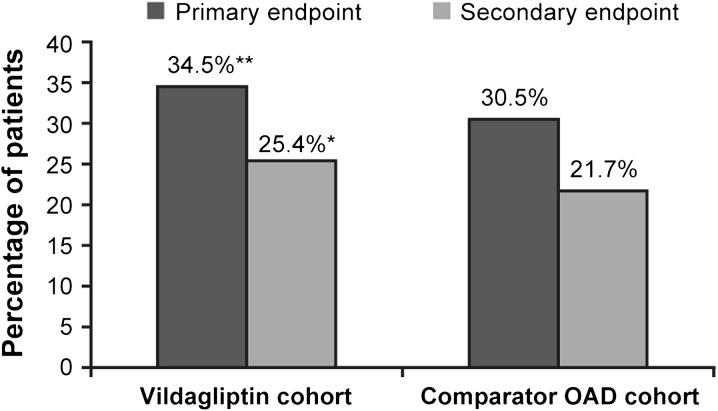
Of 8,887 patients enrolled in Germany, 6,679 received vildagliptin and 1,695 received other OADs. The mean ± SD baseline age, HbA1c, and T2DM duration were 62.8 ± 11.0 years, 7.7 ± 1.2%, and 5.8 ± 4.9 years, respectively. The proportion of patients achieving the primary (34.5% vs. 30.5%, p < 0.01) and secondary (25.4% vs. 21.7%, p = 0.01) endpoints was higher with vildagliptin than comparator OADs. Vildagliptin showed a numerically greater reduction in HbA1c (0.7%) from baseline vs. comparator OADs (0.6%). The overall incidence of adverse events was similar.
CONCLUSION
In real life, treatment with vildagliptin is associated with a higher proportion of patients reaching target HbA1c without hypoglycemia and weight gain compared with other OADs in Germany.
简介
二甲双胍是治疗 2 型糖尿病(T2DM)患者的一线药物,但随着时间的推移,通常需要其他口服抗糖尿病药物(OAD)进行治疗强化。维格列汀和维格列汀/二甲双胍的糖尿病控制效果是一项为期 1 年的大型观察性研究,该研究在 27 个国家招募了 45868 名 T2DM 患者,评估了维格列汀作为其他 OAD 的附加疗法与其他比较 OAD 联合治疗的有效性和安全性。在这里,我们呈现来自德国的数据。
方法
仅在添加治疗结束后,对单药治疗控制不佳的患者进行评估。患者被分配接受维格列汀或比较 OAD 治疗[磺酰脲类、噻唑烷二酮类、格列奈类、α-葡萄糖苷酶抑制剂或二甲双胍,不包括二肽基肽酶 4(DPP-4)抑制剂或胰高血糖素样肽-1 模拟物/类似物]。主要疗效终点是在不发生外周水肿、低血糖、因胃肠道事件停药或体重增加≥5%的情况下,HbA1c 降低>0.3%的患者比例。次要疗效终点是 HbA1c<7%且无低血糖和体重增加的患者比例。评估了从基线到研究终点的 HbA1c 变化和安全性。
结果
在德国登记的 8887 名患者中,6679 名接受了维格列汀治疗,1695 名接受了其他 OAD 治疗。平均年龄为 62.8±11.0 岁,基线时的 HbA1c 和 T2DM 病程分别为 7.7±1.2%和 5.8±4.9 年。与其他 OAD 相比,维格列汀治疗组达到主要(34.5% vs. 30.5%,p<0.01)和次要(25.4% vs. 21.7%,p=0.01)终点的患者比例更高。与其他 OAD 相比,维格列汀治疗组 HbA1c 从基线水平下降(0.7%)数值更大。总体不良事件发生率相似。
结论
在现实生活中,与其他 OAD 相比,在德国,维格列汀治疗与更高比例的患者达到无低血糖和体重增加的目标 HbA1c 相关。
 Zotero 插件