
一种p53 DNA结合结构域与抗凋亡Bcl-2家族蛋白结合的保守机制。
A conserved mechanism for binding of p53 DNA-binding domain and anti-apoptotic Bcl-2 family proteins.
作者信息
Lee Dong-Hwa, Ha Ji-Hyang, Kim Yul, Jang Mi, Park Sung Jean, Yoon Ho Sup, Kim Eun-Hee, Bae Kwang-Hee, Park Byoung Chul, Park Sung Goo, Yi Gwan-Su, Chi Seung-Wook
机构信息
Medical Proteomics Research Center, Korea Research Institute of Bioscience and Biotechnology, Daejeon 305-806, Korea.
出版信息
Mol Cells. 2014 Mar;37(3):264-9. doi: 10.14348/molcells.2014.0001. Epub 2014 Mar 14.
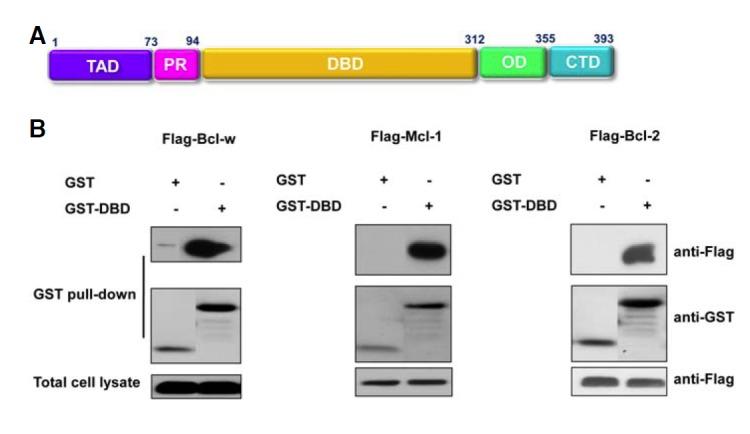
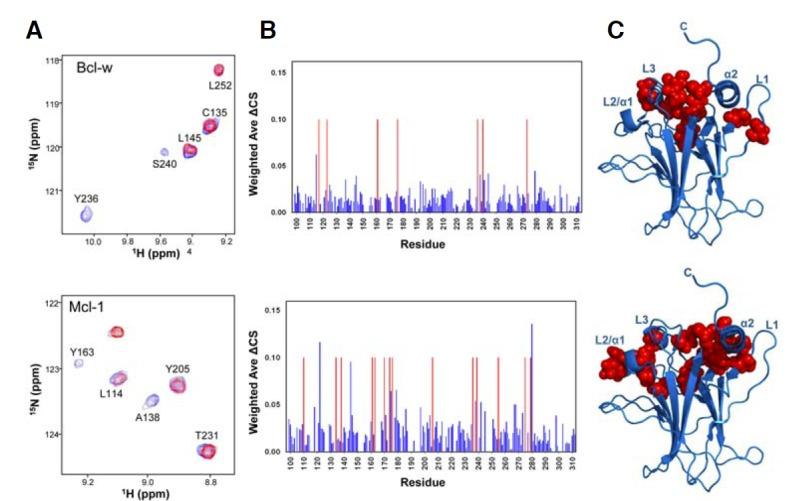
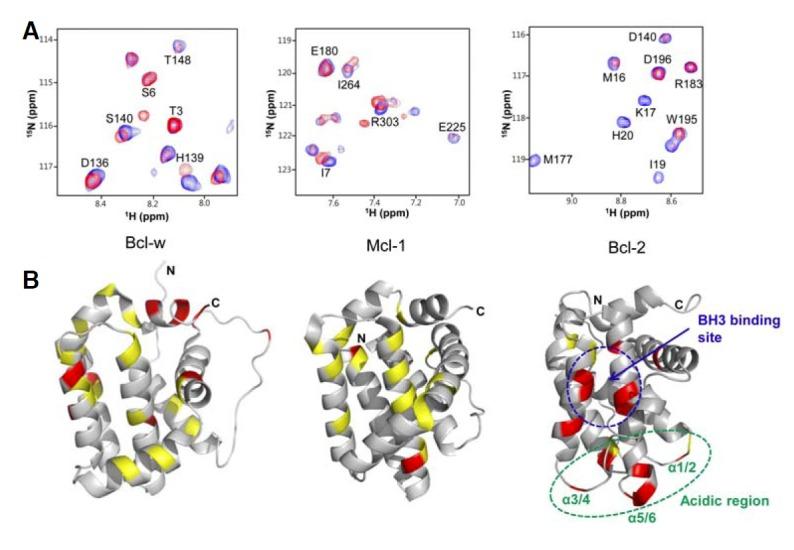
The molecular interaction between tumor suppressor p53 and the anti-apoptotic Bcl-2 family proteins plays an essential role in the transcription-independent apoptotic pathway of p53. In this study, we investigated the binding of p53 DNA-binding domain (p53DBD) with the anti-apoptotic Bcl-2 family proteins, Bcl-w, Mcl-1, and Bcl-2, using GST pull-down assay and NMR spectroscopy. The GST pull-down assays and NMR experiments demonstrated the direct binding of the p53DBD with Bcl-w, Mcl-1, and Bcl-2. Further, NMR chemical shift perturbation data showed that Bcl-w and Mcl-1 bind to the positively charged DNA-binding surface of p53DBD. Noticeably, the refined structural models of the complexes between p53DBD and Bcl-w, Mcl-1, and Bcl-2 showed that the binding mode of p53DBD is highly conserved among the anti-apoptotic Bcl-2 family proteins. Furthermore, the chemical shift perturbations on Bcl-w, Mcl-1, and Bcl-2 induced by p53DBD binding occurred not only at the p53DBD-binding acidic region but also at the BH3 peptide-binding pocket, which suggests an allosteric conformational change similar to that observed in Bcl-XL. Taken altogether, our results revealed a structural basis for a conserved binding mechanism between p53DBD and the anti-apoptotic Bcl-2 family proteins, which shed light on to the molecular understanding of the transcription-independent apoptosis pathway of p53.
肿瘤抑制因子p53与抗凋亡Bcl-2家族蛋白之间的分子相互作用在p53的非转录依赖性凋亡途径中起着至关重要的作用。在本研究中,我们使用谷胱甘肽-S-转移酶(GST)下拉实验和核磁共振波谱法研究了p53 DNA结合结构域(p53DBD)与抗凋亡Bcl-2家族蛋白Bcl-w、Mcl-1和Bcl-2的结合情况。GST下拉实验和核磁共振实验证明了p53DBD与Bcl-w、Mcl-1和Bcl-2的直接结合。此外,核磁共振化学位移扰动数据表明,Bcl-w和Mcl-1与p53DBD带正电荷的DNA结合表面结合。值得注意的是,p53DBD与Bcl-w、Mcl-1和Bcl-2复合物的精细结构模型表明,p53DBD的结合模式在抗凋亡Bcl-2家族蛋白中高度保守。此外,p53DBD结合诱导的Bcl-w、Mcl-1和Bcl-2的化学位移扰动不仅发生在p53DBD结合的酸性区域,也发生在BH3肽结合口袋,这表明存在类似于在Bcl-XL中观察到的变构构象变化。综上所述,我们的结果揭示了p53DBD与抗凋亡Bcl-2家族蛋白之间保守结合机制的结构基础,这为深入了解p53的非转录依赖性凋亡途径的分子机制提供了线索。

 Zotero 插件