
印度德里一家三级护理医院诊断出的肺外患者的治疗途径。
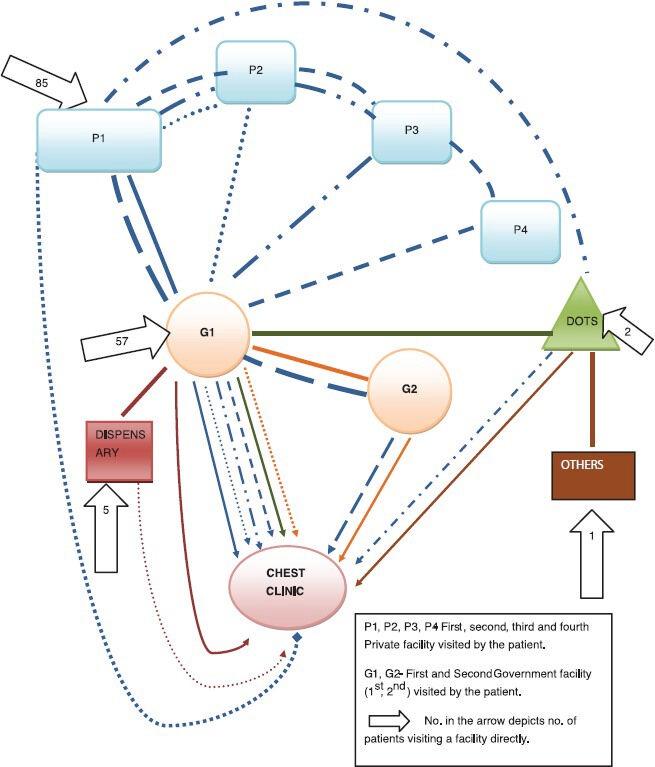
Treatment pathways of extrapulmonary patients diagnosed at a tertiary care hospital in Delhi, India.
作者信息
Grover Manoj, Bhagat Neelima, Sharma Nandini, Dhuria Meera
机构信息
Department of Community Medicine, Maulana Azad Medical College, New Delhi, India.
Department of Epidemiology, New Delhi Tuberculosis Centre, New Delhi, India.
出版信息
Lung India. 2014 Jan;31(1):16-22. doi: 10.4103/0970-2113.125888.
BACKGROUND
In order to put extrapulmonary tuberculosis patients early on treatment, it is important to study pathways, which these patients adopt in for seeking treatment.
MATERIALS AND METHODS
In order to study the treatment pathways of extrapulmonary patients and assess appropriate points for intervention, a cross-sectional study was conducted in chest clinic of a tertiary care hospital in Delhi.
RESULTS
Factors associated with longer paths included reason for going to first health facility (nearness and known provider), availing more than one health facilities, presenting symptoms of fever, joint pain, nodular skin swelling and skin lesion. Self-referral to the chest clinic was associated with shorter paths. Lower level of education, occupation, non-serious perception of the disease and visiting five health facilities were significantly associated with patient delay of more than 3.5 weeks. Symptoms of fever, joint pain and skin lesion, visiting private health facility first, availing more than two health facilities and travelling distance of more than 100 km to reach chest clinic were significantly associated with the health facility delay of more than 4.5 weeks.
CONCLUSIONS
Increasing public awareness, training of private practitioners and capacity building of government facilities will help in reducing delay.
背景
为了使肺外结核患者尽早接受治疗,研究这些患者寻求治疗所采取的途径很重要。
材料与方法
为了研究肺外结核患者的治疗途径并评估合适的干预点,在德里一家三级护理医院的胸科门诊进行了一项横断面研究。
结果
与较长治疗途径相关的因素包括前往首个医疗机构的原因(距离近和有熟悉的医疗服务提供者)、利用多个医疗机构、出现发热、关节疼痛、结节性皮肤肿胀和皮肤病变症状。自行前往胸科门诊与较短的治疗途径相关。低教育水平、职业、对疾病的不重视以及就诊于五个医疗机构与患者延迟超过3.5周显著相关。发热、关节疼痛和皮肤病变症状、首先就诊于私立医疗机构、利用两个以上医疗机构以及前往胸科门诊的距离超过100公里与医疗机构延迟超过4.5周显著相关。
结论
提高公众意识、培训私人执业医生以及加强政府医疗机构的能力建设将有助于减少延迟。
 Zotero 插件