
嗜热产氢菌快速热解嗜热栖热菌中代谢通量分布受外部pH值和氢气分压影响的评估。
Assessment of metabolic flux distribution in the thermophilic hydrogen producer Caloramator celer as affected by external pH and hydrogen partial pressure.
作者信息
Ciranna Alessandro, Pawar Sudhanshu S, Santala Ville, Karp Matti, van Niel Ed W J
机构信息
Department of Chemistry and Bioengineering, Tampere University of Technology, Korkeakoulunkatu 8, FI-33720 Tampere, Finland.
出版信息
Microb Cell Fact. 2014 Mar 28;13(1):48. doi: 10.1186/1475-2859-13-48.
BACKGROUND
Caloramator celer is a strict anaerobic, alkalitolerant, thermophilic bacterium capable of converting glucose to hydrogen (H2), carbon dioxide, acetate, ethanol and formate by a mixed acid fermentation. Depending on the growth conditions C. celer can produce H2 at high yields. For a biotechnological exploitation of this bacterium for H2 production it is crucial to understand the factors that regulate carbon and electron fluxes and therefore the final distribution of metabolites to channel the metabolic flux towards the desired product.
RESULTS
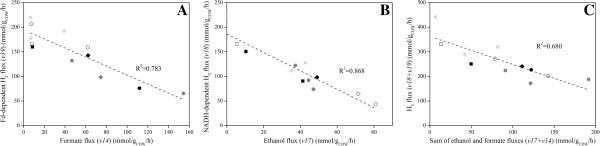
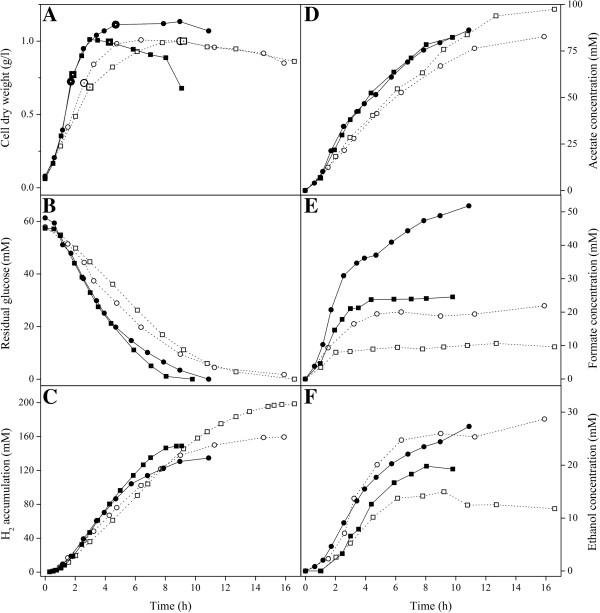
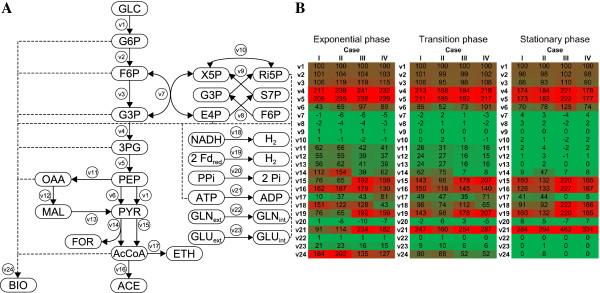
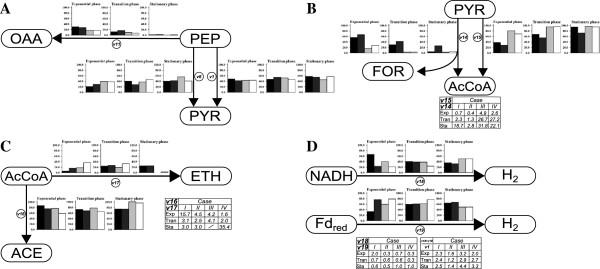
Combining experimental results from batch fermentations with genome analysis, reconstruction of central carbon metabolism and metabolic flux analysis (MFA), this study shed light on glucose catabolism of the thermophilic alkalitolerant bacterium C. celer. Two innate factors pertaining to culture conditions have been identified to significantly affect the metabolic flux distribution: culture pH and partial pressures of H2 (PH2). Overall, at alkaline to neutral pH the rate of biomass synthesis was maximized, whereas at acidic pH the lower growth rate and the less efficient biomass formation are accompanied with more efficient energy recovery from the substrate indicating high cell maintenance possibly to sustain intracellular pH homeostasis. Higher H2 yields were associated with fermentation at acidic pH as a consequence of the lower synthesis of other reduced by-products such as formate and ethanol. In contrast, PH2 did not affect the growth of C. celer on glucose. At high PH2 the cellular redox state was balanced by rerouting the flow of carbon and electrons to ethanol and formate production allowing unaltered glycolytic flux and growth rate, but resulting in a decreased H2 synthesis.
CONCLUSION
C. celer possesses a flexible fermentative metabolism that allows redistribution of fluxes at key metabolic nodes to simultaneously control redox state and efficiently harvest energy from substrate even under unfavorable conditions (i.e. low pH and high PH2). With the H2 production in mind, acidic pH and low PH2 should be preferred for a high yield-oriented process, while a high productivity-oriented process can be achieved at alkaline pH and high PH2.
背景
嗜热强碱厌氧梭菌是一种严格厌氧、耐碱、嗜热的细菌,能够通过混合酸发酵将葡萄糖转化为氢气(H₂)、二氧化碳、乙酸、乙醇和甲酸。根据生长条件,嗜热强碱厌氧梭菌能够高产氢气。对于利用这种细菌进行生物技术产氢而言,了解调节碳和电子通量的因素以及代谢物的最终分布,从而将代谢通量导向所需产物至关重要。
结果
本研究将分批发酵的实验结果与基因组分析、中心碳代谢重建及代谢通量分析(MFA)相结合,揭示了嗜热强碱厌氧梭菌的葡萄糖分解代谢。已确定两个与培养条件相关的内在因素会显著影响代谢通量分布:培养pH值和H₂分压(PH₂)。总体而言,在碱性至中性pH条件下,生物量合成速率最大化,而在酸性pH条件下,较低的生长速率和较低效率的生物量形成伴随着从底物中更高效的能量回收,这表明可能需要较高的细胞维持量来维持细胞内pH稳态。由于甲酸和乙醇等其他还原副产物的合成减少,酸性pH条件下的发酵与更高的H₂产量相关。相比之下,PH₂并不影响嗜热强碱厌氧梭菌利用葡萄糖的生长。在高PH₂条件下,通过将碳和电子流重新导向乙醇和甲酸的产生来平衡细胞氧化还原状态,从而使糖酵解通量和生长速率保持不变,但导致H₂合成减少。
结论
嗜热强碱厌氧梭菌具有灵活的发酵代谢,能够在关键代谢节点重新分配通量,从而即使在不利条件下(即低pH值和高PH₂)也能同时控制氧化还原状态并有效地从底物中获取能量。考虑到产氢,以高产为导向的过程应优先选择酸性pH和低PH₂,而以高生产率为导向的过程可在碱性pH和高PH₂条件下实现。

 Zotero 插件