
组蛋白去乙酰化酶抑制剂罗米地辛在接受抑制性抗逆转录病毒治疗的患者的CD4 T细胞中,以临床给药所达到的浓度诱导HIV表达。
Histone deacetylase inhibitor romidepsin induces HIV expression in CD4 T cells from patients on suppressive antiretroviral therapy at concentrations achieved by clinical dosing.
作者信息
Wei Datsen George, Chiang Vicki, Fyne Elizabeth, Balakrishnan Mini, Barnes Tiffany, Graupe Michael, Hesselgesser Joseph, Irrinki Alivelu, Murry Jeffrey P, Stepan George, Stray Kirsten M, Tsai Angela, Yu Helen, Spindler Jonathan, Kearney Mary, Spina Celsa A, McMahon Deborah, Lalezari Jacob, Sloan Derek, Mellors John, Geleziunas Romas, Cihlar Tomas
机构信息
Gilead Sciences, Foster City, California, United States of America.
Division of Infectious Diseases, Department of Medicine, University of Pittsburgh School of Medicine, Pittsburgh, Pennsylvania, United States of America.
出版信息
PLoS Pathog. 2014 Apr 10;10(4):e1004071. doi: 10.1371/journal.ppat.1004071. eCollection 2014 Apr.
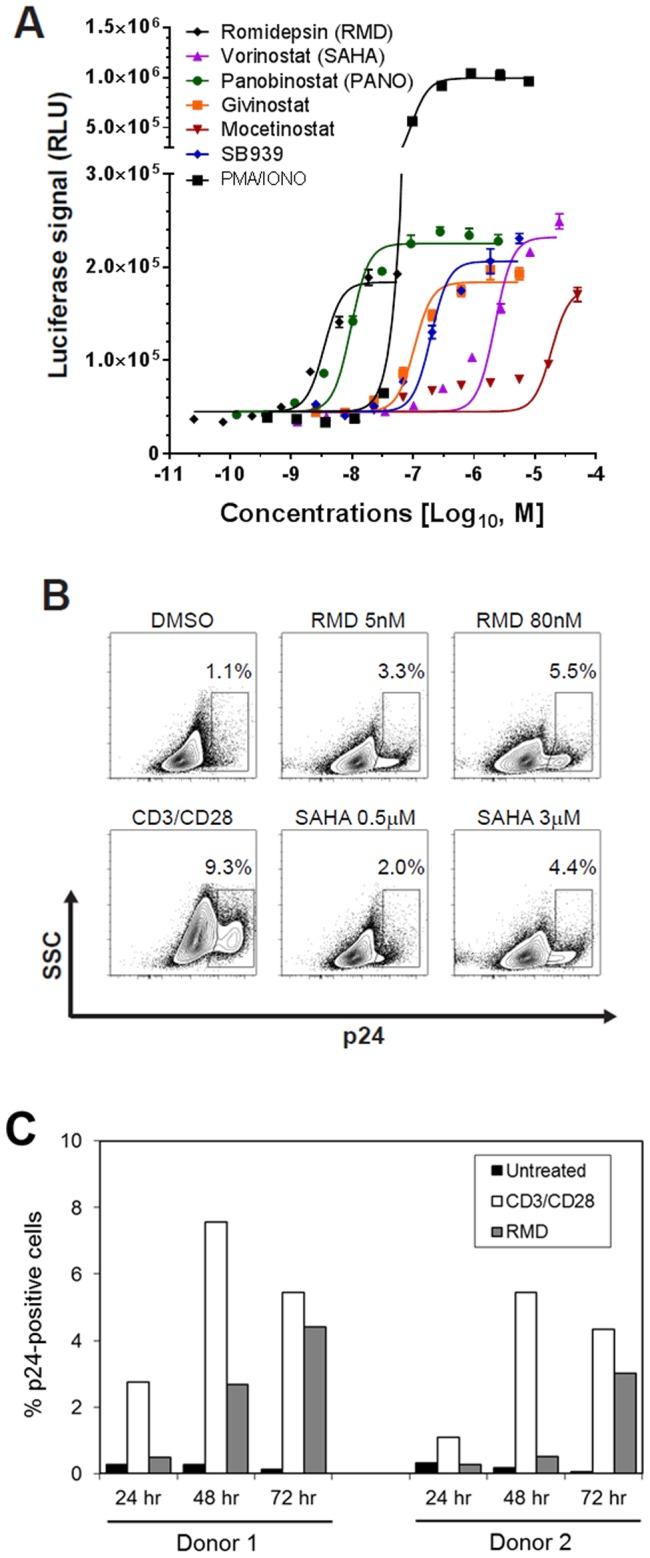
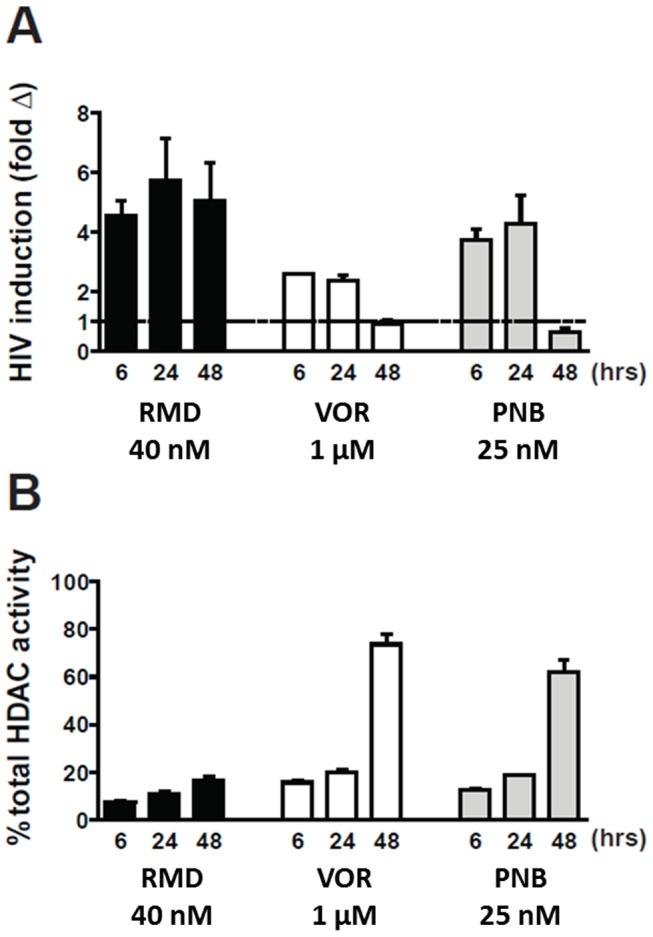
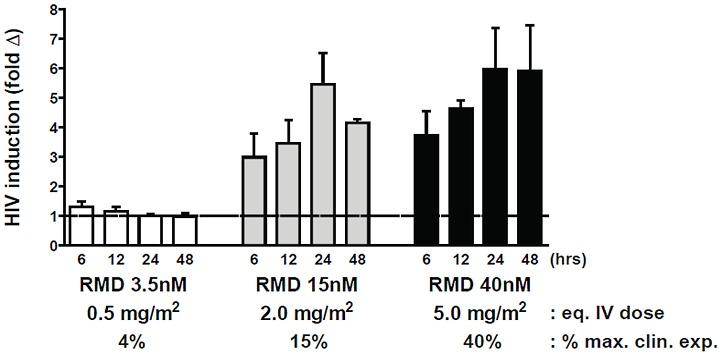
Persistent latent reservoir of replication-competent proviruses in memory CD4 T cells is a major obstacle to curing HIV infection. Pharmacological activation of HIV expression in latently infected cells is being explored as one of the strategies to deplete the latent HIV reservoir. In this study, we characterized the ability of romidepsin (RMD), a histone deacetylase inhibitor approved for the treatment of T-cell lymphomas, to activate the expression of latent HIV. In an in vitro T-cell model of HIV latency, RMD was the most potent inducer of HIV (EC50 = 4.5 nM) compared with vorinostat (VOR; EC50 = 3,950 nM) and other histone deacetylase (HDAC) inhibitors in clinical development including panobinostat (PNB; EC50 = 10 nM). The HIV induction potencies of RMD, VOR, and PNB paralleled their inhibitory activities against multiple human HDAC isoenzymes. In both resting and memory CD4 T cells isolated from HIV-infected patients on suppressive combination antiretroviral therapy (cART), a 4-hour exposure to 40 nM RMD induced a mean 6-fold increase in intracellular HIV RNA levels, whereas a 24-hour treatment with 1 µM VOR resulted in 2- to 3-fold increases. RMD-induced intracellular HIV RNA expression persisted for 48 hours and correlated with sustained inhibition of cell-associated HDAC activity. By comparison, the induction of HIV RNA by VOR and PNB was transient and diminished after 24 hours. RMD also increased levels of extracellular HIV RNA and virions from both memory and resting CD4 T-cell cultures. The activation of HIV expression was observed at RMD concentrations below the drug plasma levels achieved by doses used in patients treated for T-cell lymphomas. In conclusion, RMD induces HIV expression ex vivo at concentrations that can be achieved clinically, indicating that the drug may reactivate latent HIV in patients on suppressive cART.
记忆性CD4 T细胞中具有复制能力的前病毒持续潜伏库是治愈HIV感染的主要障碍。探索在潜伏感染细胞中进行HIV表达的药理学激活作为耗尽潜伏HIV库的策略之一。在本研究中,我们表征了已被批准用于治疗T细胞淋巴瘤的组蛋白脱乙酰酶抑制剂罗米地辛(RMD)激活潜伏HIV表达的能力。在HIV潜伏的体外T细胞模型中,与伏立诺他(VOR;EC50 = 3950 nM)和其他处于临床开发阶段的组蛋白脱乙酰酶(HDAC)抑制剂包括帕比司他(PNB;EC50 = 10 nM)相比,RMD是最有效的HIV诱导剂(EC50 = 4.5 nM)。RMD、VOR和PNB的HIV诱导效力与其对多种人类HDAC同工酶的抑制活性平行。在接受抑制性联合抗逆转录病毒疗法(cART)的HIV感染患者分离出的静息和记忆性CD4 T细胞中,40 nM RMD暴露4小时导致细胞内HIV RNA水平平均增加6倍,而1 μM VOR处理24小时导致增加2至3倍。RMD诱导的细胞内HIV RNA表达持续48小时,并与细胞相关HDAC活性的持续抑制相关。相比之下,VOR和PNB诱导的HIV RNA是短暂的,24小时后减弱。RMD还增加了来自记忆性和静息性CD4 T细胞培养物的细胞外HIV RNA和病毒颗粒水平。在低于接受T细胞淋巴瘤治疗的患者所用剂量所达到的药物血浆水平的RMD浓度下观察到HIV表达的激活。总之,RMD在可在临床上实现的浓度下离体诱导HIV表达,表明该药物可能在接受抑制性cART的患者中重新激活潜伏的HIV。




 Zotero 插件