
自然杀伤细胞受体识别细胞和病毒配体的结构基础。
Structural basis for recognition of cellular and viral ligands by NK cell receptors.
作者信息
Li Yili, Mariuzza Roy A
机构信息
W. M. Keck Laboratory for Structural Biology, Institute for Bioscience and Biotechnology Research, University of Maryland , Rockville, MD , USA ; Department of Cell Biology and Molecular Genetics, University of Maryland , College Park, MD , USA.
出版信息
Front Immunol. 2014 Mar 26;5:123. doi: 10.3389/fimmu.2014.00123. eCollection 2014.
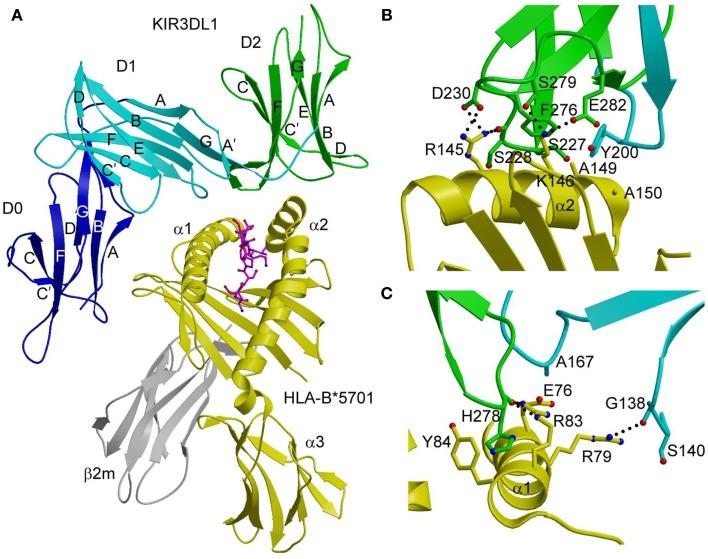
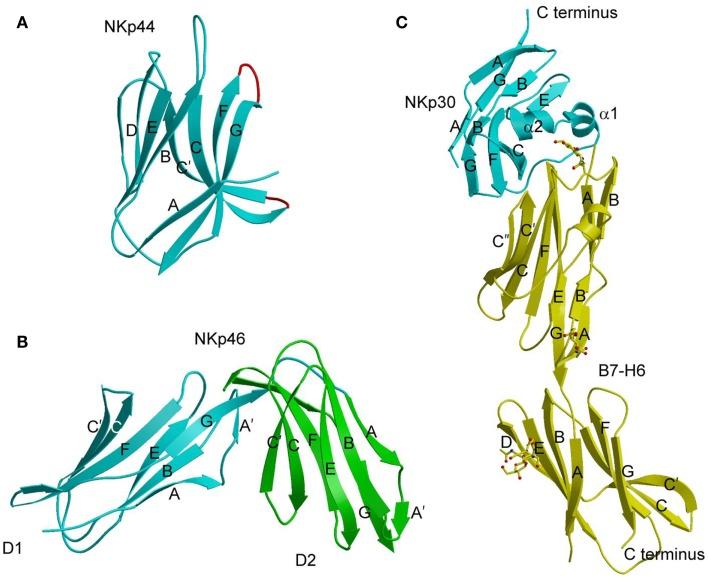
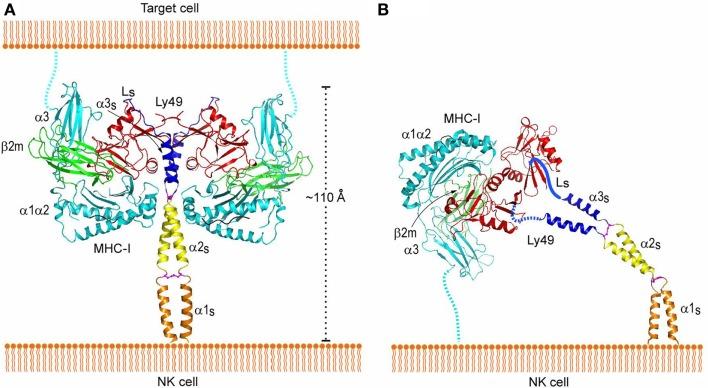
Natural killer (NK) cells are key components of innate immune responses to tumors and viral infections. NK cell function is regulated by NK cell receptors that recognize both cellular and viral ligands, including major histocompatibility complex (MHC), MHC-like, and non-MHC molecules. These receptors include Ly49s, killer immunoglobulin-like receptors, leukocyte immunoglobulin-like receptors, and NKG2A/CD94, which bind MHC class I (MHC-I) molecules, and NKG2D, which binds MHC-I paralogs such as the stress-induced proteins MICA and ULBP. In addition, certain viruses have evolved MHC-like immunoevasins, such as UL18 and m157 from cytomegalovirus, that act as decoy ligands for NK receptors. A growing number of NK receptor-ligand interaction pairs involving non-MHC molecules have also been identified, including NKp30-B7-H6, killer cell lectin-like receptor G1-cadherin, and NKp80-AICL. Here, we describe crystal structures determined to date of NK cell receptors bound to MHC, MHC-related, and non-MHC ligands. Collectively, these structures reveal the diverse solutions that NK receptors have developed to recognize these molecules, thereby enabling the regulation of NK cytolytic activity by both host and viral ligands.
自然杀伤(NK)细胞是对肿瘤和病毒感染的先天性免疫反应的关键组成部分。NK细胞功能受NK细胞受体调节,这些受体可识别细胞和病毒配体,包括主要组织相容性复合体(MHC)、MHC样分子和非MHC分子。这些受体包括与MHC I类(MHC-I)分子结合的Ly49s、杀伤细胞免疫球蛋白样受体、白细胞免疫球蛋白样受体和NKG2A/CD94,以及与MHC-I旁系同源物(如应激诱导蛋白MICA和ULBP)结合的NKG2D。此外,某些病毒已进化出MHC样免疫逃逸蛋白,如巨细胞病毒的UL18和m157,它们可作为NK受体的诱饵配体。还发现了越来越多涉及非MHC分子的NK受体-配体相互作用对,包括NKp30-B7-H6、杀伤细胞凝集素样受体G1-钙黏蛋白和NKp80-AICL。在这里,我们描述了迄今为止确定的与MHC、MHC相关和非MHC配体结合的NK细胞受体的晶体结构。总体而言,这些结构揭示了NK受体为识别这些分子而开发的多种解决方案,从而使宿主和病毒配体都能调节NK细胞的溶细胞活性。







 Zotero 插件