
用原儿茶酸调节p66shc信号通路可保护肠道免受缺血再灌注损伤,并减轻继发性肝损伤。
Modulating the p66shc signaling pathway with protocatechuic acid protects the intestine from ischemia-reperfusion injury and alleviates secondary liver damage.
作者信息
Ma Lingfei, Wang Guangzhi, Chen Zhao, Li Zhenlu, Yao Jihong, Zhao Haidong, Wang Shu, Ma Zhenhai, Chang Hong, Tian Xiaofeng
机构信息
Department of General Surgery, The Second Hospital of Dalian Medical University, Dalian 116023, China.
Department of Pharmacology, Dalian Medical University, Dalian 116044, China.
出版信息
ScientificWorldJournal. 2014 Mar 16;2014:387640. doi: 10.1155/2014/387640. eCollection 2014.
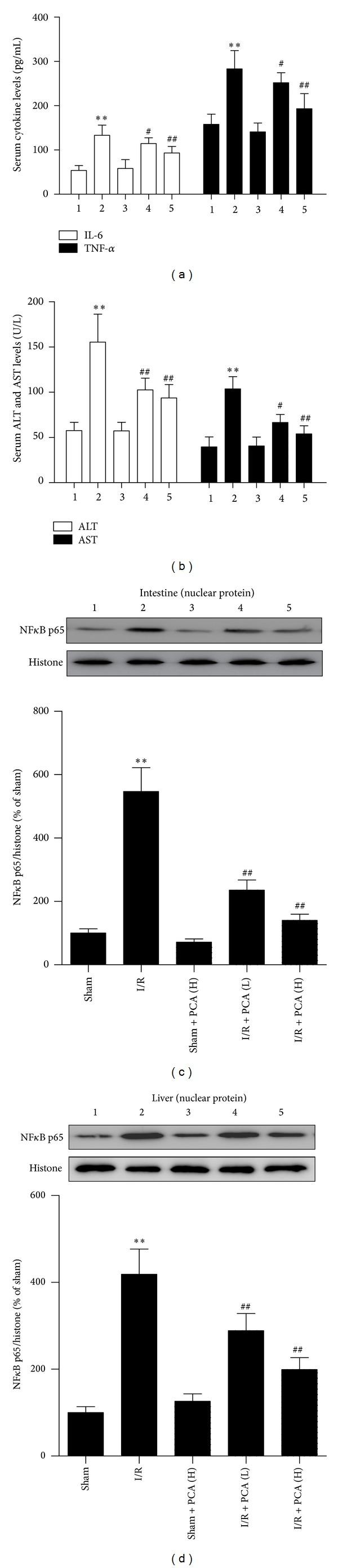
Intestinal ischemia-reperfusion (I/R) injury is a serious clinical pathophysiological process that may result in acute local intestine and remote liver injury. Protocatechuic acid (PCA), which has been widely studied as a polyphenolic compound, induces expression of antioxidative genes that combat oxidative stress and cell apoptosis. In this study, we investigated the effect of PCA pretreatment for protecting intestinal I/R-induced local intestine and remote liver injury in mice. Intestinal I/R was established by superior mesenteric artery occlusion for 45 min followed by reperfusion for 90 min. After the reperfusion period, PCA pretreatment markedly alleviated intestine and liver injury induced by intestinal I/R as indicated by histological alterations, decreases in serological damage parameters and nuclear factor-kappa B and phospho-foxo3a protein expression levels, and increases in glutathione, glutathione peroxidase, manganese superoxide dismutase protein expression, and Bcl-xL protein expression in the intestine and liver. These parameters were accompanied by PCA-induced adaptor protein p66shc suppression. These results suggest that PCA has a significant protective effect in the intestine and liver following injury induced by intestinal I/R. The protective effect of PCA may be attributed to the suppression of p66shc and the regulation of p66shc-related antioxidative and antiapoptotic factors.
肠道缺血再灌注(I/R)损伤是一种严重的临床病理生理过程,可导致急性局部肠道和远处肝脏损伤。原儿茶酸(PCA)作为一种多酚类化合物已被广泛研究,它可诱导抗氧化基因的表达,以对抗氧化应激和细胞凋亡。在本研究中,我们调查了PCA预处理对保护小鼠肠道I/R诱导的局部肠道和远处肝脏损伤的作用。通过肠系膜上动脉闭塞45分钟,然后再灌注90分钟来建立肠道I/R模型。再灌注期后,PCA预处理显著减轻了肠道I/R诱导的肠道和肝脏损伤,这表现为组织学改变、血清损伤参数降低、核因子-κB和磷酸化foxo3a蛋白表达水平降低,以及肠道和肝脏中谷胱甘肽、谷胱甘肽过氧化物酶、锰超氧化物歧化酶蛋白表达和Bcl-xL蛋白表达增加。这些参数伴随着PCA诱导的衔接蛋白p66shc的抑制。这些结果表明,PCA对肠道I/R诱导的损伤后的肠道和肝脏具有显著的保护作用。PCA的保护作用可能归因于对p66shc的抑制以及对p66shc相关的抗氧化和抗凋亡因子的调节。


 Zotero 插件