
磷酸肌醇代谢在 Toll 样受体信号转导和运输中的作用。
Phosphoinositide turnover in Toll-like receptor signaling and trafficking.
机构信息
Neuroscience Graduate Program, Department of Biomedical Sciences, and Chronic Inflammatory Disease Research Center, Ajou University School of Medicine, Suwon, Gyeonggi 443-721, Korea.
出版信息
BMB Rep. 2014 Jul;47(7):361-8. doi: 10.5483/bmbrep.2014.47.7.088.
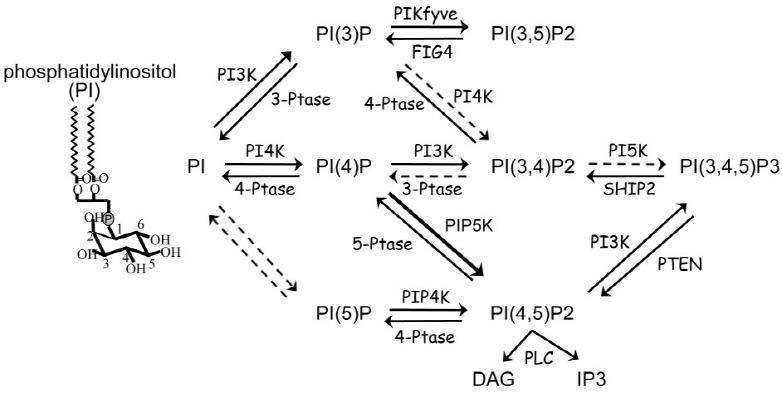
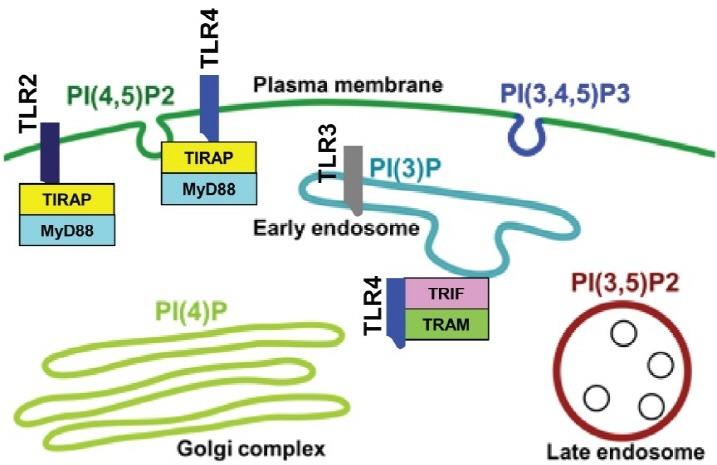
Lipid components in biological membranes are essential for maintaining cellular function. Phosphoinositides, the phosphorylated derivatives of phosphatidylinositol (PI), regulate many critical cell processes involving membrane signaling, trafficking, and reorganization. Multiple metabolic pathways including phosphoinositide kinases and phosphatases and phospholipases tightly control spatio-temporal concentration of membrane phosphoinositides. Metabolizing enzymes responsible for PI 4,5-bisphosphate (PI(4,5)P2) production or degradation play a regulatory role in Toll-like receptor (TLR) signaling and trafficking. These enzymes include PI 4-phosphate 5-kinase, phosphatase and tensin homolog, PI 3-kinase, and phospholipase C. PI(4,5)P2 mediates the interaction with target cytosolic proteins to induce their membrane translocation, regulate vesicular trafficking, and serve as a precursor for other signaling lipids. TLR activation is important for the innate immune response and is implicated in diverse pathophysiological disorders. TLR signaling is controlled by specific interactions with distinct signaling and sorting adaptors. Importantly, TLR signaling machinery is differentially formed depending on a specific membrane compartment during signaling cascades. Although detailed mechanisms remain to be fully clarified, phosphoinositide metabolism is promising for a better understanding of such spatio-temporal regulation of TLR signaling and trafficking.
生物膜中的脂质成分对于维持细胞功能至关重要。磷酸肌醇(PI)的磷酸化衍生物——磷酯酰肌醇 4,5-二磷酸(PI(4,5)P2),调节着许多涉及膜信号转导、运输和重排的关键细胞过程。包括磷酸肌醇激酶和磷酸酶以及磷脂酶在内的多种代谢途径,可严格控制膜磷酯酰肌醇的时空浓度。负责 PI 4,5-二磷酸(PI(4,5)P2)生成或降解的代谢酶在 Toll 样受体(TLR)信号转导和运输中发挥着调节作用。这些酶包括 PI 4-磷酸 5-激酶、磷酸酶和张力蛋白同系物、PI3-激酶和磷脂酶 C。PI(4,5)P2 介导与靶细胞溶质蛋白的相互作用,以诱导其膜易位、调节囊泡运输,并作为其他信号脂质的前体。TLR 激活对于先天免疫反应很重要,并且与多种病理生理紊乱有关。TLR 信号转导受与特定信号和分选衔接蛋白的特异性相互作用的控制。重要的是,在信号级联过程中,TLR 信号机制根据特定的膜隔室而有差异地形成。尽管详细的机制仍有待充分阐明,但磷酸肌醇代谢为更好地理解 TLR 信号转导和运输的这种时空调节提供了可能。

 Zotero 插件