
三千水稻基因组计划。
The 3,000 rice genomes project.
出版信息
Gigascience. 2014 May 28;3:7. doi: 10.1186/2047-217X-3-7. eCollection 2014.
BACKGROUND
Rice, Oryza sativa L., is the staple food for half the world's population. By 2030, the production of rice must increase by at least 25% in order to keep up with global population growth and demand. Accelerated genetic gains in rice improvement are needed to mitigate the effects of climate change and loss of arable land, as well as to ensure a stable global food supply.
FINDINGS
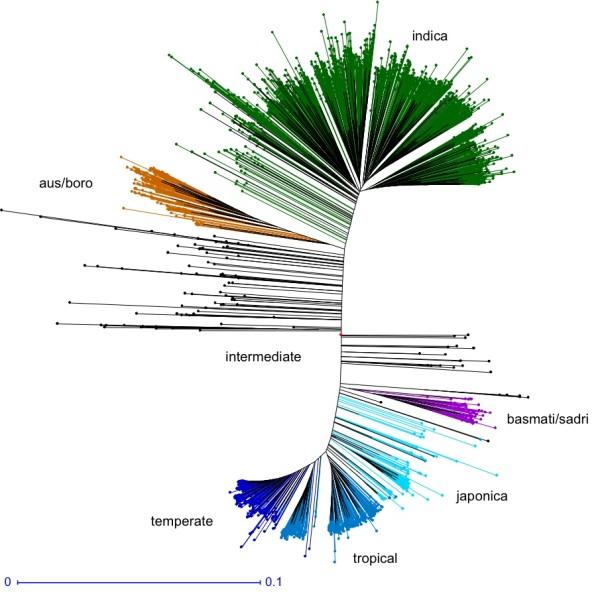
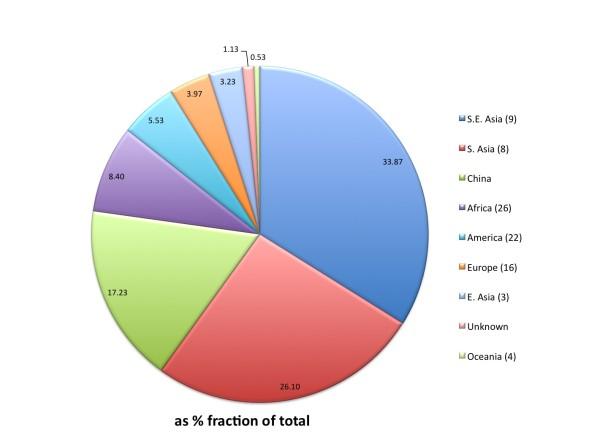
We resequenced a core collection of 3,000 rice accessions from 89 countries. All 3,000 genomes had an average sequencing depth of 14×, with average genome coverages and mapping rates of 94.0% and 92.5%, respectively. From our sequencing efforts, approximately 18.9 million single nucleotide polymorphisms (SNPs) in rice were discovered when aligned to the reference genome of the temperate japonica variety, Nipponbare. Phylogenetic analyses based on SNP data confirmed differentiation of the O. sativa gene pool into 5 varietal groups - indica, aus/boro, basmati/sadri, tropical japonica and temperate japonica.
CONCLUSIONS
Here, we report an international resequencing effort of 3,000 rice genomes. This data serves as a foundation for large-scale discovery of novel alleles for important rice phenotypes using various bioinformatics and/or genetic approaches. It also serves to understand the genomic diversity within O. sativa at a higher level of detail. With the release of the sequencing data, the project calls for the global rice community to take advantage of this data as a foundation for establishing a global, public rice genetic/genomic database and information platform for advancing rice breeding technology for future rice improvement.
背景
水稻(Oryza sativa L.)是全球一半人口的主食。到 2030 年,为了跟上全球人口增长和需求,水稻产量必须至少增加 25%。需要加快水稻改良的遗传增益,以减轻气候变化和耕地损失的影响,确保全球粮食供应稳定。
发现
我们对来自 89 个国家的 3000 个水稻核心品种进行了重测序。所有 3000 个基因组的平均测序深度为 14×,平均基因组覆盖率和映射率分别为 94.0%和 92.5%。通过我们的测序工作,当与温带粳稻品种 Nipponbare 的参考基因组对齐时,大约在水稻中发现了 1890 万个单核苷酸多态性(SNP)。基于 SNP 数据的系统发育分析证实,O. sativa 基因库分为 5 个品种群 - indica、aus/boro、basmati/sadri、热带粳稻和温带粳稻。
结论
在这里,我们报告了 3000 个水稻基因组的国际重测序工作。该数据为使用各种生物信息学和/或遗传方法大规模发现重要水稻表型的新等位基因奠定了基础。它还有助于更详细地了解 O. sativa 内的基因组多样性。随着测序数据的发布,该项目呼吁全球水稻界利用这些数据作为建立全球公共水稻遗传/基因组数据库和信息平台的基础,以推进未来水稻改良的水稻育种技术。
 Zotero 插件