
OGG1 Ser326Cys 和 APEX1 Asp148Glu 多态性与乳腺癌风险的关联:一项荟萃分析。
Association between OGG1 Ser326Cys and APEX1 Asp148Glu polymorphisms and breast cancer risk: a meta-analysis.
机构信息
Department of Clinical Laboratory, First Affiliated Hospital of Guangxi Medical University, Nanning, Guangxi 530021, China.
出版信息
Diagn Pathol. 2014 Jun 3;9:108. doi: 10.1186/1746-1596-9-108.
BACKGROUND
The base excision repair (BER) pathway removes DNA damage caused by ionizing radiation, reactive oxidative species and methylating agents. OGG1 and APE1 are two important genes in the BER pathway. Many epidemiological studies have evaluated the association between polymorphisms in the two BER genes (OGG1 Ser326Cys and APE1 Asp148Glu) and breast cancer risk. However, the results are inconsistent.
METHODS
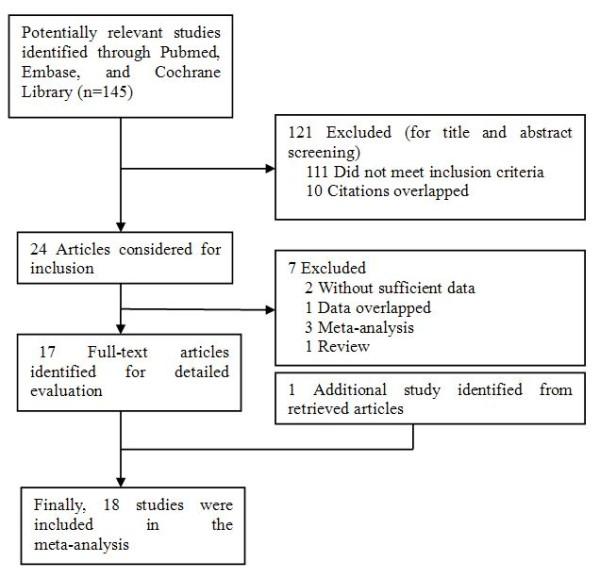
We searched the electronic databases including PubMed, Embase and Cochrane library for all eligible studies for the period up to February 2014. Data were extracted by two independent authors and pooled odds ratios (ORs) with corresponding 95% confidence intervals (CIs) were used to assess the strength of the association.
RESULTS
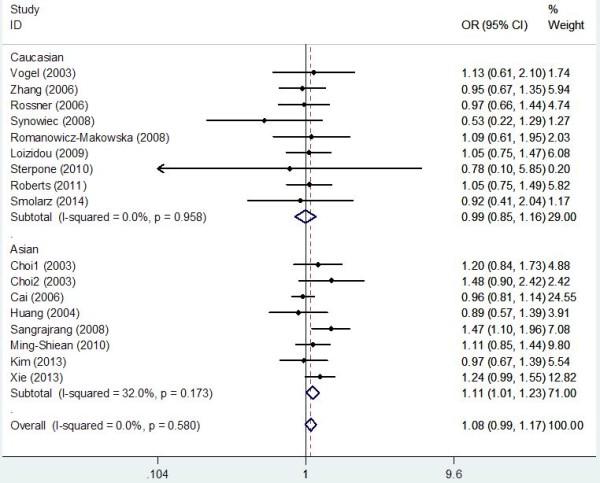
A total of 17 studies including 9,040 cases and 10,042 controls were available for OGG1 Ser326Cys polymorphism and 7 studies containing 2,979 cases and 3,111 controls were included for APE1 Asp148Glu polymorphism. With respect to OGG1 Ser326Cys polymorphism, we did not find a significant association with breast cancer risk when all eligible studies were pooled into the meta-analysis. However, in subgroup analyses by ethnicity and menopausal status, statistical significant increased breast cancer risk was found in Asian populations (Cys/Cys vs. Ser/Ser: OR=1.157, 95% CI 1.013-1.321, P=0.011; Cys/Cys vs. Ser/Cys+Ser/Ser: OR=1.113, 95% CI 1.009-1.227, P=0.014) and postmenopausal patients (Cys/Cys vs. Ser/Cys+Ser/Ser: OR=1.162, 95% CI 1.003-1.346, P=0.024). In subgroup analysis according to quality score, source of control, and HWE in controls, no any significant association was detected. With respect to APE1 Asp148Glu polymorphism, no significant association with breast cancer risk was demonstrated in the overall and stratified analyses.
CONCLUSIONS
The present meta-analysis suggests that the OGG1 Ser326Cys polymorphism may be a risk factor for breast cancer in Asians and postmenopausal patients. Further large and well-designed studies are needed to confirm this association.
VIRTUAL SLIDES
The virtual slide(s) for this article can be found here: http://www.diagnosticpathology.diagnomx.eu/vs/1156934297124915.
背景
碱基切除修复(BER)途径可清除由电离辐射、活性氧化物种和烷化剂引起的 DNA 损伤。OGG1 和 APE1 是 BER 途径中的两个重要基因。许多流行病学研究已经评估了这两个 BER 基因(OGG1 Ser326Cys 和 APE1 Asp148Glu)中的多态性与乳腺癌风险之间的关联。然而,结果并不一致。
方法
我们检索了电子数据库,包括 PubMed、Embase 和 Cochrane 图书馆,以获取截至 2014 年 2 月的所有合格研究。由两名独立作者提取数据,并使用相应的 95%置信区间(CI)汇总比值比(OR)来评估关联的强度。
结果
共有 17 项研究(9040 例病例和 10042 例对照)纳入 OGG1 Ser326Cys 多态性分析,7 项研究(2979 例病例和 3111 例对照)纳入 APE1 Asp148Glu 多态性分析。对于 OGG1 Ser326Cys 多态性,当所有合格研究合并进行荟萃分析时,我们没有发现其与乳腺癌风险之间存在显著关联。然而,在按种族和绝经状态进行的亚组分析中,在亚洲人群(Cys/Cys 与 Ser/Ser:OR=1.157,95%CI 1.013-1.321,P=0.011;Cys/Cys 与 Ser/Cys+Ser/Ser:OR=1.113,95%CI 1.009-1.227,P=0.014)和绝经后患者(Cys/Cys 与 Ser/Cys+Ser/Ser:OR=1.162,95%CI 1.003-1.346,P=0.024)中发现了统计学意义上的乳腺癌风险增加。在根据质量评分、对照来源和对照中 HWE 进行的亚组分析中,未发现任何显著关联。对于 APE1 Asp148Glu 多态性,总体和分层分析均未显示其与乳腺癌风险之间存在显著关联。
结论
本荟萃分析提示 OGG1 Ser326Cys 多态性可能是亚洲人和绝经后女性乳腺癌的一个危险因素。需要进一步进行大型和精心设计的研究来证实这种关联。


 Zotero 插件