
基于miR-27b-3p和淋巴结状态的三阴性乳腺癌预后模型
A prognostic model of triple-negative breast cancer based on miR-27b-3p and node status.
作者信息
Shen Songjie, Sun Qiang, Liang Zhiyong, Cui Xiaojiang, Ren Xinyu, Chen Huan, Zhang Xiao, Zhou Yidong
机构信息
Department of Breast Surgery, Peking Union Medical College Hospital, Peking Union Medical College, Chinese Academy of Medical Sciences, Beijing, China.
Department of Pathology, Peking Union Medical College Hospital, Peking Union Medical College, Chinese Academy of Medical Sciences, Beijing, China.
出版信息
PLoS One. 2014 Jun 19;9(6):e100664. doi: 10.1371/journal.pone.0100664. eCollection 2014.
OBJECTIVE
Triple-negative breast cancer (TNBC) is an aggressive but heterogeneous subtype of breast cancer. This study aimed to identify and validate a prognostic signature for TNBC patients to improve prognostic capability and to guide individualized treatment.
METHODS
We retrospectively analyzed the prognostic performance of clinicopathological characteristics and miRNAs in a training set of 58 patients with invasive ductal TNBC diagnosed between 2002 and 2012. A prediction model was developed based on independent clinicopathological and miRNA covariates. The prognostic value of the model was further validated in a separate set of 41 TNBC patients diagnosed between 2007 and 2008.
RESULTS
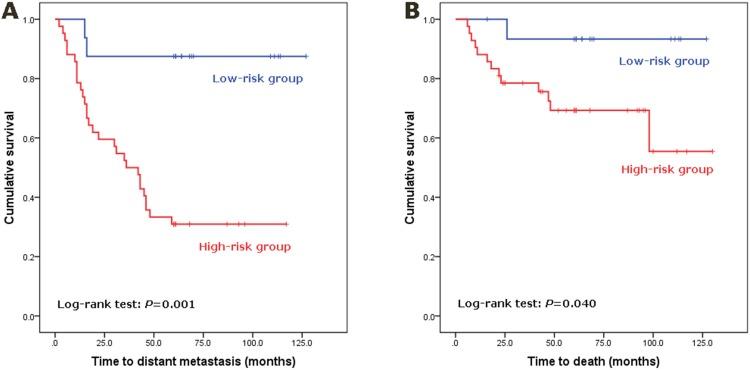
Only lymph node status was marginally significantly associated with poor prognosis of TNBC (P = 0.054), whereas other clinicopathological factors, including age, tumor size, histological grade, lymphovascular invasion, P53 status, Ki-67 index, and type of surgery, were not. The expression levels of miR-27b-3p, miR-107, and miR-103a-3p were significantly elevated in the metastatic group compared with the disease-free group (P value: 0.008, 0.005, and 0.050, respectively). The Cox proportional hazards regression analysis revealed that lymph node status and miR-27b-3p were independent predictors of poor prognosis (P value: 0.012 and 0.027, respectively). A logistic regression model was developed based on these two independent covariates, and the prognostic value of the model was subsequently confirmed in a separate validation set. The two different risk groups, which were stratified according to the model, showed significant differences in the rates of distant metastasis and breast cancer-related death not only in the training set (P value: 0.001 and 0.040, respectively) but also in the validation set (P value: 0.013 and 0.012, respectively).
CONCLUSION
This model based on miRNA and node status covariates may be used to stratify TNBC patients into different prognostic subgroups for potentially individualized therapy.
目的
三阴性乳腺癌(TNBC)是一种侵袭性但异质性的乳腺癌亚型。本研究旨在识别并验证TNBC患者的预后特征,以提高预后预测能力并指导个体化治疗。
方法
我们回顾性分析了2002年至2012年间诊断的58例浸润性导管TNBC患者训练集中临床病理特征和微小RNA(miRNA)的预后表现。基于独立的临床病理和miRNA协变量建立了一个预测模型。该模型的预后价值在2007年至2008年间诊断的另一组41例TNBC患者中进一步得到验证。
结果
仅淋巴结状态与TNBC的不良预后有微弱的显著相关性(P = 0.054),而其他临床病理因素,包括年龄、肿瘤大小、组织学分级、淋巴管浸润、P53状态、Ki-67指数和手术类型,则无相关性。与无病组相比,转移组中miR-27b-3p、miR-107和miR-103a-3p的表达水平显著升高(P值分别为0.008、0.005和0.050)。Cox比例风险回归分析显示,淋巴结状态和miR-27b-3p是不良预后的独立预测因素(P值分别为0.012和0.027)。基于这两个独立协变量建立了一个逻辑回归模型,随后在一个单独的验证集中证实了该模型的预后价值。根据该模型分层的两个不同风险组,不仅在训练集中(P值分别为0.001和0.040),而且在验证集中(P值分别为0.013和0.012),远处转移率和乳腺癌相关死亡率均显示出显著差异。
结论
这个基于miRNA和淋巴结状态协变量的模型可用于将TNBC患者分层为不同的预后亚组,以进行潜在的个体化治疗。

 Zotero 插件