
台湾一种用于预防高危早产婴儿呼吸道合胞病毒感染的新型连续六个月每月一剂帕利珠单抗预防方案。
A novel six consecutive monthly doses of palivizumab prophylaxis protocol for the prevention of respiratory syncytial virus infection in high-risk preterm infants in Taiwan.
作者信息
Chi Hsin, Hsu Chyong-Hsin, Chang Jui-Hsing, Chiu Nan-Chang, Hung Han-Yang, Kao Hsin-An, Weng Li-Chuan, Huang Fu-Yuan, Chiu Yu-Ying, Chang Luan-Yin, Huang Li-Min
机构信息
Department of Pediatrics, Mackay Memorial Hospital, Taipei, Taiwan; Graduate Institute of Clinical Medicine, National Taiwan University College of Medicine, Taipei, Taiwan; Department of Nursing, Mackay Junior College of Medicine, Nursing, and Management, Taipei, Taiwan; Department of Medicine, Mackay Medical College, New Taipei City, Taiwan.
Department of Pediatrics, Mackay Memorial Hospital, Taipei, Taiwan.
出版信息
PLoS One. 2014 Jun 27;9(6):e100981. doi: 10.1371/journal.pone.0100981. eCollection 2014.
BACKGROUND
Respiratory syncytial virus (RSV) circulates year round in Taiwan. A novel six consecutive monthly doses of palivizumab for RSV prevention protocol has been approved for high risk preterm infants since December 2010. This study aimed to determine the clinical effectiveness and safety of this novel protocol for the prevention of RSV infection.
METHODS
From April 2011 to March 2013, we enrolled infants born at ≤28 weeks gestation and infants born at ≤35 weeks gestation with chronic lung disease (CLD) who received palivizumab prophylaxis as study group and followed up for 12 months. Historic control, those who were born and followed up between July 2000 and June 2008, were retrieved for propensity score matching. Primary endpoint was RSV-related hospitalization, and secondary endpoints included the length of hospital stay and intensive care unit (ICU) care.
RESULTS
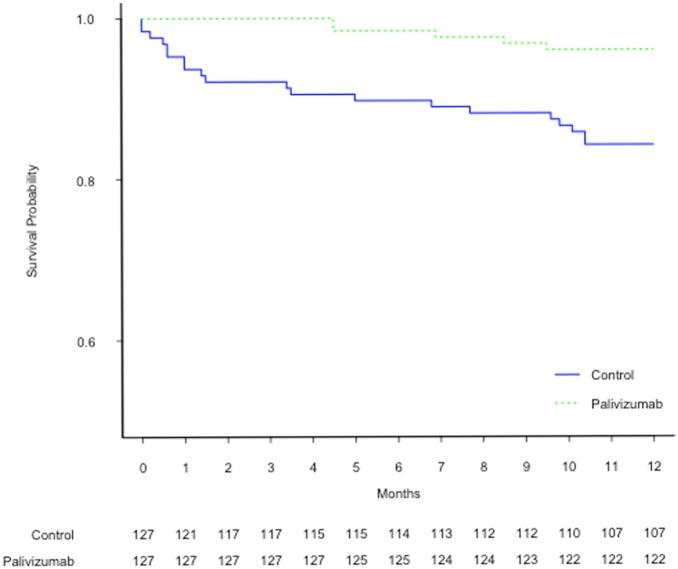
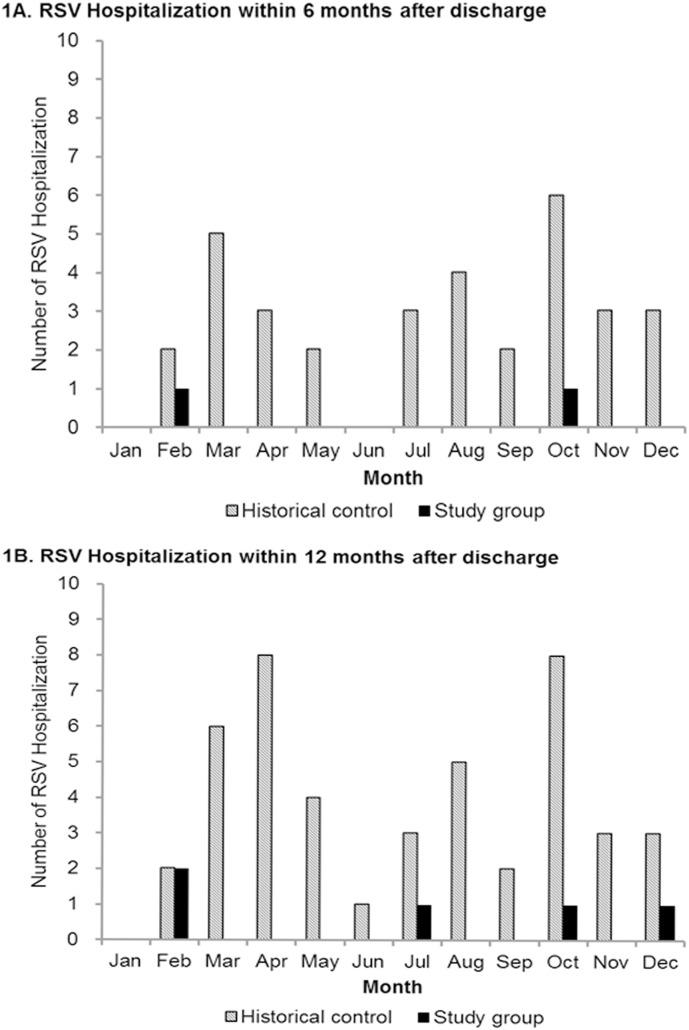
We enrolled 127 infants (108 infants born at ≤28 weeks and 19 infants born at 29-35 weeks with CLD). They completed 6-dose palivizumab as scheduled. Among the study group, the RSV-related hospitalizations were 2 (1.6%) within 6 months and 5 (3.9%) within 12 months after discharge. We matched 127 infants in the control group with 127 infants in the study group by propensity score matching. The reduction of RSV-related hospitalization rates were 86% (10.2% vs 1.6%, p = 0.002) within 6 months after discharge and 78% (15.7% vs 3.9%, p = 0.004) within 12 months after discharge. Compared to the control group, the rate of ICU care significantly decreased from 7.1% to 0.8% (p = 0.024) within 6 months after discharge and from 7.9% to 0.8% (p = 0.014) within 12 months after discharge. Adverse events were recorded in 6.4% injections.
CONCLUSIONS
Six monthly intramuscular administration of palivizumab is effective for prevention of RSV hospitalization in regions with no single seasonal peak of RSV infection such as Taiwan.
背景
呼吸道合胞病毒(RSV)在台湾全年传播。自2010年12月起,一种新型的连续六个月每月一剂的帕利珠单抗预防呼吸道合胞病毒感染方案已被批准用于高危早产儿。本研究旨在确定这一新型方案预防呼吸道合胞病毒感染的临床有效性和安全性。
方法
从2011年4月至2013年3月,我们纳入了孕周≤28周出生的婴儿以及孕周≤35周且患有慢性肺病(CLD)的婴儿,这些婴儿接受了帕利珠单抗预防治疗作为研究组,并随访12个月。通过倾向得分匹配,检索2000年7月至2008年6月期间出生并接受随访的历史对照组。主要终点是与呼吸道合胞病毒相关的住院治疗,次要终点包括住院时间和重症监护病房(ICU)护理情况。
结果
我们纳入了127名婴儿(108名孕周≤28周出生的婴儿和19名孕周29 - 35周且患有慢性肺病的婴儿)。他们按计划完成了6剂帕利珠单抗注射。在研究组中,出院后6个月内与呼吸道合胞病毒相关的住院病例有2例(1.6%),出院后12个月内有5例(3.9%)。通过倾向得分匹配,我们将对照组的127名婴儿与研究组的127名婴儿进行了匹配。出院后6个月内与呼吸道合胞病毒相关的住院率降低了86%(10.2%对1.6%,p = 0.002),出院后12个月内降低了78%(15.7%对3.9%,p = 0.004)。与对照组相比,出院后6个月内重症监护病房护理率从7.1%显著降至0.8%(p = 0.024),出院后12个月内从7.9%降至0.8%(p = 0.014)。6.4%的注射记录了不良事件。
结论
在像台湾这样呼吸道合胞病毒感染没有单一季节性高峰的地区,每月一次肌肉注射帕利珠单抗可有效预防呼吸道合胞病毒感染导致的住院治疗。
 Zotero 插件