
西妥昔单抗与5-氟尿嘧啶/亚叶酸(FA)/奥沙利铂/伊立替康(FOLFOXIRI)用于转移性结直肠癌患者一线治疗的剂量递增研究。
Dose escalating study of cetuximab and 5-FU/folinic acid (FA)/oxaliplatin/irinotecan (FOLFOXIRI) in first line therapy of patients with metastatic colorectal cancer.
作者信息
Folprecht Gunnar, Hamann Susanne, Schütte Katharina, Trarbach Tanja, Stoehlmacher-Williams Jan, Ehninger Gerhard
机构信息
Medical Department I, University Hospital Carl Gustav Carus, University Cancer Center, Fetscherstr 74, 01307 Dresden, Germany.
出版信息
BMC Cancer. 2014 Jul 19;14:521. doi: 10.1186/1471-2407-14-521.
BACKGROUND
The FOLFOXIRI regimen (irinotecan, oxaliplatin, fluorouracil [5-FU] and folinic acid [FA]) increased the response rate and overall survival compared to FOLFIRI in patients with metastatic colorectal cancer (mCRC). Adding cetuximab to FOLFOX or FOLFIRI increased efficacy in patients with k-ras wild type mCRC. We explored the dose limiting toxicity and feasibility of the combination cetuximab, irinotecan, oxaliplatin, 5-FU and FA in mCRC patients.
METHODS
In a dose-escalation study patients with previously untreated mCRC and a WHO performance status 0-1 received cetuximab (500 mg/m2, 2 h), followed by irinotecan (95, 125, and 165 mg/m2 in the dose levels [DL] 1, 2, and 3 respectively), followed by oxaliplatin (85 mg/m2, 2 h) which was given parallel to FA (400 mg/m2, 2 h) and followed by 5-FU (3200 mg/m2, 46 h) in an outpatient setting every two weeks. The primary endpoints were the maximum tolerable dose and the safety. The trial was approved by the local ethics committee.
RESULTS
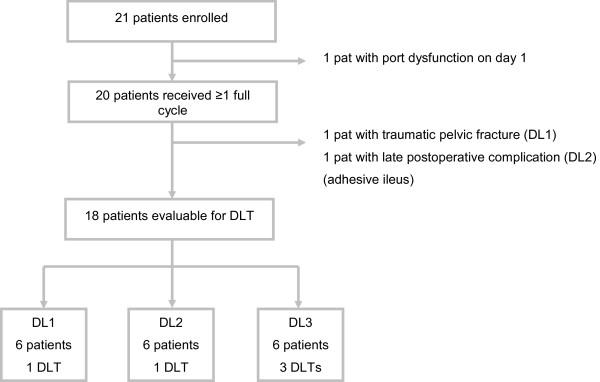
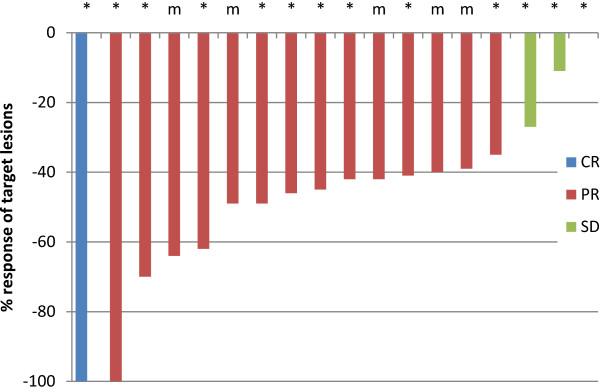
From 2007 to 2008, twenty patients were treated in this trial. In the first dose level (irinotecan 95 mg/m2) one patient developed neutropenia grade 4. One patient experienced diarrhoea grade 3 as DLT in dose level 2 (irinotecan 125 mg/m2). In dose level 3 (irinotecan 165 mg/m2), three patients experienced a DLT (diarrhoea grade 3 and two patients with neutropenia grade 4). Thus, the recommended dose for a phase II trial is 125 mg/m2 irinotecan in combination with oxaliplatin, 5-FU/FA and cetuximab. Most common grade ≥3 toxicities were neutropenia (40%), diarrhoea (25%) and acne-like rash (15%). No therapy associated death occurred.The confirmed overall response rate in all cohorts was 75% (95%-CI 51-91%). The best response was reached after a median of 3.0 (95%-CI 2.2 to 3.7) months. Median progression free survival (PFS) is 16 (95%-CI 12.6-19.4) months, overall survival (OS) 33 (95%-CI 26.2-39.8) months.
CONCLUSIONS
The combination of cetuximab and FOLFOXIRIis feasible and has an acceptable toxicity profile in patients with a good performance status. The observed clinical activity with a confirmed response rate of 75% is promising and further evaluated in the ongoing CELIM2.
TRIAL REGISTRATION
http://www.clinicaltrials.gov: NCT00422773.
背景
与FOLFIRI方案相比,FOLFOXIRI方案(伊立替康、奥沙利铂、氟尿嘧啶[5-FU]和亚叶酸[FA])可提高转移性结直肠癌(mCRC)患者的缓解率和总生存期。在k-ras野生型mCRC患者中,FOLFOX或FOLFIRI方案联合西妥昔单抗可提高疗效。我们探讨了西妥昔单抗、伊立替康、奥沙利铂、5-FU和FA联合方案在mCRC患者中的剂量限制性毒性和可行性。
方法
在一项剂量递增研究中,既往未接受过治疗且世界卫生组织体能状态为0-1的mCRC患者接受西妥昔单抗(500mg/m²,静脉滴注2小时),随后分别在剂量水平(DL)1、2和3中给予伊立替康(分别为95、125和165mg/m²),然后给予奥沙利铂(85mg/m²,静脉滴注2小时),同时给予FA(400mg/m²,静脉滴注2小时),随后在门诊环境中每两周给予5-FU(3200mg/m²,持续静脉滴注46小时)。主要终点为最大耐受剂量和安全性。该试验获得了当地伦理委员会的批准。
结果
2007年至2008年,本试验共治疗了20例患者。在第一个剂量水平(伊立替康95mg/m²),1例患者出现4级中性粒细胞减少。1例患者在剂量水平2(伊立替康125mg/m²)出现3级腹泻作为剂量限制性毒性(DLT)。在剂量水平3(伊立替康165mg/m²),3例患者出现DLT(3级腹泻和2例4级中性粒细胞减少)。因此,II期试验的推荐剂量为伊立替康125mg/m²联合奥沙利铂、5-FU/FA和西妥昔单抗。最常见的≥3级毒性为中性粒细胞减少(40%)、腹泻(25%)和痤疮样皮疹(15%)。未发生与治疗相关的死亡。所有队列中确认的总缓解率为75%(95%置信区间51-91%)。最佳缓解在中位3.0(95%置信区间2.2至3.7)个月后达到。中位无进展生存期(PFS)为16(95%置信区间12.6-19.4)个月,总生存期(OS)为33(9%置信区间26.2-39.8)个月。
结论
西妥昔单抗与FOLFOXIRI联合方案在体能状态良好的患者中可行且毒性可接受。观察到的临床活性和75%的确认缓解率令人鼓舞,正在进行的CELIM2试验将对其进行进一步评估。
试验注册


 Zotero 插件