
计划怀孕夫妇尿液中邻苯二甲酸酯的浓度及其与氧化应激生物标志物8-羟基-2'-脱氧鸟苷的关联:生育与环境研究的纵向调查
Urinary concentrations of phthalates in couples planning pregnancy and its association with 8-hydroxy-2'-deoxyguanosine, a biomarker of oxidative stress: longitudinal investigation of fertility and the environment study.
作者信息
Guo Ying, Weck Jennifer, Sundaram Rajeswari, Goldstone Alexandra E, Louis Germaine Buck, Kannan Kurunthachalam
机构信息
Wadsworth Center, New York State Department of Health, and Department of Environmental Health Sciences, School of Public Health, State University of New York at Albany , Empire State Plaza, P.O. Box 509, Albany, New York 12201-0509, United States.
出版信息
Environ Sci Technol. 2014 Aug 19;48(16):9804-11. doi: 10.1021/es5024898. Epub 2014 Aug 8.
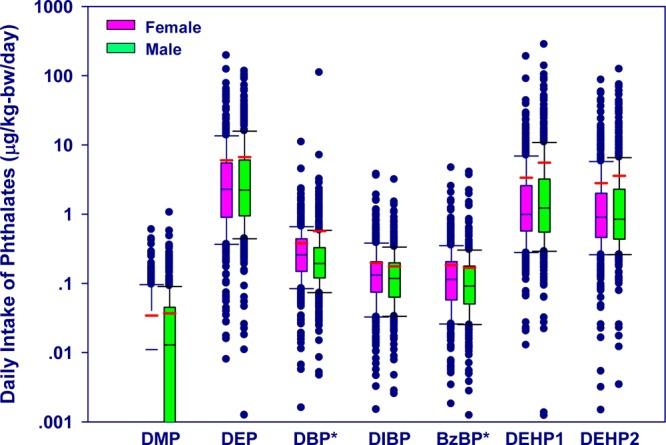
Oxidative stress has been recognized as one of the most important contributors to infertility in both males and females. Exposure to many environmental chemicals, such as phthalates, has been shown to induce oxidative stress. In a longitudinal study designed to assess exposure to environmental chemicals and fecundity in couples who were planning pregnancy, 894 urine samples were collected from 469 couples from Michigan and Texas during 2005-2009. The concentrations of 14 phthalate metabolites and a marker of oxidative stress, 8-hydroxy-2'-deoxyguanosine (8-OHdG), were determined in these samples. Concentrations, profiles, and estimated daily intakes (DIs) of phthalates were positively associated with 8-OHdG. The median concentrations of monomethyl phthalate (mMP), monoethyl phthalate (mEP), mono(3-carboxypropyl) phthalate (mCPP), mono-n-butyl phthalate (mBP), mono(2-isobutyl) phthalate (miBP), monobenzyl phthalate (mBzP), Σ5mEHP (sum of five metabolites of di(2-ethylhexyl) phthalate (DEHP)) and Σ14phthalates (sum of 14 urinary phthalate metabolites) were 0.48, 85.2, 4.50, 7.66, 4.36, 3.80, 54.8, and 249 μg/g creatinine, respectively. The estimated DI values for DEHP in 39 individuals were above the U.S. Environmental Protection Agency's (EPA) reference dose (RfD) of 20 μg/kg-bw/day. The mean and median concentrations of 8-OHdG were 6.02 and 3.13 μg/g creatinine, respectively, which were significantly higher in females than in males. Statistically significant associations were found between 8-OHdG and urinary concentrations of mEP, and Σ5mEHP for females. Similarly, a significant association was found between 8-OHdG and DIs estimated for select phthalates. Our results suggested that phthalate exposure increases oxidative stress, which can be a mechanism for the diminished fertility observed in couples who were highly exposed to select phthalates.
氧化应激已被认为是导致男性和女性不孕的最重要因素之一。已表明,接触许多环境化学物质,如邻苯二甲酸盐,会诱发氧化应激。在一项旨在评估计划怀孕夫妇接触环境化学物质情况及其生育能力的纵向研究中,2005年至2009年期间从密歇根州和得克萨斯州的469对夫妇中收集了894份尿液样本。测定了这些样本中14种邻苯二甲酸酯代谢物的浓度以及氧化应激标志物8-羟基-2'-脱氧鸟苷(8-OHdG)的浓度。邻苯二甲酸酯的浓度、分布情况以及估计每日摄入量(DI)与8-OHdG呈正相关。邻苯二甲酸单甲酯(mMP)、邻苯二甲酸单乙酯(mEP)、邻苯二甲酸单(3-羧丙基)酯(mCPP)、邻苯二甲酸单正丁酯(mBP)、邻苯二甲酸单(2-异丁基)酯(miBP)、邻苯二甲酸单苄酯(mBzP)、Σ5mEHP(邻苯二甲酸二(2-乙基己基)酯(DEHP)的五种代谢物之和)和Σ14邻苯二甲酸酯(14种尿中邻苯二甲酸酯代谢物之和)的中位数浓度分别为0.48、85.2、4.50、7.66、4.36、3.80、54.8和249μg/g肌酐。39名个体中DEHP的估计DI值高于美国环境保护局(EPA)20μg/kg体重/天的参考剂量(RfD)。8-OHdG的平均浓度和中位数浓度分别为6.02和3.13μg/g肌酐,女性显著高于男性。在女性中,发现8-OHdG与mEP以及Σ5mEHP的尿液浓度之间存在统计学上的显著关联。同样,在8-OHdG与选定邻苯二甲酸酯的估计DI之间也发现了显著关联。我们的结果表明,邻苯二甲酸酯暴露会增加氧化应激,这可能是在高度接触选定邻苯二甲酸酯的夫妇中观察到生育能力下降的一种机制。
 Zotero 插件